
Private certification - meaning, registration process, accreditation system, and criteria
Private certifications are non-government credentials covering 52,879 types across 14,772 institutions - here's how to register one and earn official accreditation.
Hello, this is Kolleges.
Today we’ll discuss what private certifications mean, along with their registration process and the accreditation system and criteria.
Private certifications offer opportunities to take on challenges in a wide range of fields, and they’re attracting a lot of interest.
For those of you who are still unfamiliar with private certifications, we’ll go through it step by step. Let’s begin.
What does “private certification” mean? What does “private certification” mean? What does “private certification” mean? What does “private certification” mean?

A private certification, as the name suggests, is a certification created, managed, and operated not by the government but by an individual, corporation, or organization.
In simple terms, it’s a certification created to demonstrate the expertise required in a specific field.
This system was created to meet the demand from increasingly diverse occupational categories as our society develops, and to help individuals develop their job competencies. Through it, you can build your own competitiveness and improve your social and economic position.
As of 2024, there are 52,879 types of private certifications registered across 14,772 institutions.
The choices are wide - from fields close to daily life like yoga, psychological counseling, and barista, to occupational categories that demand high expertise.
Now that you have a sense of what private certification means, it can be a good tool for opening up new possibilities in your field of interest.
What’s the registration process for a private certification? What’s the registration process for a private certification? What’s the registration process for a private certification? What’s the registration process for a private certification?

How do you go about newly creating or registering a private certification? If you’re worried it might be complicated, don’t be. Following the steps in order, it’s not that hard.
- 1 Check eligibility - First, confirm that the certification you want to create doesn't fall under a prohibited field.
- 2 Apply with the competent ministry - Prepare the certification information and submit a registration application to the minister in charge.
- 3 Registration completion - Once registration is approved, information like the certification name, grade, and managing organization is recorded in the registration ledger.
Private certification registration is the first step toward systematic management and higher credibility. If you want to set up a new certification, it’s important to thoroughly review the relevant regulations and follow the precise procedure.
What are the accreditation system and criteria? What are the accreditation system and criteria? What are the accreditation system and criteria? What are the accreditation system and criteria?
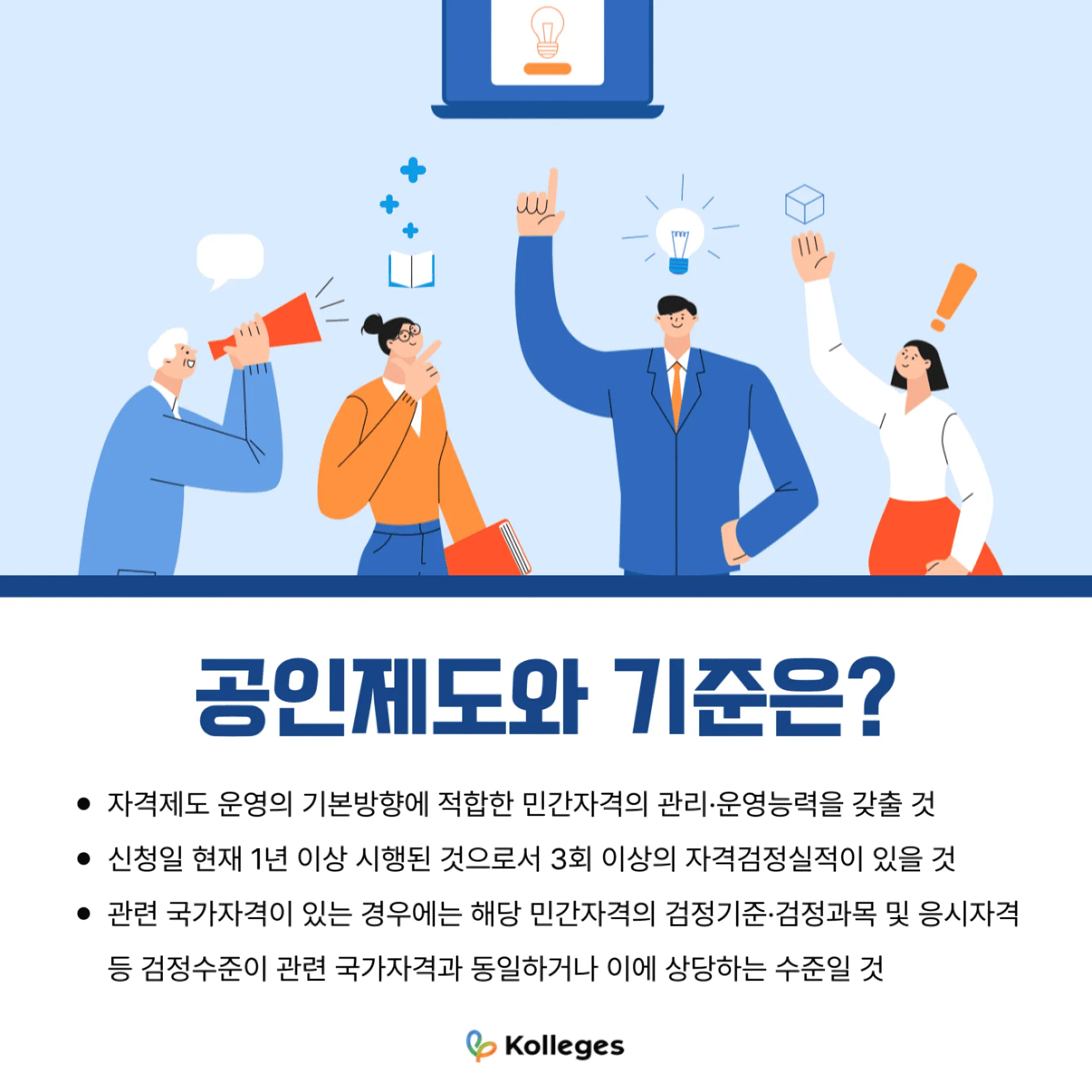
Private certifications also have an “accreditation” concept. The accreditation system is one in which the government recognizes private certifications to raise their credibility and ensure social acceptance. To receive accreditation, several criteria must be met.
If these requirements are met, accreditation can be granted after deliberation by the Qualification Policy Committee. Accredited private certifications gain greater social credibility, which is a big help to those who hold them.
Today we covered the meaning of private certifications and related topics. We hope this was useful information, and start your successful certification journey with Kolleges.
Frequently asked questions
Want to turn learning outcomes into verifiable assets?
From issuing to verifying and amplifying, see it for yourself with Kolleges.
Request a Kolleges demoRelated posts

Registering a Private Certification, Part 1: Required Documents and Application Process | Kolleges
Educational institutions and sole proprietors can officially register a private certification in Korea by submitting the right documents and an Operations Regulation to KRIVET's Private Qualification Information Service between the 1st and 20th of each month.

How to Register a Private Certificate
Learn the full Korean private certificate registration process, key pitfalls to avoid, and how to register for free with Kolleges consulting instead of paying up to 1,000,000 KRW.
Top 5 Popular Private Certifications: Which One Fits You?
From counselor to barista, this guide compares five in-demand private certifications - who each suits, where they lead, and how to earn them.