
What Is DID - Managing Digital Badges with Decentralized Identity

Kolleges builds digital badges on DID using the did:key method, so both issuers and recipients hold cryptographic key pairs that let anyone verify badge authenticity without a central server.
“How much can you trust a digital badge?” Kolleges has a clear answer to that question.
The answer is DID, decentralized identity technology.
🔍 Why does a digital badge need DID?
Today, many educational institutions are converting certificates and credentials into digital badges. But if there is no trust that these digital credentials are authentic, issued by a verifiable party, and verifiable anywhere, the value of the badge inevitably collapses.
Traditional approaches depend on a central server or specific platform, which creates the following limits:
-
If the platform disappears, the credential disappears too
-
There is a risk of tampering or hacking
-
It is difficult to verify issuance history and recipient information
“What if anyone could verify the badges I hold?”
The technology that answers this question is DID (Decentralized Identifier).
🪪 What is a decentralized identifier, DID?
DID stands literally for “Decentralized Identifier.”
It is a technology that lets anyone create their own unique identifier (DID),
and prove who they are by themselves.
A simple comparison
-
Traditional approach: “I am Hong Gildong. The resident registration number issued by the government confirms it.”
-
DID approach: “I am the person who holds this key pair. I can sign the information I need to prove, directly.”
🔐 Public key and private key - understood through a seal analogy
The core of DID is two digital keys:
a public key and a private key.
These two keys are generated as a pair and are tightly linked to each other.
Let me explain with an analogy:
-
Private key = a personal seal only I own → When I sign a document, it’s the same as stamping it with this seal.
-
Public key = a tool to verify whether the seal is authentic → Anyone who receives the document can use this tool (the public key) to confirm whether the seal is genuine.
So “the person who holds this seal signed it directly”
can be verified by anyone using only the public key.
This process is called PoP (Proof of Possession).
🧩 did:key - the simplest yet most powerful DID method
There are several ways to create a DID,
but Kolleges chose the did:key method.
This approach requires no blockchain and no registration authority -
anyone can create a DID with nothing more than a public key.
Setup is simple and fast.
🔧 Generation structure
-
Distinguish the public key byte data with multicodec
-
Encode with multibase
-
Generate a unique ID that looks like the example below:
This string is not just plain text;
it is a globally unique ID with the public key information encoded into it.
When you sign with the private key of this DID,
anyone can verify its authenticity using only the public key.
At Kolleges, the did:key described above is generated through the following flow:
[1] Generate RSA key pair (2048bit) ├─ Private Key (PEM) └─ Public Key (PEM → ASN.1 → DER) │ ▼ [2] Encrypt the private key │ ▼ [3] Attach Multicodec prefix (0x00f5) to the public key │ ▼ [4]
[1] Generate RSA key pair (2048bit) ├─ Private Key (PEM) └─ Public Key (PEM → ASN.1 → DER) │ ▼ [2] Encrypt the private key │ ▼ [3] Attach Multicodec prefix (0x00f5) to the public key │ ▼ [4]
[1] Generate RSA key pair (2048bit) ├─ Private Key (PEM) └─ Public Key (PEM → ASN.1 → DER) │ ▼ [2] Encrypt the private key │ ▼ [3] Attach Multicodec prefix (0x00f5) to the public key │ ▼ [4]
[1] Generate RSA key pair (2048bit) ├─ Private Key (PEM) └─ Public Key (PEM → ASN.1 → DER) │ ▼ [2] Encrypt the private key │ ▼ [3] Attach Multicodec prefix (0x00f5) to the public key │ ▼ [4]
👤 Who holds a DID in Kolleges?
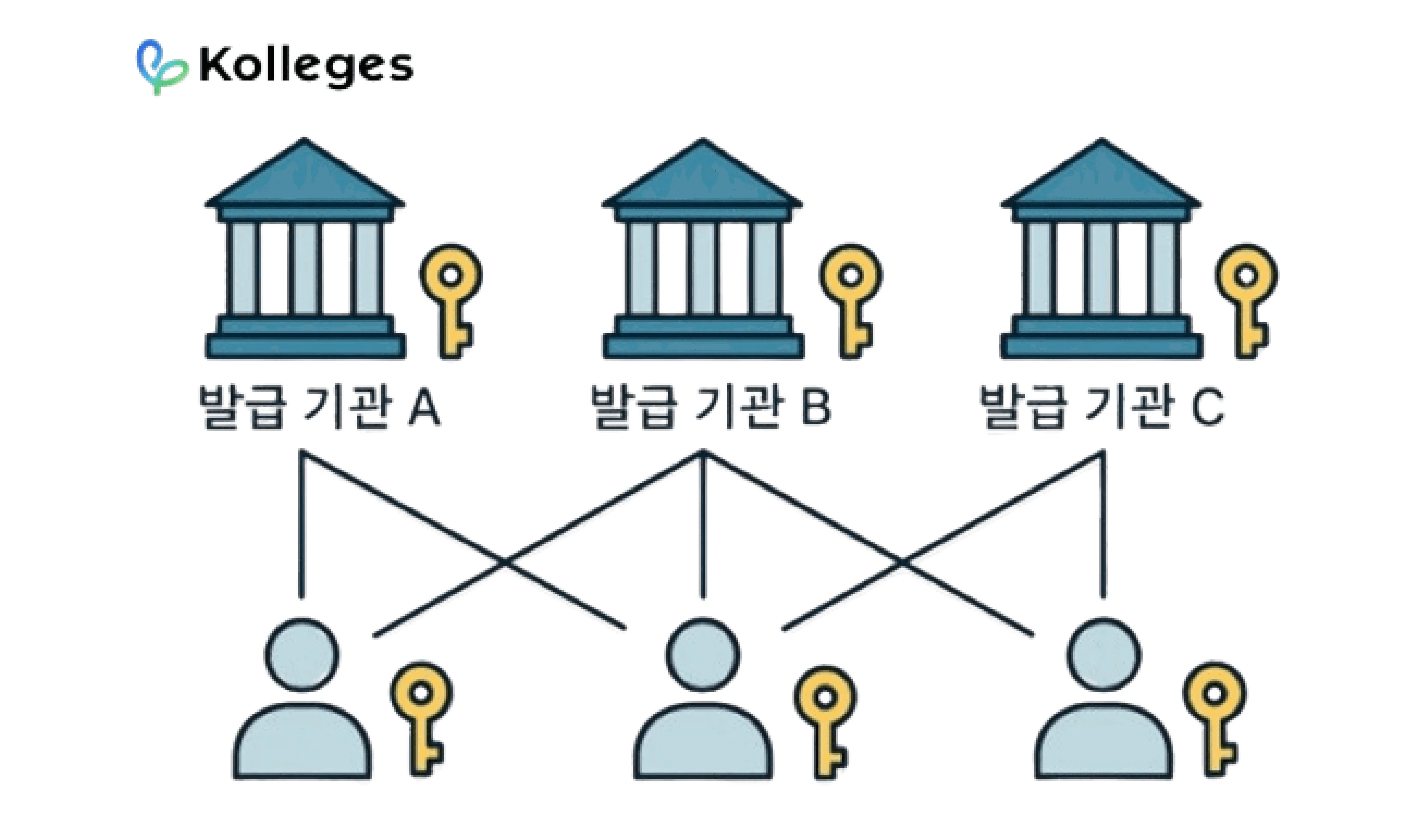
In Kolleges, to strengthen the trust and scalability of digital badges, the following two parties each hold their own DID.
-
Issuing institution The party that issues digital badges. The badge’s authenticity can be verified through a DID-based digital signature.
-
User (recipient) The individual or organization receiving the badge. They prove their identity through their own DID and can submit the badge externally.
This completes a structure where badge authenticity can be verified without any central server.
🔐 How is a DID managed?
To issue and verify digital badges securely, Kolleges operates the following security framework:
-
The public key is open for anyone to look up and is used to verify badges.
-
The private key is held only by the user and is never stored on a server.
✅ The user can download the private key directly
and keep it safe on a USB drive or in offline storage.
The DID generated from this key pair is then used to issue VCs (Verifiable Credentials) and to apply digital signatures.
🎯 DID is not just a login technology
DID is the technology that provides the “trust foundation” for digital badges. With DID, the following becomes possible:
-
Verification remains possible even if the central server disappears
-
Certificates and credentials can be verified anywhere
-
It can be extended through integration with blockchain, IPFS, and other external storage
In other words, DID is a digital seal that lets you “prove your identity without anyone’s permission.”
And what you create with that seal is a trustworthy digital badge.
✅ DID enables real digital badges
A Kolleges digital badge is not just an image file.
-
It is issued on top of DID, so anyone can verify it
-
It follows the VC standard, so it is globally compatible
-
It can be linked to IPFS for permanent storage
Issue certificates and credentials in a way anyone can trust. Grow into a trusted education brand with Kolleges.
📌 Introducing digital badges for the first time?
👉 Check out the [Digital Badge Adoption Checklist] as well.
Frequently asked questions
Want to turn learning outcomes into verifiable assets?
From issuing to verifying and amplifying, see it for yourself with Kolleges.
Request a Kolleges demoRelated posts
Digital Badges: How Is a DID Created and Stored?
Kolleges generates DID-based digital badges using the did:key method with RSA key pairs - storing only the public key server-side while delivering the encrypted private key to the user for self-custody.

A New Standard for the AI Era: Digital Identity Verification
Personhood Credentials let users prove their humanity online without exposing personal data, and digital badge platforms like Kolleges are positioned as a key asset for this emerging trust layer.
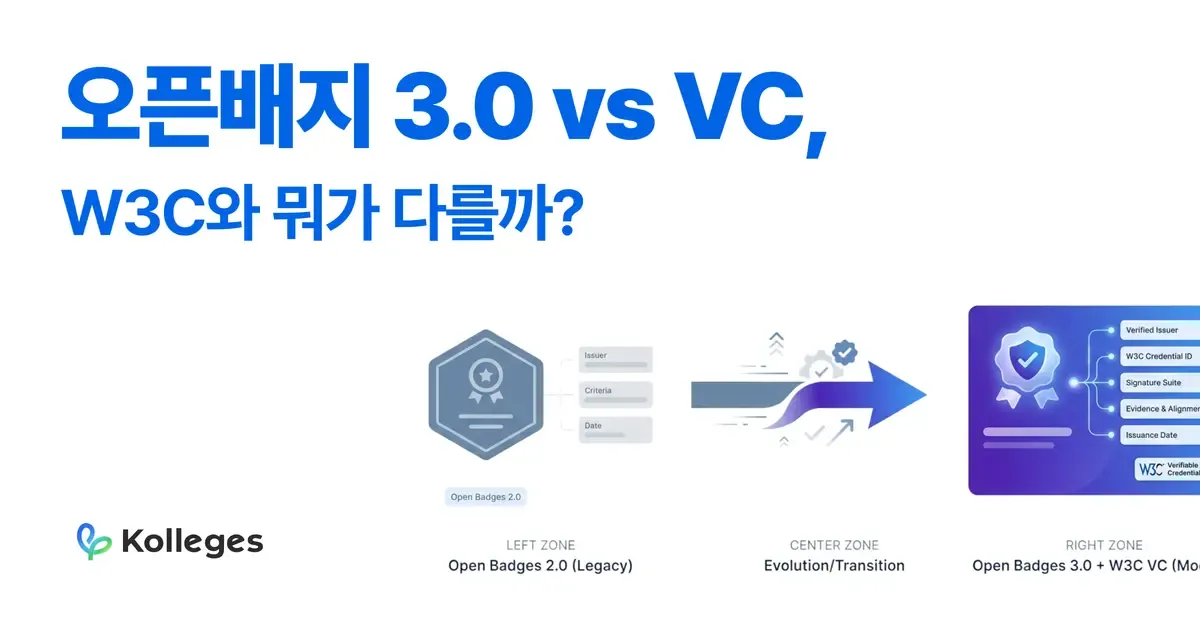
The complete Open Badges 3.0 guide: how it differs from W3C Verifiable Credentials
Open Badges 3.0 wraps W3C Verifiable Credentials with an education-specific metadata layer, replacing platform-dependent verification with cryptographic signatures that let learners own and selectively disclose their credentials.