
Korea's 2026 Youth Startup Grants: Conditions and What to Expect, Based on 2025 Data
Korea's 2026 youth startup grants (ages 19-39) will mirror 2025's core programs and reviewer priorities - start your business plan, team, and evidence portfolio now to compete effectively when announcements open in January-March.
The startup landscape shifts year by year, but government youth startup programs have a core structure that does not change much.
So when we look at the data from a full year of 2025, what 2026 will require - in capability, in documentation, in preparation - becomes much clearer.
As 2025 draws to a close,
“When will the 2026 startup grant programs open?”
“What should I prepare now to be competitive?”
For aspiring founders asking these questions, we have organized the most realistic prep strategy from the current vantage point.
🔎 What Are Youth Startup Grants?

Youth startup grants are a package of business funding, education, mentoring, and space support provided to young people aged 19 to 39.
Their greatest strength is that they go beyond “funding” to provide structural support that builds out a full startup ecosystem.
✔ Main Targets
-
Aspiring founders
-
CEOs of early-stage companies founded within the past three years (some programs allow up to five years)
✔ Why They Matter
Early-stage founders jump in lacking item validation, customer acquisition, expense management, and operating experience - so failure rates are high.
Government support meaningfully reduces this gap.

📌 The Most Important Startup Support Programs as of 2025
① Preliminary Startup Package (Ministry of SMEs and Startups)
-
Aspiring founders or those within three years of founding
-
Up to KRW 100 million in commercialization funding
-
Startup education, mentoring, and practice-based growth support
-
Among the most competitive programs each year
② Youth Startup Academy
-
Up to age 39
-
One year of intensive startup education
-
Commercialization funding (up to KRW 100 million) + monthly allowance of KRW 1 million
-
Operates campuses nationwide, with high post-graduation growth rates
③ Local Youth Startup Grants (Local Governments)
-
Programs by region: Seoul, Gyeonggi, Busan, Gwangju, etc.
-
Scale ranges from KRW 5 million to 30 million
-
Many programs weigh “intent to settle in the region” heavily, so residency verification is essential
④ Korea SMEs and Markets Foundation Programs
-
No age limit
-
For practical founders in food service, services, and similar sectors
-
New Business Startup Academy, Youth Mall entry support, and more
The 2026 lineup is very likely to follow these largely identical core programs.
That makes analyzing how they ran this year extremely important.
✏ The “Eligibility Conditions” Checklist Likely to Continue in 2026

Analyzing the 2025 youth startup grant announcements, the common requirements across nearly all programs were as follows.
✔ Age Condition
- Generally 19 to 39 years old
✔ Business Track Record
-
Aspiring founder, or
-
Within three years of founding
-
Some regional programs allow up to five years

✔ Innovation of the Business Item
-
Market potential
-
Differentiation
-
Feasibility
Explanations grounded in data and evidence become increasingly important.
✔ Exclusions
-
Unpaid national or local taxes
-
Default to financial institutions
-
Receiving overlapping grants for the same business
The same is very likely to apply in 2026.
In particular, restrictions on overlapping support continue to tighten - take care.
✅ How to Apply, Plus Practical Tips to Improve Your Odds
① Watch for the Announcement (Mandatory January-March)
-
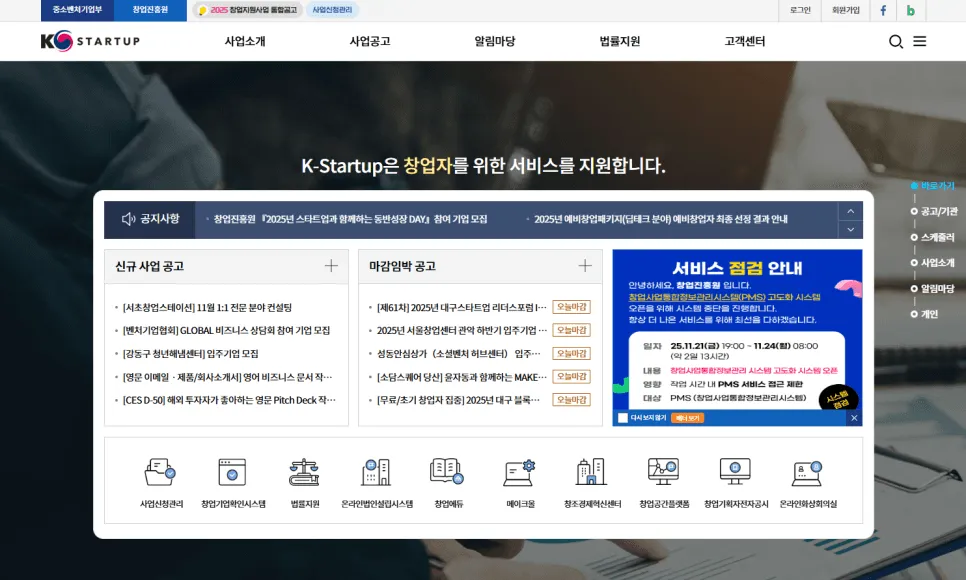
K-Startup
-
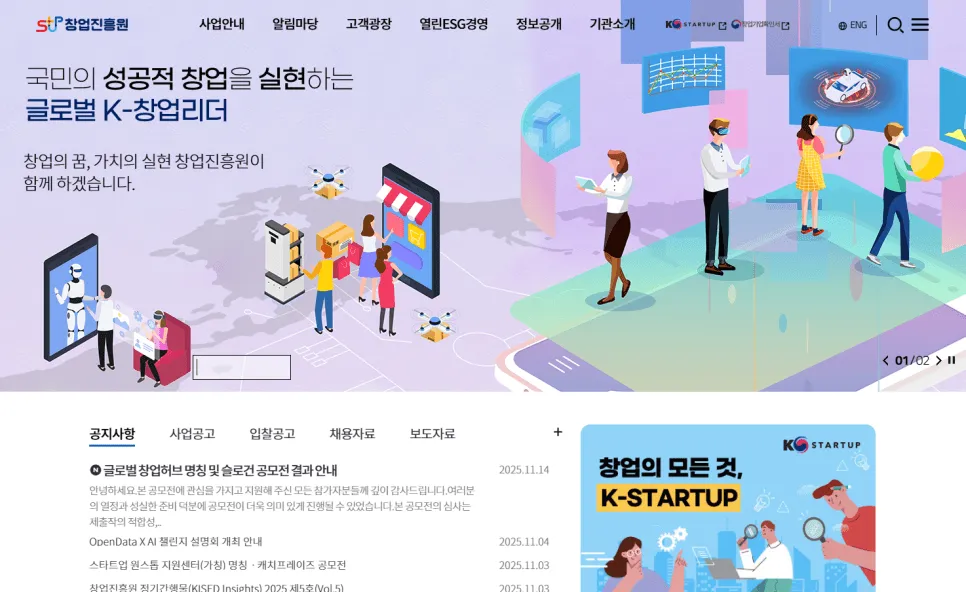
Korea Institute of Startup and Entrepreneurship Development
-
Each local government’s announcement
-
Regional startup support centers
The 2026 announcements are very likely to be concentrated in January-March.

② Prepare Your Business Plan (What 2025 Reviewers Looked at Most)
Keywords that recurred in 2025 review feedback:
In short, it is not enough to claim “this is feasible.” You must
prove why it is feasible.
③ Tips for Online Submission
④ Tips for the Pitch and Interview
-
Build a “core storyline” that can be explained in three minutes
-
Problem-solution-differentiation-revenue model-team is the most reliably evaluated flow
💡 “Aspiring Founder” Strategy for 2026 Startup Grants

Preparing now, as of the end of 2025, lets you move the fastest and from the most advantageous position the moment the 2026 announcements drop.
① Upgrade Your Item Level from “Idea” to “Clear Problem-Solving Structure”
The 2025 reviewers
repeatedly emphasized: “We evaluate problem-solving ability, not ideas.”
So you must be able to answer the following.
-
What problem are you solving?
-
Who is the customer?
-
What is different from existing approaches?
-
Can it actually be validated?
② Draft the Skeleton of the Business Plan in Advance
Starting from zero only after the announcement leaves too little time.
For now, draft just these sections.
-
Business overview
-
Execution timeline
-
Required budget
-
Team composition
-
Growth strategy
-
Validation method (MVP)
In 2026, “evidence-based business plans” are expected to matter even more.
③ Secure a Team or Partners
Sole founders are fine, but because evaluations weight execution capability highly,
experience collaborating with developers, designers, and marketers is an advantage.
④ Complete Foundational Education and Mentoring
In 2025,
completion of startup education was frequently used as a bonus-points factor.
The same will likely hold in 2026.
-
Free lectures from the Korea Institute of Startup and Entrepreneurship Development
-
Regional Center for Creative Economy and Innovation programs
-
K-Startup education
Starting now secures a competitive edge by the time the announcement drops.
📢 The 2026 Startup Grants - Preparation Has Already Begun
The 2026 startup support programs have not been announced yet, but preparation has effectively already begun.
In particular, looking at 2025 operating data and the recent direction of startup reviews, how a team substantiates “technical capability” and “execution feasibility” in growth assessments has become the deciding factor.
Startup support programs do not require professional work experience,
but evaluation credibility increases dramatically when a team can show technical capability and execution evidence that “we can actually build this item.”
That is why teams with project deliverables, an MVP, technical documentation, and education-completion records - supporting evidence - fare much better than teams that present only a plan.
From now, if aspiring founders steadily accumulate project records, education completions, and test versions -
evidence-grade material - their 2026 competitiveness follows naturally.
In particular, recently, e-portfolios and digital-badge-based “technical-capability proof” methods that systematically organize one’s capability and outcomes are being used more and more in startup support programs.
They show execution transparently and tend to draw positive evaluations.
Competition in 2026 will be tougher, but more opportunities will open for prepared founders.
As 2025 wraps up, take the first step toward next year’s startup challenge.
We are rooting for your new beginning. 🚀
Frequently asked questions
Want to turn learning outcomes into verifiable assets?
From issuing to verifying and amplifying, see it for yourself with Kolleges.
Request a Kolleges demoRelated posts

What's Changing in Korea's 2026 Youth Policy
Korea's 2026 youth policies ramp up AI education, regional employment incentives, and startup support, making verifiable experience credentials a decisive competitive advantage.

2025 Certificate Acquisition Subsidy: Application Process, Documents, and Benefits
Unemployed youth aged 19-39 can get up to KRW 200,000 in exam fee reimbursements through South Korea's 2025 Certificate Acquisition Subsidy - but budgets run out fast.

Public Education Is Changing: A Guide to Korea's 2025 Coding, AI, and Creative Education Policy
South Korea's 2025 national policy transforms coding, AI, and creativity from electives into core K-12 subjects, aiming for full adoption across all schools by 2027.