
Why Practice-Based Education Raises Employment Rates

Practice-based experience only translates into hiring advantage when it is objectively recorded - digital badges embedded in an E-Portfolio give employers instant, data-rich verification of real-world competencies.
If you had to name the single biggest change in the job market, it would be this: the kind of talent companies want has completely changed.
According to a Saramin survey of companies, 9 out of 10 employers prefer “experienced new hires” (new hires who can be deployed immediately).
This signals a move away from purely credential-based hiring toward competency-based hiring focused on people who can step into actual work right away.
Employers are wary of investing significant time and budget into training after hiring.
In an environment shaped by digital transformation, AI adoption, and rapidly shifting industries, the need is for “people who can work on the front line from day one,”
and as a result, practice-based education, project-based learning, and internship experience have emerged as the deciding factors for job market competitiveness.
📊 What JobKorea’s Survey Confirms About the Effect of “Practice-Based Experience”
A JobKorea survey on internships made this trend even clearer.
Among internship participants, close to 9 out of 10 - 85.9% - answered that the experience “was helpful.”
Many respondents specifically cited the following as the most meaningful outcomes.

1) Experiencing Organizational Culture → Confirming Fit with the Job
The biggest advantage of an internship is the chance to experience firsthand a company’s culture, collaboration style, and work rhythm.
This becomes a critical reference point for choosing the right job and industry for yourself.
-
The environment in which you’re least stressed at work
-
Which competencies - speed, accuracy, creativity, communication - are actually needed on the job
-
Which roles offer long-term growth potential
These are things you simply can’t learn from classroom education alone.
2) Experiencing Real Work Environments to Minimize Trial and Error
Many respondents said that experiencing actual workplaces was the single biggest factor in reducing trial and error after employment.
For example:
-
Hands-on experience with real-world tools
-
Experience with actual work processes
-
Understanding how to collaborate with practitioners
These experiences become far stronger competitive advantages than theoretical knowledge.
This is precisely why companies prefer talent that’s “ready to deploy immediately.”
❗ But Not All Internships Are Effective
Interestingly, some internship participants also said the experience was not helpful.
The reasons were very clear.

The Top Reason → Repetitive, Menial Tasks
The experience of being assigned only menial support work without real practical training actually left people disappointed.
-
Repetitive document organization
-
Miscellaneous tasks
-
Pure assistant roles with no training
These don’t translate into genuine “practical skills,” so they don’t carry much weight on a resume.
Worse, this kind of experience can deepen career uncertainty and reduce motivation to job-hunt.
The conclusion is clear
→ With internships, what you actually did is what matters.
Simply having “done an internship” isn’t the differentiator - what practical skills you built in the process is.
That’s why the operational quality of the internship program, whether it provides real job experience, and how outcomes are recorded matter more than anything.
💡 The Core of Practice-Based Education Is “Proving Competency”
Multiple surveys have already shown that practice-based education effectively raises employment rates.
But it comes with one big question.
”How do you actually prove this experience?”
Companies prefer practical talent, but a resume alone can’t accurately convey:
-
Which tools the candidate actually used
-
Which work processes they experienced
-
What role they played in team projects
-
Whether deliverables or outputs actually exist
-
Whether an educational institution verified the work
The structural problem in the job market has been this: practice-based experience itself is valuable, but there hasn’t been a good way to objectively certify it.
The mechanism filling this gap is the digital badge.
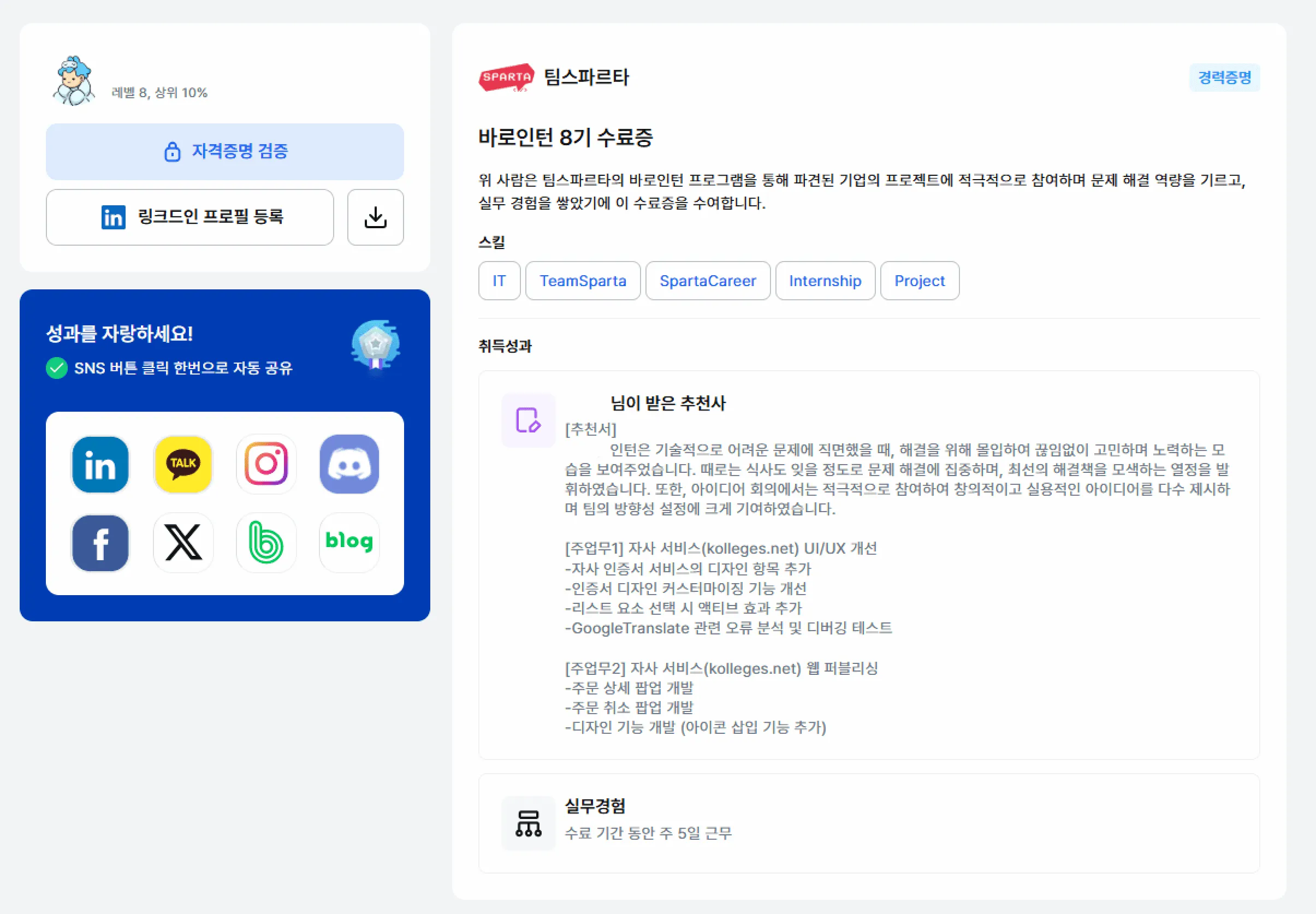
🔎 Why Digital Badges Fit Practice-Based Education So Well
Digital badges aren’t just a “completion certificate image.”
They’re digital certifications that record and prove every outcome generated through practice-based education as data.
Here’s why companies can trust practice-based experience when it’s backed by badges.
1) The Entire Practice Process Is Recorded as Data
Digital badges can structure and record practice-based outcomes like the following:
-
Completed program name, training period, curriculum
-
Evaluation criteria and whether they were met
-
Project deliverable files, links, and screenshots
-
Tools and tech stacks used
-
Individual contribution and role
-
Verification by a supervising professor or designated manager
This is the kind of record that paper certificates or simple resumes can’t capture.
2) Employers Can Instantly See the Depth of Experience
With a single click on a badge, a company can verify a candidate’s competencies in detail.
-
The work flows they experienced
-
The actual work tools they used
-
The problems they solved
-
The difficulty level they completed
In other words, from the company’s perspective, digital badges are a tool that reduces verification burden
and are emerging as a new standard for trusting practice-based educational outcomes.
3) A Certification Model That Maximizes the Impact of Practice-Based Education
The more field experience the better - but if it isn’t properly recorded, its value shrinks.
Digital badges prevent this loss of experience, capture learners’ achievements in full, and become a powerful selling point in the job search process.
📌 Practice-Based Experience + E-Portfolios
Practice-based education remains the most effective way to raise job market competitiveness.
But for that experience to be properly recognized in the job search, a “method of proof” has to be in place. Doing a lot of practice work doesn’t automatically let employers see the depth of that work.
So you need a structure with these elements:
-
Whether the firsthand work experience is recorded
-
Whether actual job-based outcomes remain, not just repetitive routine tasks
-
Whether outcomes can be systematically organized and presented
-
Whether employers can verify competencies with a single click
The standard way to satisfy these conditions is the E-Portfolio.
E-Portfolios systematically capture the projects, assignments, tech stacks, and collaboration experiences generated during practice, maximizing the impact of practice-based learning.
Combining a digital badge with this makes the structure even stronger.
✔ Because you can add digital badges inside an E-Portfolio.
A digital badge isn’t just a simple completion image -
it’s a certification that records granular data including the practice process, evaluation criteria, project deliverables, contribution, and technical competencies.
So adding digital badges inside an E-Portfolio means:
-
You can present practice-based experience alongside objective data,
-
You can describe project outcomes with both quantitative and qualitative information,
-
Employers can instantly verify a candidate’s practical skills, and
-
Competency-based questions become much clearer in interviews.
In other words, practice-based experience provides the “content,”
and the E-Portfolio plus digital badges provide the structure that “proves” that content.
📢 Job Market Competitiveness Is Decided by “How You Show Your Experience”
Today, the method of proof for experience matters more than the volume of experience.
👉 Practice-Based Experience + E-Portfolio + Digital Badges
This combination is the most credible way to demonstrate the practical competencies a learner has built,
and the most efficient structure for employers to identify talent ready to deploy immediately.
In the job market going forward, this structure
will become the standard that produces the strongest practical-talent competitiveness.
Frequently asked questions
Want to turn learning outcomes into verifiable assets?
From issuing to verifying and amplifying, see it for yourself with Kolleges.
Request a Kolleges demoRelated posts

What to Do After Bootcamp? Digital Certification Strategies That Lead to IT Jobs
Combining bootcamp training, role-specific certifications, and digital badges creates a verifiable, shareable evidence trail that gives IT job seekers a concrete edge over traditional resumes.
Proving Practical Skills with Digital Badges, Not Exams
Digital badges embed project links, tech stacks, and assessor sign-offs directly into verifiable metadata, replacing scattered files with a standardized proof of practical capability.

An Education Roadmap for Career Changers
Career changers succeed not by collecting certifications but by building verifiable, practice-based competency across five stages - and digital badges are the most efficient way to prove each step.