
Proving Practical Skills with Digital Badges, Not Exams

Digital badges embed project links, tech stacks, and assessor sign-offs directly into verifiable metadata, replacing scattered files with a standardized proof of practical capability.
Recently, companies have been weighing real projects and hands-on experience more heavily than exam scores.
But outcomes from practice-based education tend to scatter across files and folders or live only on paper certificates,
making them hard to prove accurately.
Digital badges fill this gap.
Kolleges, in collaboration with various institutions,
issues badges that capture the actual practical process, outcomes, and technical data,
functioning as a credentialing approach that clearly demonstrates practical capability.
In this article, we cover
why practical training is proven through digital badges, along with real Kolleges issuance examples.
🔎 Why proving practice-based education is still hard
Practical outcomes usually remain in the following forms.
-
Project deliverables (PPT, Notion, GitHub)
-
Code written during the practice
-
Experiment records, dashboards, reports
-
Outcomes of on-the-job application
-
Presentation materials and collaboration artifacts
These deliverables are extremely valuable, but
as time passes, files are lost or stop being updated,
and their usability in the hiring stage drops sharply.
For educational institutions as well,
the lack of a data format that objectively expresses graduates’ capability is a major concern.
A certificate doesn’t reveal the curriculum or the technologies used,
and the criteria differ across institutions, making systematic outcome management impossible.

So as practical training spreads,
systems that make outcomes standardized, data-fied, and verifiable are needed.
To fully solve this problem,
Kolleges has implemented digital badge solutions across hundreds of institutions.
📌 Why use digital badges to prove practical outcomes
Kolleges digital badges offer the following capabilities.
-
Store practical deliverables and project links as badge metadata
-
Specify the assessment criteria, tech stack, and tools used per badge
-
Secure trust through institutional verification
-
Strengthen credibility through “institution-issued” rather than individual claims
-
Share instantly to resume, portfolio, social media, and LinkedIn
-
Anyone can click and confirm authenticity on a verification page
-
A structure trusted by institution, learner, and company alike
In other words, this approach simultaneously solves the two core problems of
“standardization of records” and “verifiability of practical capability.”
💡 Practice-based education, proven with digital badges
① Bootcamp and job-training practice badges
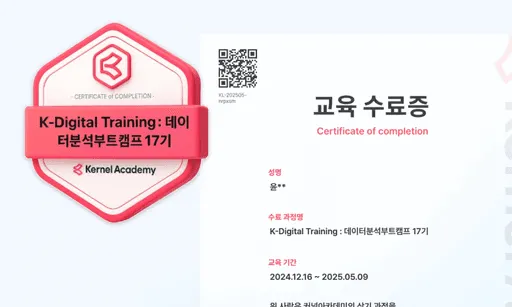
Kolleges partners with various private institutions, edtech companies, and practice-driven bootcamps
to issue project-centric, practice-oriented completion badges.
In particular, the digital badge clearly records not simply “completion status” but
“which project was performed, with which technologies, to build what.”
The main practice components are as follows.
-
Data analysis practice using Python and SQL
-
AI model implementation (forecasting, recommendation, classification, etc.)
-
Full web service development flow (planning → design → FE → BE)
-
Corporate workshop projects (market research, marketing strategy design, etc.)
-
Collaboration records and deliverables based on GitHub and Notion
-
UI/UX prototyping (with Figma links attached)
Kolleges reflects assessment criteria tailored per curriculum into the badge metadata,
so certification is centered not on “how much you sat through”
but on “what you actually performed (What you did).”
As a result, in the resume, portfolio, and interview stages, graduates
can clearly demonstrate the depth of the project, the practical vocabulary, and the actual deliverables,
which significantly strengthens their employment competitiveness.
② Public agency and university practical training badges

Kolleges, together with public agencies, universities, and education institutions affiliated with local governments nationwide,
builds digital badge issuance systems for public projects, university education, and administrative practice.
Representative badge types are as follows.
-
Public agency practical training (policy planning, administrative practice, regional data utilization, etc.)
-
Local government digital talent development practical courses
-
University industry-collaboration practical projects and capstone programs
-
Youth Startup Academy admission and graduation outcomes (auto-issuance + verification page provided)
These badges are not simple participation or completion records - they include actual outcome-based data such as:
-
Hands-on assignments and achievement levels based on real business processes
-
Analysis reports leveraging policy, administrative, and regional industry data
-
Assessment criteria (accuracy, logic, applicability to practice)
-
Verification and approval records by the institution’s responsible staff
-
Lists of required job skills and proficiency level
Digital badges issued by public agencies and universities
carry very high credibility even with private companies,
and serve as a useful certification tool that demonstrates, with objective data,
that the holder has performed roles in expert, public, and policy-driven contexts.
For institutions as well,
automated outcome management → educational promotion → accumulation of graduate competency creates
a virtuous loop, securing both operational efficiency and advanced education.
③ Field practice and internship practical badges

Kolleges, in partnership with universities, vocational high schools, and university-industry cooperation foundations,
also provides a badge framework that structures field practice and internship outcomes.
Unlike traditional logbooks or attendance-check methods, field practice badges
clearly capture the learner’s actual work performed, performance indicators, and professional competencies.
The main recorded elements are as follows.
-
Practice tasks per role (data cleansing, customer management, product testing, content production, etc.)
-
Workplace soft skills such as work attitude, collaboration, and problem-solving
-
Assessments and checklists by on-site supervisors
-
Project deliverables, reports, and work records
-
Practice hours, duration, and institution information
-
A skill map reflecting actual field criteria
In particular, for industry-academia field practice,
the university can track the student’s job performance and growth records on the job,
and the company can confirm the practicum participant’s competency as official data,
making the field-to-employment pipeline very effective.
For graduates, this badge serves as
a field-oriented competitiveness credentialing tool that records, in objective data,
“in which role you actually performed which tasks.”
📢 Practical capability is proven through “records,” not exams
As practice-based education grows,
how that outcome is recorded grows in importance as well.
But until now, practical deliverables
remained scattered as files,
and certificates didn’t carry practical capability data -
a missing credentialing structure.
Digital badges solve this problem.
-
Structure and permanently store practical outcomes as data
-
Record technology, outcomes, and assessment criteria, all clearly
-
Deliver strong competitiveness in resumes, portfolios, and interviews
Practical capability is now proven
through data-based “practice records,” not exams.
Kolleges will continue
to build standardization of practical capability credentialing -
linking education, outcomes, verification, and employment.
Frequently asked questions
Want to turn learning outcomes into verifiable assets?
From issuing to verifying and amplifying, see it for yourself with Kolleges.
Request a Kolleges demoRelated posts

What to Do After Bootcamp? Digital Certification Strategies That Lead to IT Jobs
Combining bootcamp training, role-specific certifications, and digital badges creates a verifiable, shareable evidence trail that gives IT job seekers a concrete edge over traditional resumes.

Why Practice-Based Education Raises Employment Rates
Practice-based experience only translates into hiring advantage when it is objectively recorded - digital badges embedded in an E-Portfolio give employers instant, data-rich verification of real-world competencies.

How to Use Digital Badges: Why Educational Institutions and Enterprises Must Adopt Them
Digital badges embed verifiable skill, issuer, and criteria data in a shareable credential - enabling personalized learning, learner motivation, and data-driven HR strategy.