
What to Do After Bootcamp? Digital Certification Strategies That Lead to IT Jobs

Combining bootcamp training, role-specific certifications, and digital badges creates a verifiable, shareable evidence trail that gives IT job seekers a concrete edge over traditional resumes.
The IT job market is changing at a pace that’s incomparable to the past.
In recent years, two major shifts in particular stand out.
First, the spread of no-code tools has made IT accessible even to non-majors.
In the past, you couldn’t take the first step without development knowledge.
Now, from automation to website creation to data processing -
an environment is in place where “anyone can build and test things themselves.”
Second, we’ve entered an era where practical capability matters more than academic credentials.
Companies no longer evaluate candidates primarily by department, GPA, or university tier.
Actual project experience, problem-solving ability, and data that prove technical capability
have become the core metrics of hiring.
That’s why many job seekers and working adults choose
the bootcamp + certification combination.
In this post, we lay out a path that first-time IT entrants can use to prepare effectively -
from “practice-based learning → competency verification → use in job placement.”
📌 Building a practical foundation through a bootcamp
Bootcamps deliver the most practical, fastest growth path for IT job preparation.
For non-majors in particular, they’ve become a “realistic skill-acquisition route.”
✔ Practice-centered learning
Where university and online courses are theory-based,
bootcamps are organized around the actual workflow.
-
Experience the full cycle: planning → development → deployment
-
Pair programming, code reviews, real-world assignments - practitioner-grade curriculum
-
Direct mentoring by industry practitioners
This experience isn’t just one line on a resume -
it becomes powerful evidence that “you’ve actually done it.”
✔ Securing project experience
In IT hiring, project experience matters most.
Companies use a candidate’s portfolio to assess:
Bootcamps are designed so this kind of project experience accumulates naturally.
✔ Non-majors can grow quickly

Even without a major in IT or computer science,
it’s possible to grow to a job-ready level within 3-6 months -
because compressed practical experience plus immediately applicable assignments repeat continuously.
Even within a short timeframe, this concentrated hands-on experience
becomes a definite competitive edge in the job market.
🚀 Strengthening credential trust through certifications
If a bootcamp builds practical capabilities,
certifications objectively certify them.

✔ Theoretical verification of bootcamp knowledge
What companies look at carefully is
“Can this person do the work?” and
“Is the foundational knowledge solid?”
Certifications officially verify the practical knowledge gained at a bootcamp,
and as a result they significantly raise the credibility of a resume.
✔ Recommended certifications by role
Below is a post recommending certifications by role.
Learn practical skills at a bootcamp,
and solidify the theoretical foundation with these certifications -
the ideal structure of “practical experience + official verification” is complete.
📢 Why digital badges matter for both bootcamps and graduates
Once you’ve built practical capabilities through a bootcamp and certifications,
what matters next is how to prove and use those capabilities.
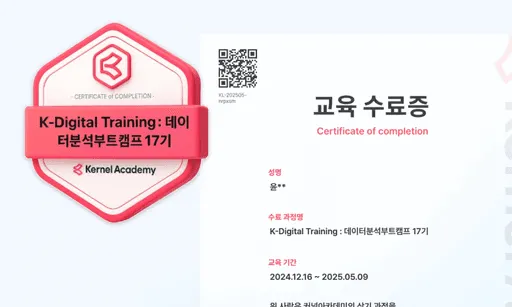
The most effective method here is the Digital Badge.
A digital badge isn’t a simple certificate of completion -
it’s a formal certification method that structures learning, skill, and outcome data.
Adopting it brings the following concrete benefits to both graduates and bootcamps.
👩💻 Graduate-side benefits (advantageous for job placement)
① Submit your practical experience and technical capabilities as “verifiable data”
Project experience, role, and performance metrics
that were hard to convey with a PDF certificate
are structured within the digital badge,
so companies can see capabilities at a glance.
② Share to portfolios, LinkedIn, and Notion instantly
In one click, embed in:
-
Portfolio
-
LinkedIn
-
Notion
-
Email applications
-
making it a credible career-evidence asset.
③ Unified management of multiple evidence materials
Bootcamp completion certificates, professional certifications, mini-projects, and more
no longer scatter across files -
they accumulate within a single profile.
The complexity of job preparation drops dramatically.
🏫 Bootcamp-side benefits (operational efficiency & quality)
① A branding effect that objectively shows graduates’ capabilities
The skills graduates learned at the bootcamp
and the outcomes they delivered are transparently visible externally,
so the institution’s quality of education is naturally proven.
This also positively affects recruitment of new applicants.
② Education-operation automation (completion → certification issuance, all automatic)
Administrators no longer need to manually produce and send PDFs -
digital badges are issued automatically when completion is processed,
significantly improving operational efficiency.
③ Program improvement based on graduate outcome data
Through issued badges,
graduates’ learning patterns, acquired skills, and project outcomes
can be reviewed as data -
useful input for improving the next cohort’s curriculum.
💡 The final stage of practical preparation: job-market competitiveness completed by digital certification
When bootcamp learning → certification → practical capability connects to digital certification,
job preparation becomes far more efficient and transparent.
A digital badge becomes,
for the graduate, a certificate that raises career competitiveness,
and for the bootcamp, a tool that strengthens educational value and credibility.
If you’re preparing for an IT job,
and if you’re running a bootcamp,
now is the best time to switch to a new approach grounded in digital certification.
Frequently asked questions
Want to turn learning outcomes into verifiable assets?
From issuing to verifying and amplifying, see it for yourself with Kolleges.
Request a Kolleges demoRelated posts

Why Practice-Based Education Raises Employment Rates
Practice-based experience only translates into hiring advantage when it is objectively recorded - digital badges embedded in an E-Portfolio give employers instant, data-rich verification of real-world competencies.

Proving Practical Skills with Digital Badges, Not Exams
Digital badges embed project links, tech stacks, and assessor sign-offs directly into verifiable metadata, replacing scattered files with a standardized proof of practical capability.

An Education Roadmap for Career Changers
Career changers succeed not by collecting certifications but by building verifiable, practice-based competency across five stages - and digital badges are the most efficient way to prove each step.