
The fundamentals of career growth: a complete guide to building your performance portfolio

A performance portfolio built around quantified outcomes and digital badges is the most credible way to prove job-performing ability during hiring, role transitions, and internal career growth.
Today, most companies no longer judge a candidate’s competence on a single sheet of resume.
What you’ve actually done, what problems you’ve solved, and what outcomes you’ve produced has become far more important.
On the other side, many working professionals share a common frustration:
“I’ve been doing my job consistently,
but I don’t have any organized record of accomplishments
to show for it.”
That’s why the performance portfolio has recently become an essential capability in HR, career transitions, and the job market.
For new hires and juniors, it’s proof of working competence,
and for experienced professionals, it’s the most important material to show project leadership and the evidence of growth.
Today we’ll cover, one by one:
-
why a portfolio is needed
-
what elements it should consist of
-
how to raise your working competence
-
portfolio writing know-how
and how all of this connects to digital badges and e-portfolios.
Why is a performance portfolio needed?
Portfolio definition
A performance portfolio is not simply a “collection of deliverables.”
It’s a proof of work performance that organizes the problems you’ve solved, how you contributed, and the outcomes you produced, on a data basis.
Purpose of a portfolio
A performance portfolio shows its power in the following situations.
-
When you need to convince someone “why me?” in hiring or job transitions
-
When you need to accurately show your contribution to a project you participated in
-
When you need to prove competence for a team move or role expansion
-
When you use it as internal positioning material to take on a new project
In one actual case,
during the process of forming a new project TF,
instead of merely saying “I have experience doing similar work,”
a person presented the portfolio they had organized,
and the past achievements were clearly visible,
leading directly to an opportunity to join the project.
In this way, a portfolio is a strong piece of supporting evidence that immediately raises credibility.

In short, a portfolio is essential not only for hiring
but also as a tool for creating opportunities and expanding roles internally.
Key elements of a portfolio
A performance portfolio is not a “list of experiences” document.
It needs a structure where Problem → Solution → Outcome is clearly visible.
① Problem situation & goal

-
What was the problem?
-
Why did it need to be solved?
-
What was the goal?
This step needs to be clear so the meaning and difficulty of the project come through.
② Your contribution
The most important section.
Separate the organization’s outcome from your individual outcome,
and clearly explain the scope of what you did.
③ Outcome (numbers, charts, images)
Outcomes have to be visualized to be persuasive.
Examples:
-
Conversion rate 18% → 27%
-
Revenue up 12%
-
Work time down 30%
-
MAU 3,000 → 5,600
Numbers, comparison images, and charts are more powerful than explanations.
Strategy for improving working competence
To create a good portfolio,
you first need experience (raw material).
① Build real project experience
Working competence grows fastest from project experience.
In the process of solving real problems, collaboration, analysis, communication, and execution naturally come through,
and these become the core evidence in a portfolio.

② Job-related learning
Continuously learning the latest tech and knowledge brings
-
creative thinking
-
higher work efficiency
-
faster problem-solving
-
all immediately useful at work.
③ Use feedback
The process of acting on feedback and producing improved results
is the capability companies value most.
In a portfolio, the “feedback → improvement → outcome” structure is very persuasive.
Portfolio writing know-how
① Use the STAR method
The Situation-Task-Action-Result structure
is the portfolio writing approach the reader can most quickly understand.
② Use a digital portfolio
Modern portfolios must be digital-first.
-
PDF
-
Online portfolio
-
LinkedIn
-
Notion
-
Digital badge-based e-portfolio
Companies prefer digital formats because verification and sharing are easier.
③ Concise and focused on the essentials
Without extra fluff,
it’s best to show only “Problem → Solution → Outcome” clearly.

A portfolio is your competitiveness document, and digital badges extend its value
A performance portfolio is more than a document listing experiences -
it’s an official competitiveness document that proves your job-performing ability and problem-solving ability.
Consistently building working competence, organizing outcomes, and visualizing them
is itself a core career-growth strategy.
Recently, to certify these outcomes more transparently and objectively,
digital badges have been spreading rapidly.
A digital badge officially certifies project experience, contribution, leadership, and technical capability
on a data basis, significantly raising portfolio credibility.
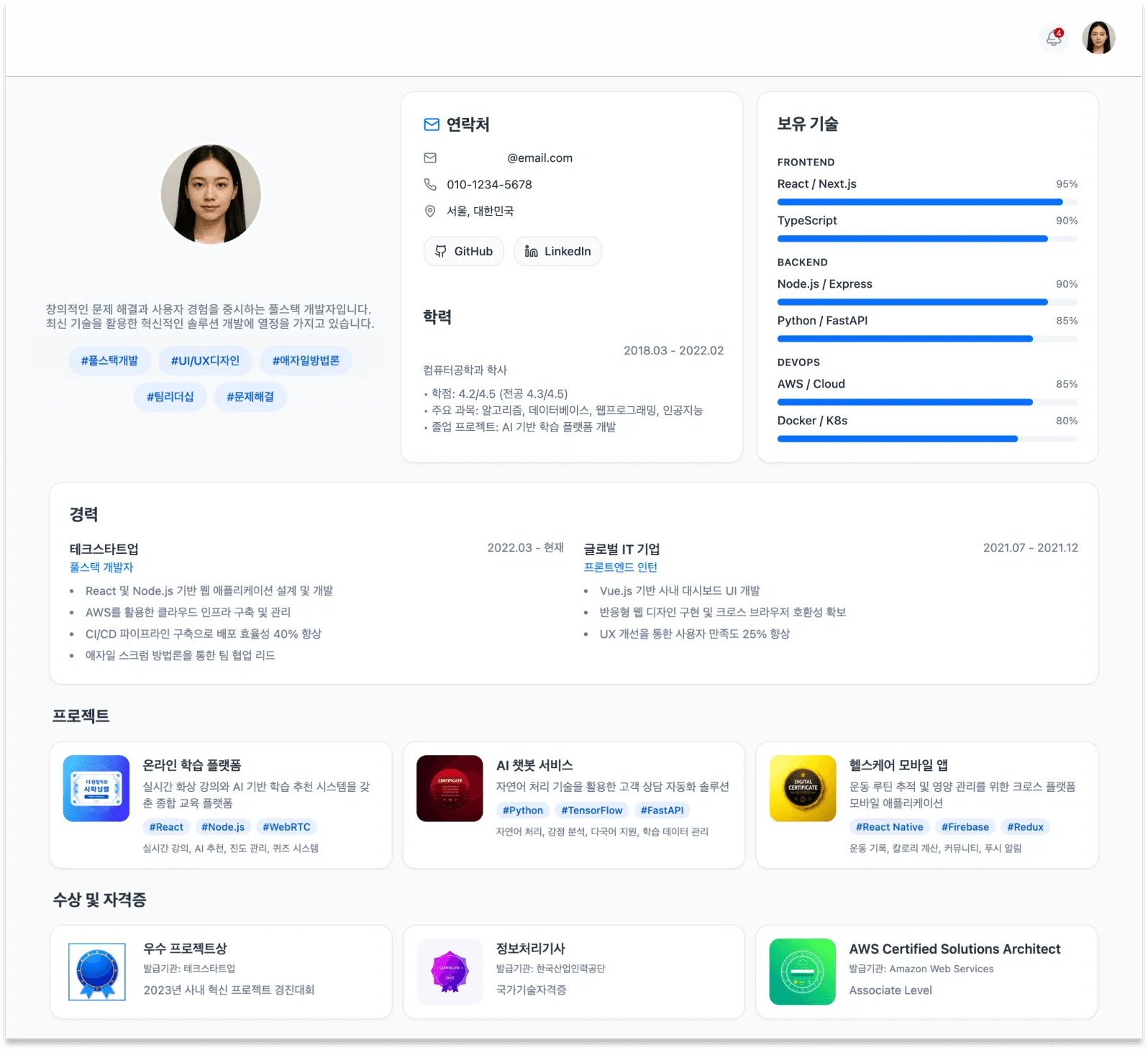
In particular, building an e-portfolio with digital badges produces the following effects.
- Performance management becomes automated, making career organization easier
- Competency badges accumulate, visually showing the trajectory of growth
- Companies, institutions, and interviewers get a high-credibility portfolio verifiable with a single click
Kolleges helps you systematically manage learning, projects, and outcomes
by automating these performance records into digital badge and e-portfolio form.
A portfolio is the document that proves you,
and digital badges are the technology that officially guarantees that competence.
If you want to show your growth more clearly and powerfully,
build your portfolio digitally with Kolleges.
Frequently asked questions
Want to turn learning outcomes into verifiable assets?
From issuing to verifying and amplifying, see it for yourself with Kolleges.
Request a Kolleges demoRelated posts

An Education Roadmap for Career Changers
Career changers succeed not by collecting certifications but by building verifiable, practice-based competency across five stages - and digital badges are the most efficient way to prove each step.

How to Use Digital Badges in Resumes and Portfolios
Digital badges embedded in resumes, portfolios, and LinkedIn profiles function as verifiable, metadata-rich credentials that strengthen your case in skills-based hiring.

When Grades Aren't Enough: How Do You Capture Student Competencies?
Transcripts capture scores but not skills - digital badges and CLR close that gap by connecting learning objectives through CASE to portable, verifiable competency records.