
When Grades Aren't Enough: How Do You Capture Student Competencies?

Transcripts capture scores but not skills - digital badges and CLR close that gap by connecting learning objectives through CASE to portable, verifiable competency records.
Grades remain on the transcript, but what a student can actually do often doesn’t. Extracurricular activities, projects, collaboration, problem-solving - the more meaningful the experience, the harder it is to capture in a single line on a transcript. Educational institutions are turning away from score-centered records toward approaches that capture student growth more clearly.
What transcripts miss
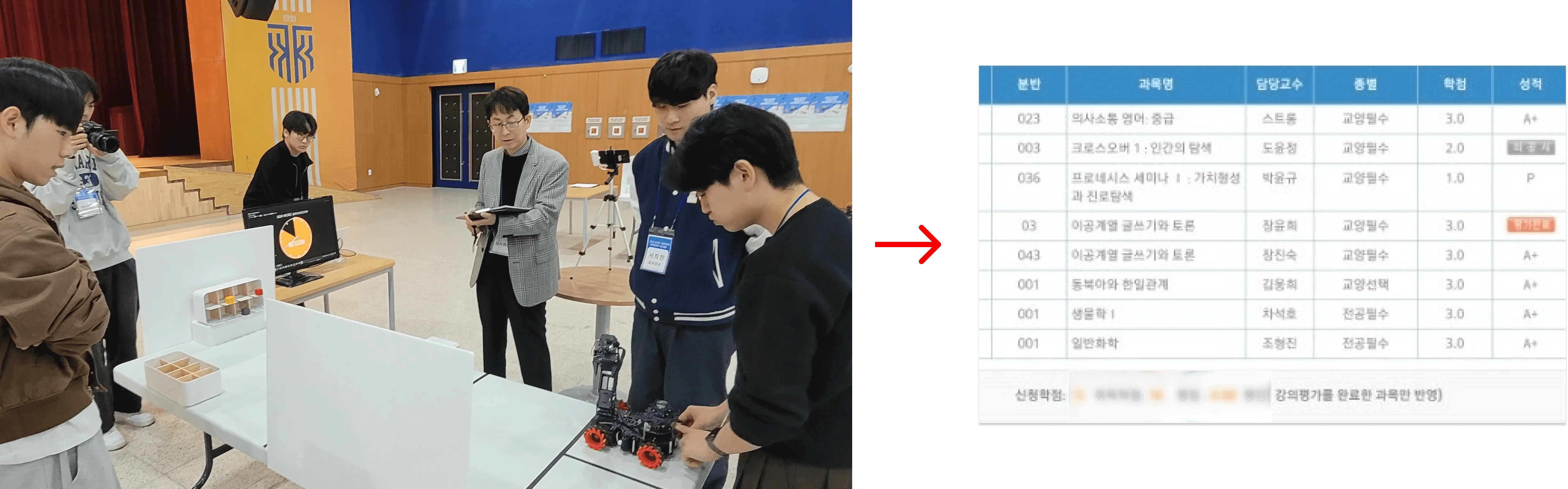
The persistence to revise a research report three times. The role of organizing ideas and seeing a team project through. The collaboration skill of pulling the team together right before a presentation. These moments reveal a student’s competency, but they don’t show up in a letter grade. Korean universities and educational institutions face the same challenge. They want to show what students experienced and what capabilities they developed, but the records that remain are often limited to completion status or participation hours. Students end up with weaker portfolios, and institutions lack the evidence to explain their educational outcomes.
Why the shift to competency-centered

Against this backdrop, competency-based learning is drawing attention. It’s the approach of looking at what students actually learned and mastered rather than how much time they put in. Students advance once they meet the criteria, and teachers can give more concrete feedback on what’s missing. The problem isn’t direction - it’s operations.
In the field, learning objectives, assessment, curriculum, and certification often move separately. Teachers shuttle between systems to align data, and administrators struggle to see the whole flow at a glance. What’s needed is a common language.
The 1EdTech CASE standard helps connect achievement standards and learning objectives as data. When standards trapped inside documents link up with assessments, activities, and deliverables, it becomes much clearer which programs built which competencies.
When records change, so does the explanation
If students built competencies, those outcomes need to remain in portable, verifiable form. This is where digital badges and CLR come in.
A digital badge isn’t just a completion image. It can contain what was learned, which criteria were met, and what deliverables serve as evidence.
For students, it becomes easy to surface and showcase achievements. For institutions, it makes outcomes more persuasive.
CLR ties these records together more multidimensionally. Beyond courses and grades, it presents projects, activities, performance results, and traces of growth.
If a transcript is a one-line summary, this is closer to a profile that lets readers see the learning journey.
The on-the-ground impact is real.
-
Students can carry their outcomes from college through to the workplace.
-
Career services teams can describe competencies and experiences in more concrete terms.
-
Institutions can move beyond reports that just count participants and start showing the outcomes that accumulated.
When criteria organized through CASE link to badges, and those records flow into learner profiles, you can tell a much richer story than a single grade. For both higher education and employment, what matters now is what students can do, not just what they learned.
For student growth records, connection is what counts
Showing student growth properly means learning objectives, assessment, certification, and portfolios can’t move in isolation. They need to connect - so students get outcomes they can actually surface, and institutions get an explainable outcomes management system. Sending a single PDF completion certificate is no longer enough.
Frequently Asked Questions (FAQ)
Q. Can extracurricular activities be formally recorded like grades?
A. Yes. Projects, volunteering, leadership, and collaboration experiences can be recorded as formal outcomes when accompanied by criteria and evidence. That turns extracurriculars from mere participation history into materials that demonstrate a student’s competencies.
Q. Is competency-based learning about eliminating grades?
A. No. Grades remain necessary - this is closer to complementing what grades alone can’t explain. When scores are paired with actual performance and achievement, you can understand the student in far more dimensions.
Q. How are digital badges different from completion certificates?
A. Certificates typically only show that completion occurred, while digital badges can also embed criteria and evidence. You can see who did what, at what level - making them highly useful as outcome certification tools.
Q. How is CLR different from a college transcript?
A. Where a transcript centers on courses and scores, a CLR also shows activities, projects, and achievements. The result is a broader, more concrete view of a student’s learning history.
Q. Why do institutions need this kind of system?
A. Participant counts and satisfaction scores often aren’t enough to explain educational outcomes. To make reporting and evaluation persuasive, you have to show which competencies were developed and how those outcomes carried into next steps.
Q. Do we have to roll out a full system from the start?
A. Not necessarily. You can start by organizing achievement criteria and certification methods for a specific program or extracurricular area. Building outcome certification experience at a small scale first, then expanding to the full learning history, is the more realistic path.
Grades remain, but the process of student growth fades - many institutions are stuck here. In that case, it helps to first organize a structure that connects learning objectives through to certification. Looking at how Kolleges is solving this challenge for universities, public agencies, and education companies in real cases will sharpen the picture of where to start in your own organization.
Frequently asked questions
Want to turn learning outcomes into verifiable assets?
From issuing to verifying and amplifying, see it for yourself with Kolleges.
Request a Kolleges demoRelated posts

Why Academic Certificates Are Turning Into Digital Badges
Digital badges replace paper certificates by embedding verified competency data - practical outcomes, skills, and issuer credentials - that learners can share instantly and employers can trust.

The Strategy of Universities with High Employment Rates: Digital Badges That Convert Student Experience Into Outcomes
Digital badges turn invisible student experiences - extracurriculars, capstone projects, overseas programs - into verifiable, shareable competency credentials that employers can trust instantly.

The fundamentals of career growth: a complete guide to building your performance portfolio
A performance portfolio built around quantified outcomes and digital badges is the most credible way to prove job-performing ability during hiring, role transitions, and internal career growth.