
'Technology' and 'care' on a single certificate - Korea Polytechnic University Daejeon Campus's 'AI × Human Care' co-issuance
 Robin Yoon · Customer Success Team Published
Two universities in Daejeon co-issued a single digital badge bearing both institutions' logos, solving the NCS stage-recognition gap inside a RISE regional innovation consortium.
Technology universities and health science universities usually don’t stand in the same classroom. Through the RISE (Regional Innovation System & Education) initiative, the Department of Artificial Intelligence at Korea Polytechnic University Daejeon Campus formed an “AI Human Care” consortium with Daejeon Health Institute of Technology, which has health and welfare infrastructure. The two universities are co-designing the stages of demand discovery, technology development, on-site validation, and talent retention - starting from the youth startup support space “Gayang Node” - and the results of completed coursework are issued not as paper certificates, but as digital badges bearing both institutions’ logos. We sat down with Professor Kim Dae-gon, who leads the regional startup and RISE direction, and Professor Han Ik-seob, who runs the practical education in the AI department.
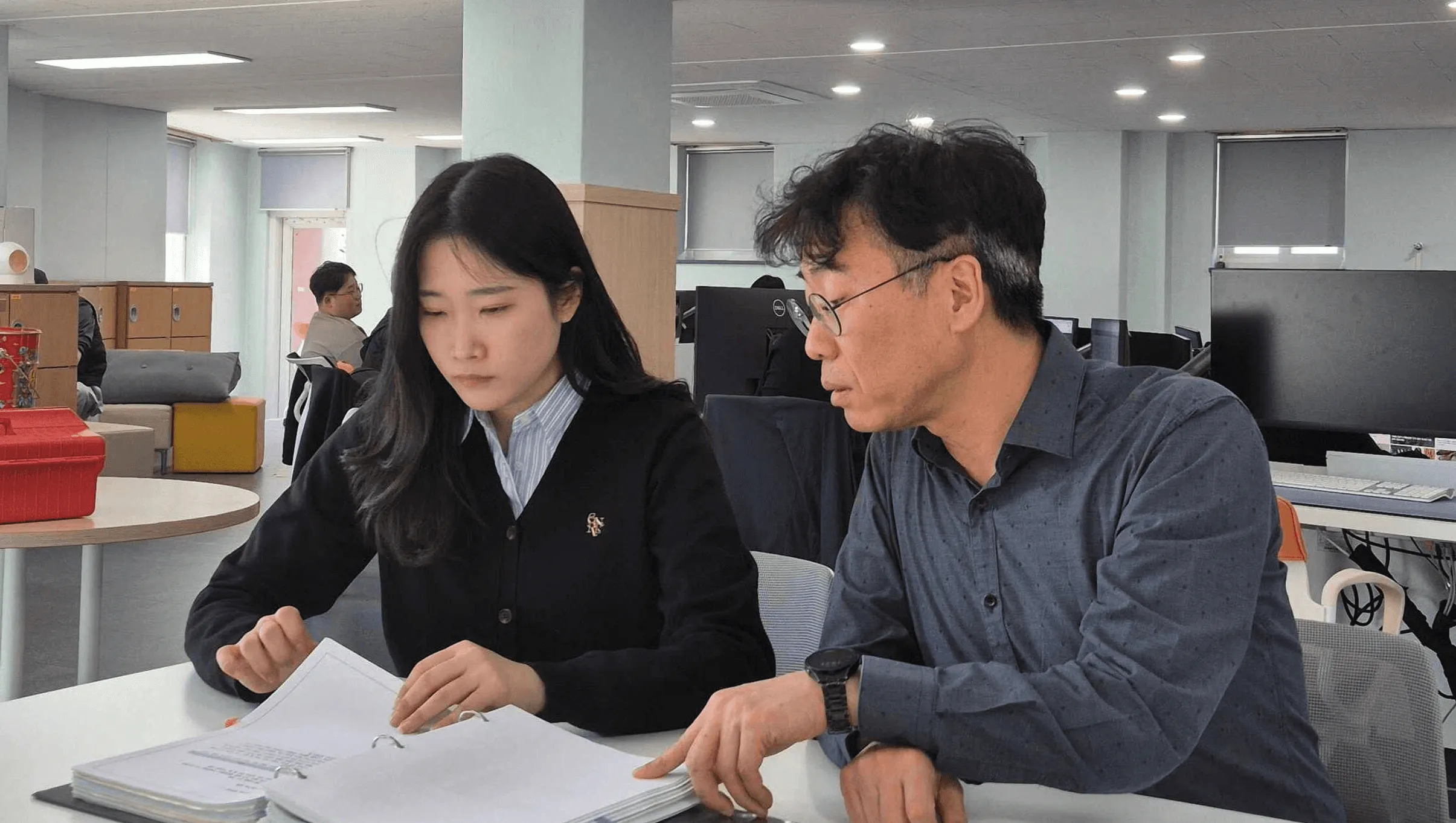
We aim to build more than a tool for issuing badges - a ‘standard for competency credentialing’ that connects universities, companies, and local governments.
Why the two universities came together - the RISE AI Human Care consortium
Two problems facing Daejeon met on the same track. The growth of seniors living alone and the shortage of care workers form one curve; the outflow of young people to Seoul and the mismatch between regional jobs and youth talent form the other. Professor Kim diagnosed it this way: “Many young people want to learn AI, but their eyes are on platform companies in Seoul and the metropolitan area, while our region’s welfare field and healthcare SMEs are starting out short of technical talent.”
The solution was the combination of the two universities. Daejeon Health Institute of Technology, with health, nursing, and social welfare infrastructure, takes “service design,” while Korea Polytechnic University, with AI and digital implementation capability, takes “technology implementation.” It’s not a simple credit exchange - it’s a structure that ties the two universities’ strengths together within a single track.
It’s also notable that the starting point of governance is not a desk-level agreement but a “space.” The youth startup support space “Gayang Node,” launched alongside the Youth Settlement Council in 2025, functions as the first button of the consortium, so the flow of demand discovery → technology development → on-site validation → talent settlement runs in the order of “space → people → records.”
A vessel for stage-by-stage credentialing - the question NCS asked
The starting point for considering digital badges was experience running NCS (National Competency Standards). Korea Polytechnic University and the Human Resources Development Service of Korea have a history of participating together in NCS system development, and one limitation became clear in operating it. NCS divides job roles into stages, but in practice it often gets operated as a structure where “you only get recognition if you complete the entire program,” making the in-between stages invisible to both learners and employers.
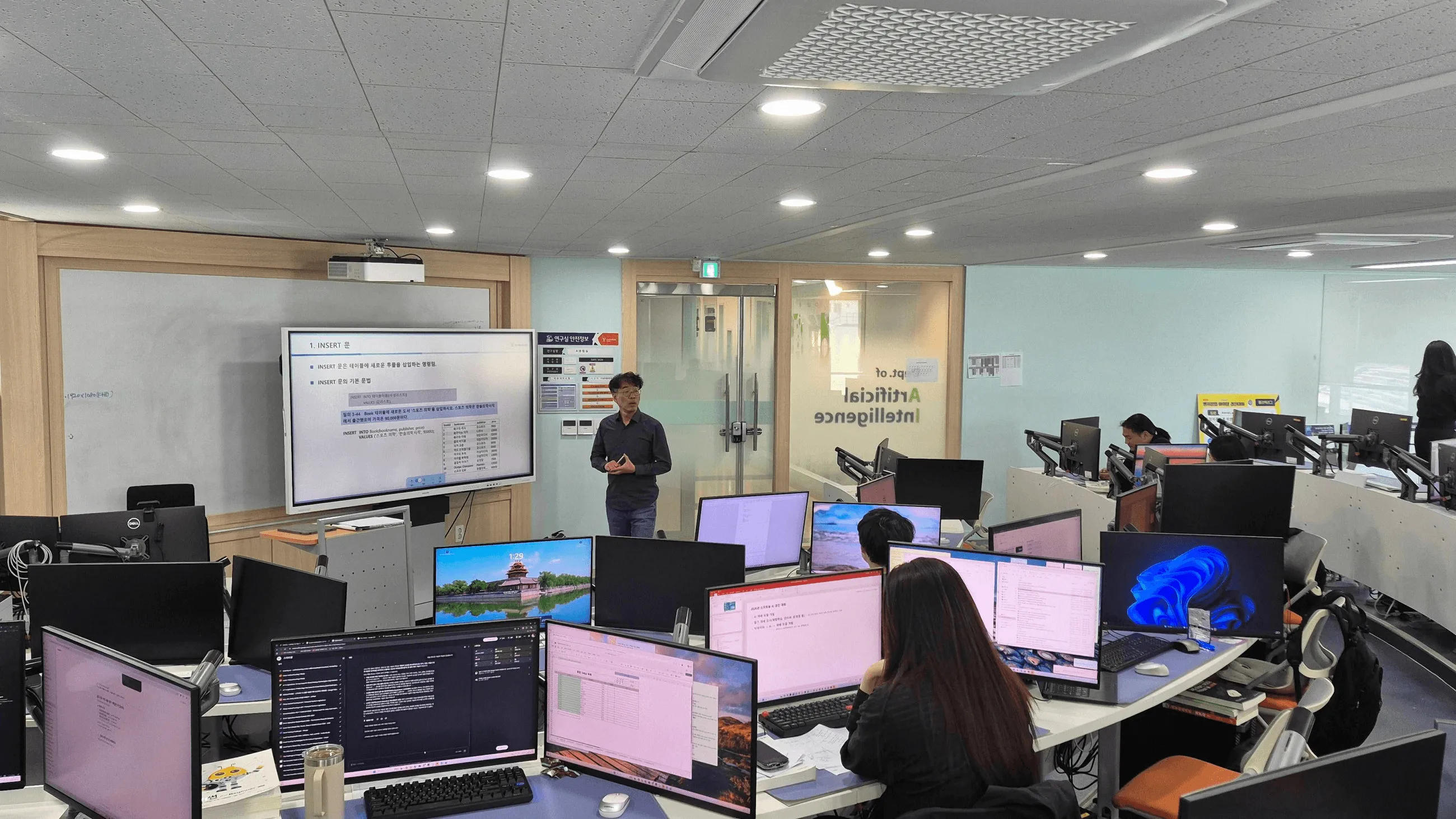
The AI department classroom Professor Han runs is where this limitation is felt first. Non-major humanities graduates, experienced workers who realized they needed automation, health and welfare practitioners facing the limits of digital transformation, and people hoping to change careers all enter the same classroom. For learners starting from different points, a stage-by-stage expandable curriculum becomes essential rather than a single course. This structure aligns directly with the “stage-by-stage credentialing” of digital badges.
The criterion for selection was not the “issuance tool” but the “credentialing standard.” The RISE consortium wasn’t looking for a solution that just kept records well within one institution - it was looking for a common vessel where universities, companies, and local governments could speak the same language about competency.
A certificate with two logos - running co-issuance
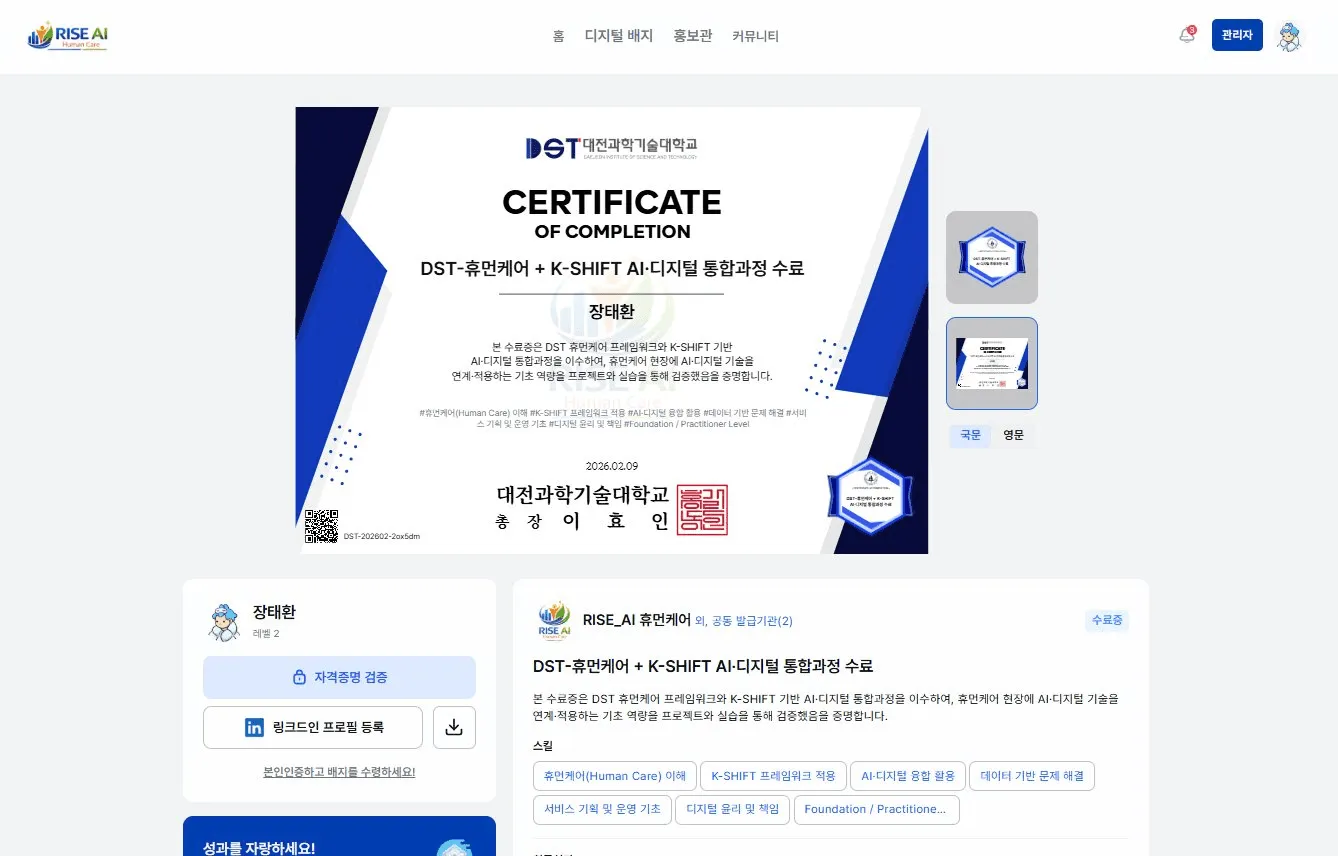
The most unique part of this interview is “co-issuance.” It’s common for one university to issue a digital badge alone, but operating an issuance where two universities together attach their names to a single learning experience is a level up in difficulty.
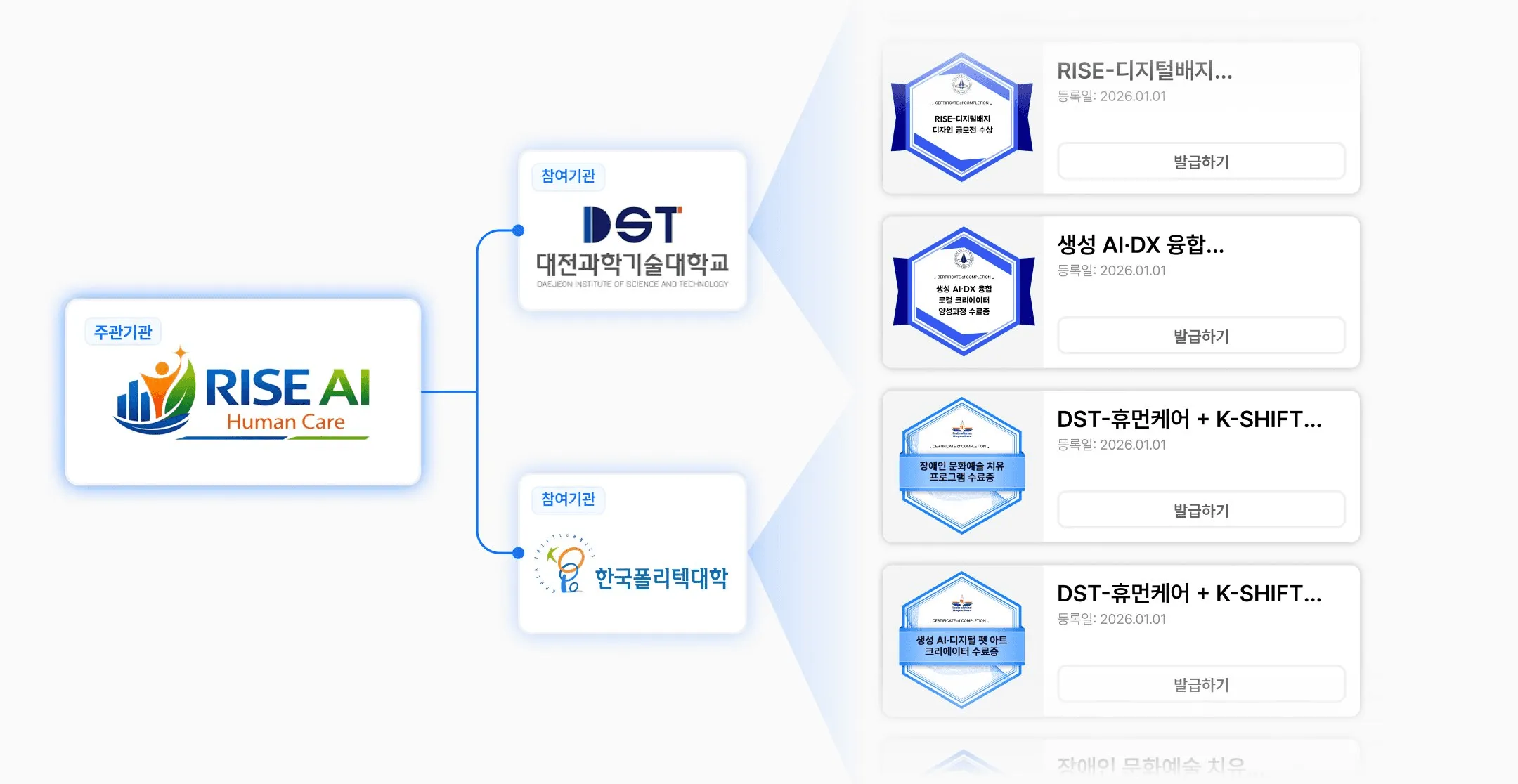
The two universities built a stage-by-stage module structure around the “DST-Human Care + K-SHIFT AI · Digital Integration Course.” Polytechnic handles AI technology implementation, Daejeon Health Institute of Technology handles arts-mediated healing and personalized counseling, and Living Lab-based validation activities are done jointly by both universities and local companies. At the end of each stage, a co-credentialed badge bearing both institutions’ logos is issued.
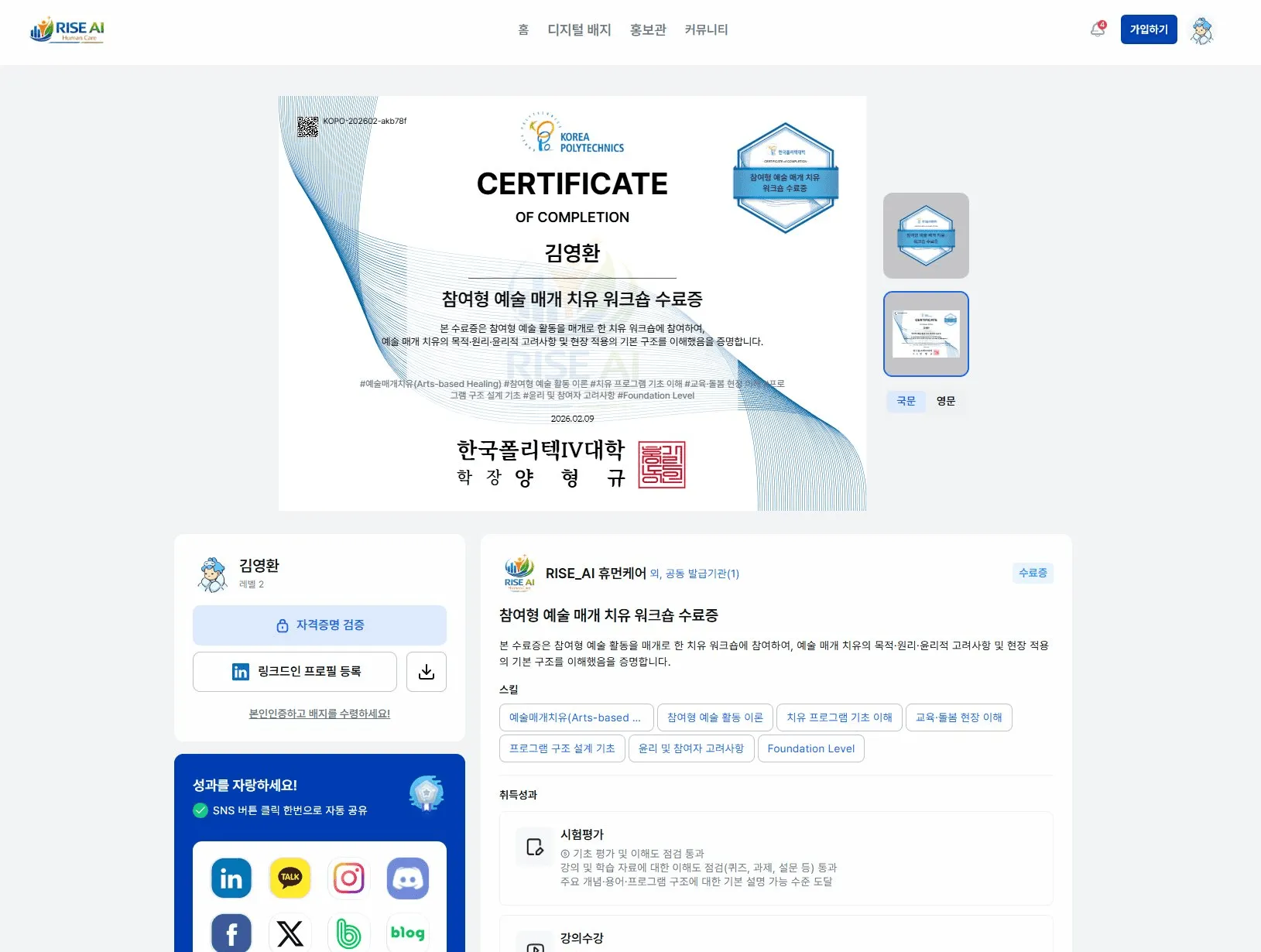
The real difficulty was not technology but “criteria alignment,” Professor Kim explained. A tech-centered university asks “what can you do,” while a university with health and welfare infrastructure asks “how do you treat people.” For these two questions to fit inside a single credential, both institutions had to agree on the same evaluation criteria.
The most striking moment was a conflict encountered during operation. “If AI detects abnormal behavior with 98% probability, how do you resolve the 2% error on-site?” For an engineer, 98% is a sufficiently good model, but in a care setting, a 2% false positive is directly connected to the safety of one person. It’s a moment that shows this is not just the combination of two departments but the combination of two value systems.
When asked what feature of Kolleges helped most, the answer was “the multi-credentialing system that allows multiple institutions to embed credentialing information into a single digital data record, without complex paperwork.” If two universities each issued paper certificates, students would have two documents, and companies would have to separately interpret the relationship between the two documents. A co-issued digital badge consolidates this into a single verifiable data record.
The change felt after adoption - from completion to competency
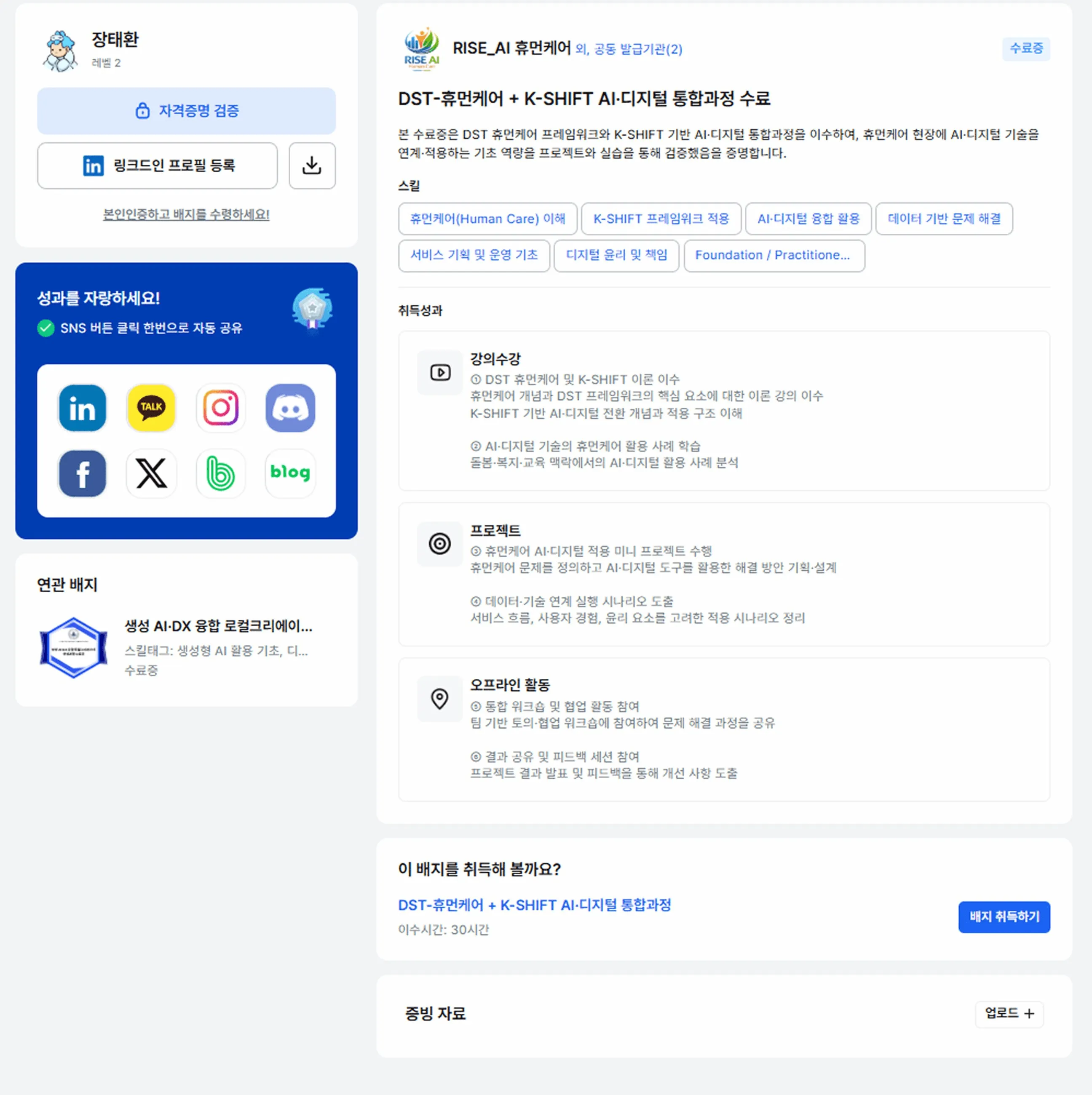
The biggest change is that the distance between “training completion” and “specific job competency” became clear. A paper certificate only says, “this person attended this course,” while a digital badge leaves a data record of “what this person did at which stage.” That difference matters both in RISE program reporting and in industry collaboration.
What stood out in student responses was the “badge design contest.” Not a certificate one-sidedly issued by the institution, but one in which the learner themselves participated in the design process. This experience makes a digital badge feel like “an asset I created” rather than “paper someone else gave me.” The fact that you can prove it immediately on mobile translates directly into utility in everyday situations like job preparation and interviews.
The change is also clear on the RISE program reporting side. It’s hard to explain a program’s differentiation through “how many people completed the course” alone. Only when “what kind of talent, with what stages of competency, connected to what regional problems, was nurtured” is organized as visualized data does “why our program is different” become visible.
There are also clear remaining tasks. More time is needed for the “stage where external institutions accept these credentials as official credentialing,” and “administrative agreements” must be continuously built so that the joint certificate gains substantial credibility in industry. These are issues that one digital badge solution cannot solve on its own - they’re areas that require standards, policy, and industry awareness to move together. Professor Kim’s expectation that Kolleges should function as more than a simple issuance tool, but as “a standard of competency credentialing connecting universities, companies, and local governments,” fits precisely with this point.
The picture Daejeon Campus is drawing isn’t a single track of certificates but a “regional talent credentialing infrastructure” where multiple tracks connect on top of the same badge system. Professor Kim closed with this: “Education is finally completed when it’s recorded and proven. We hope that the attempt to embed each institution’s specialty in the common vessel of a digital badge becomes a strong driver helping local young people settle and grow.”
After the interview - a follow-up MOU with the Industry-Academic Cooperation Foundation and Blockspoon
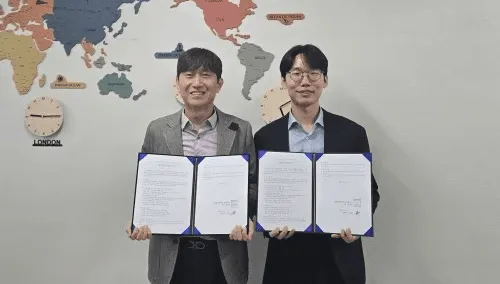
After this interview, there’s a step-further update. On April 16, 2026, the Industry-Academic Cooperation Foundation of Korea Polytechnic University IV and Blockspoon Inc., the operator of Kolleges, signed an MOU for “activating industry-academic cooperation through building a digital badge issuance service platform, an e-portfolio system, and an AI-based job matching and career plan support service.” Attending the signing were Foundation Director Kim Geon-wan, Blockspoon CEO Yoon Chang-jin, and Professor Han Ik-seob of the AI department.
As an extension of last year’s Kolleges adoption and operation of digital badges for students, the goal of the agreement is to expand from accumulated issuance data and operational experience into an integrated system that goes beyond simple completion credentialing to include accumulation and use of student competency data, all the way to AI-based job matching. The two organizations are cooperating in three areas: ① digital badge issuance service platform (1EdTech Open Badges 2.0, 2.1, and 3.0 full version certification, blockchain authenticity verification), ② integration with an e-portfolio system that records and manages learning processes, outputs, and competencies, and ③ AI-analysis-based job and career path recommendation with personalized career plan support.
In vocational education, “concretely proving students’ working competence to the outside and connecting them to the right career path” has long been a difficult challenge. This MOU is meaningful in that it designs the flow within a single system - leaving learning history as verifiable digital badges, accumulating and managing it through e-portfolios, and connecting it to careers via AI job matching. Kolleges is currently used by over 200 institutions including universities, public agencies, education companies, and associations, and once this model - reflecting the characteristics of vocational education - is completed, it’s expected to become a reference that can spread to other Polytechnic campuses and vocational education institutions.
Frequently asked questions
What’s the effect of adopting digital badges in a RISE program?
Rather than just reporting completion numbers, you can report “what kind of talent, with what stages of competency, was nurtured” as visualized data. Professor Kim Dae-gon explained, “Because you can present specific target talent profiles and competency indicators nurtured to solve local social problems as data, it’s effective for demonstrating program differentiation.”
How does the “co-issued digital badge” between the two universities work?
Korea Polytechnic University Daejeon Campus and Daejeon Health Institute of Technology defined stage-by-stage competencies around the “DST-Human Care + K-SHIFT AI · Digital Integration Course,” covering everything from AI technology implementation to arts-mediated healing, personalized counseling, and Living Lab validation. At the end of each stage, a co-credentialed badge bearing both institutions’ logos is issued - a structure where two universities’ credentialing is stacked onto one student’s learning experience.
What’s the hardest part when a tech-centered university and a health and welfare-centered university build a credential together?
“Aligning different perspectives.” Even an AI model that detects abnormal behavior with 98% probability needs a “human perspective” in the face of the 2% error on-site, as the example shows. Building a unified credentialing standard took the most time, and the process of establishing administrative agreements so the joint certificate gains substantial credibility in industry remains the core task.
How do NCS stage credentialing and digital badges relate?
Korea Polytechnic University and the Human Resources Development Service of Korea have experience participating together in NCS system development. In operating it, the limitation of a structure where “competency is only recognized after completing the entire program” became clear, and to address this, digital badges that allow stage-by-stage detailed proof were considered - that’s Professor Kim’s explanation. Digital badges play the role of a vessel that records the learning stages between NCS levels as data.
Frequently asked questions
Want to turn learning outcomes into verifiable assets?
From issuing to verifying and amplifying, see it for yourself with Kolleges.
Request a Kolleges demo Related posts
"Region, Industry, and University Thrive Together": President In-Seong Jang's Dongwon Institute of Science and Technology Opens the Next Stage of Regional Co-Prosperity with Digital Badges
Dongwon Institute of Science and Technology simultaneously rolled out Kolleges digital badges across three units, cutting national-program evidence work by 40% compared with paper certificates, and is now planning S/A/B grade differentiation to signal student competency to local employers.
From Hobby to Certification to Instructor: How Hongik University Sejong's Lifelong Learning Center Is Building a Virtuous Cycle of Education
Hongik Sejong's RISE-funded Lifelong Learning Center replaced paper certificates with tiered Level 1-3 digital badges to record and sustain a hobby-to-certification-to-instructor growth path.
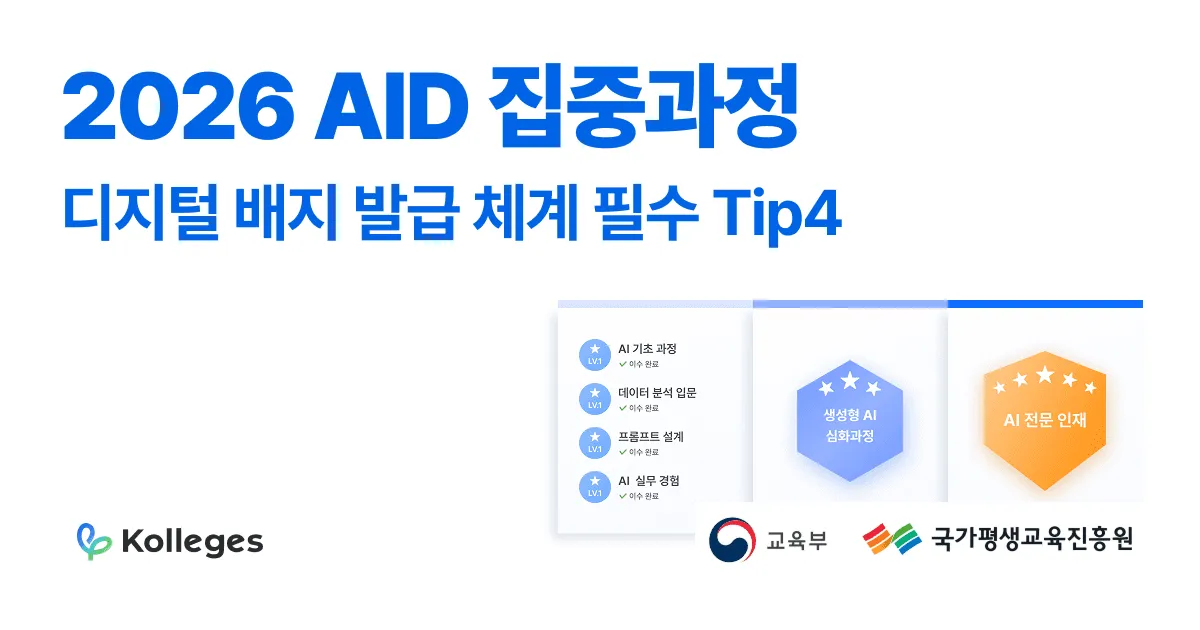
Designing the Digital Badge System for AID 30+ Intensive Camps and Bundled Courses
Design competency, course, and integrated badges for AID 30+ and Bundled Courses with the right metadata and automated issuance rules to satisfy both program evaluation and learner utility.