
Designing the Digital Badge System for AID 30+ Intensive Camps and Bundled Courses
Design competency, course, and integrated badges for AID 30+ and Bundled Courses with the right metadata and automated issuance rules to satisfy both program evaluation and learner utility.
With eight new universities added in 2026, the Ministry of Education’s AID (AI·Digital) program has entered a phase of substantive expansion. The same questions keep coming up across operating universities. The job analysis, the derivation of required competencies, the operation of curricula - these are familiar steps. But the final step, “issuing digital badges,” is the one that becomes hardest the moment it’s actually upon you.
The RFP says, briefly, “conduct project-based job-track evaluations and issue digital badges based on completion,” but in practice it is up to each operating university to decide what units to cut the badges along, what to put in the metadata, and how to automate evaluation and issuance.
Two Issuance Structures the AID Program Requires
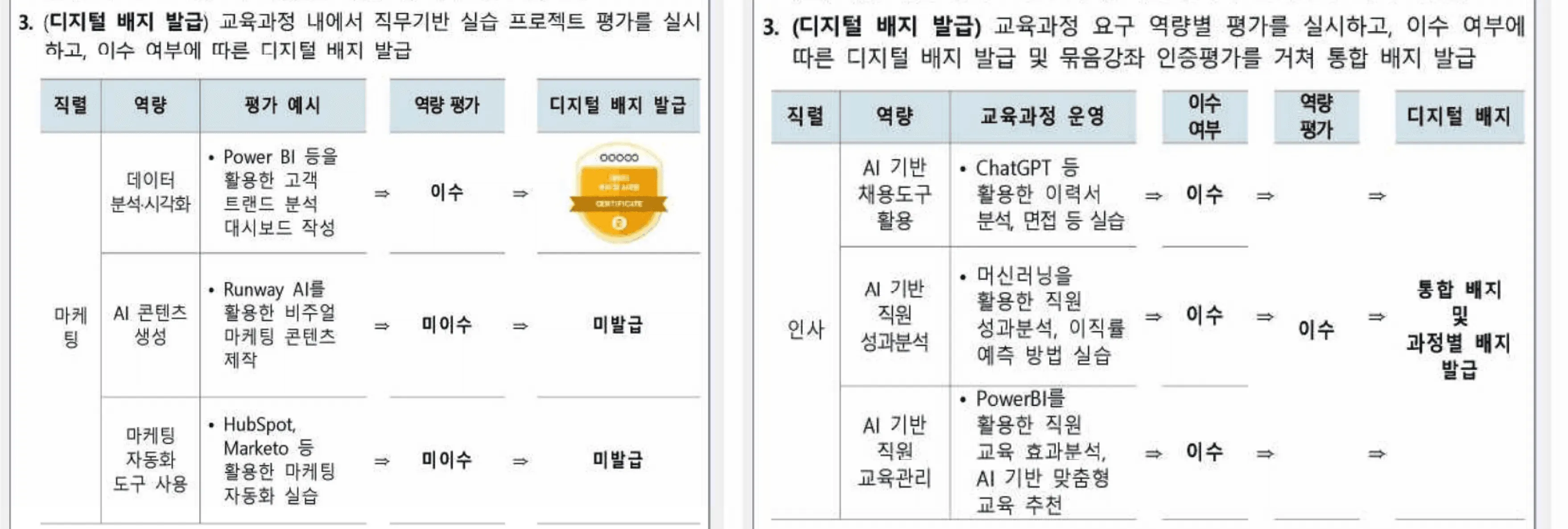
The Intensive Camp and the Bundled Courses differ in curriculum composition - but more importantly, the issuance structures the RFP itself calls for are different. You have to understand this difference from the start.
The Intensive Camp (AID 30+) derives the competencies required by job track, then conducts competency-level evaluations during a roughly four-week short, intensive course. Badges are issued only for the competencies marked “passed.”
For example, the marketing job track evaluates three competencies: “data analysis and visualization,” “AI content generation,” and “marketing automation tooling.” Each learner may pass some competencies and fail others, so the set of badges issued differs from learner to learner.
Bundled Courses group three or more courses into a job-track unit and, in addition to course-level badges, issue an integrated badge after a certification evaluation.
For the HR job track, for example, three courses - “AI-Based Recruiting Tools,” “AI-Based Employee Performance Analysis,” and “AI-Based Employee Training Management” - must all be completed and a combined certification evaluation passed before the integrated HR job-track badge is issued. The individual course badges are issued per course completed.
The difference between the two structures is not just “how many badges to issue.” The conditional branching that the issuance system has to handle is fundamentally different. If you don’t design with operational automation in mind from the start, you end up at the end of the program manually cross-checking each learner’s issuance criteria in Excel.
Competency Badges, Course Badges, Integrated Badges - How to Cut the Units
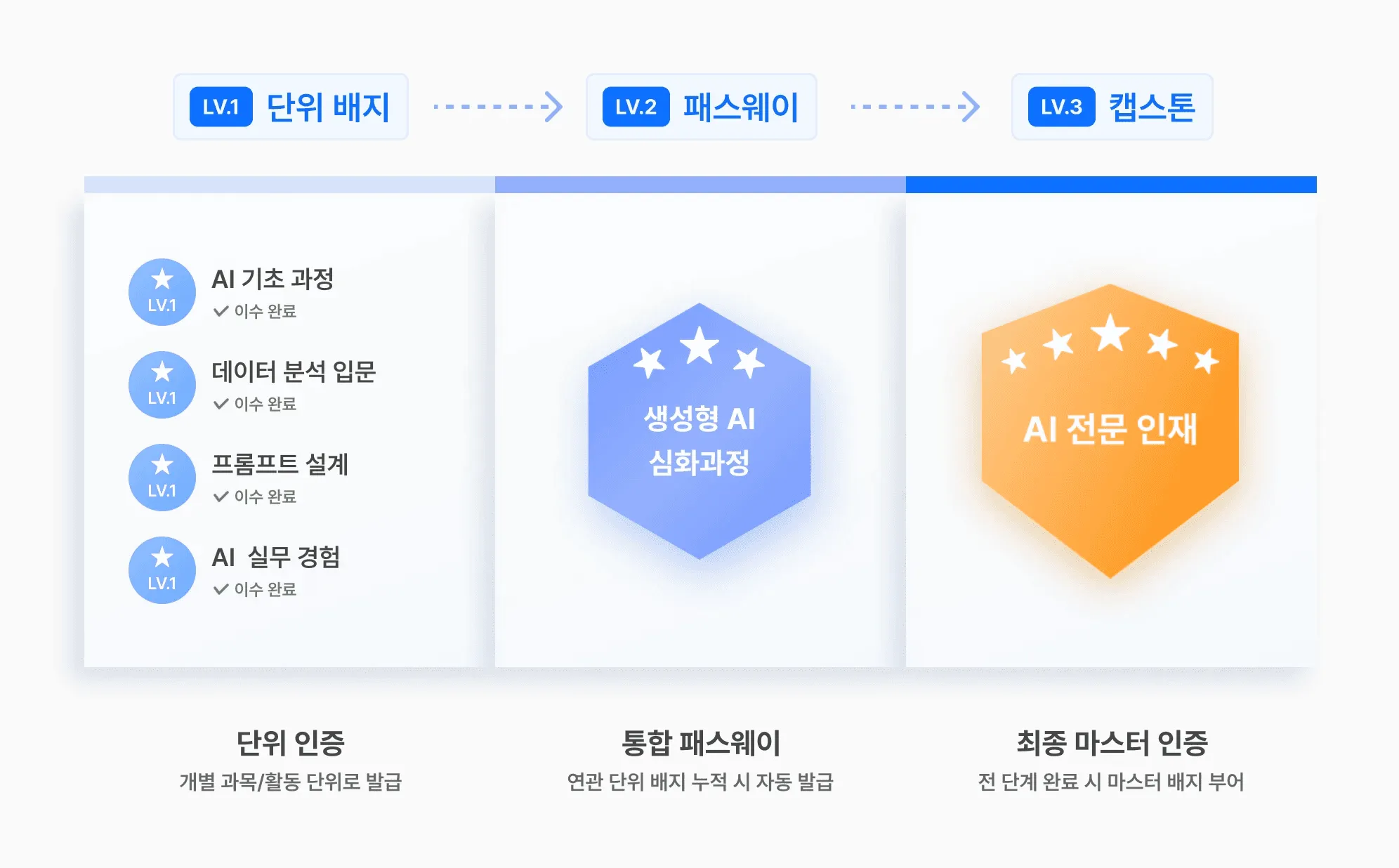
The first thing to decide when designing for AID is what unit to cut the badges along. In practice, three units are commonly used.
Competency Badge
A badge issued at the granular competency level. Best suited to the Intensive Camp structure. It shows the learner’s competencies at a point-resolution level, which gives it high utility in the job market. The “Data Analysis and Visualization Competency Badge” in the marketing job track is a typical example.
Course Badge
A badge issued upon completion of a single course or module. Corresponds to the individual courses in the Bundled Courses track. Suited to course-level operating reports, and gives learners a sense of incremental achievement. The structure looks like an “8-session Power BI/Tableau Data Visualization Course Completion Badge.”
Stackable / Meta Badge
A badge that groups multiple competencies or courses into a higher-level credential. The integrated job-track badges in Bundled Courses fall here. Accumulated completions can also evolve into a Micro-degree.
When operating all three, the key is the relationship structure between badges. The metadata must make explicit which competency badges and course badges combine to form a given integrated badge - otherwise, when externally verified, the meaning of the integrated badge cannot be precisely understood. Without that, from the learner’s perspective, what’s gained is just “three more completion certificates.”
Competency Metadata - What Should Be Included

Metadata is where a digital badge most clearly diverges from a PDF certificate. For external verification and reuse, a single badge must contain data on what the learner achieved, how, and at what level.
At minimum, AID program badges should include the following metadata.
What the program evaluation step specifically checks is “whether competency-level evaluation actually happened, and whether the evidence persists.” A badge missing evaluation information can be read in the program report as mere participation, so evaluation items must be included at the metadata-design stage.
Following 1EdTech’s Open Badges 3.0 and W3C Verifiable Credentials standards also ensures the badges are recognized identically by external systems (other universities, companies, LinkedIn), substantially increasing learner utility. It is the surest way to keep the badge alive after the program ends.
Project Submission, Evaluation, and Automated Issuance - How to Operate
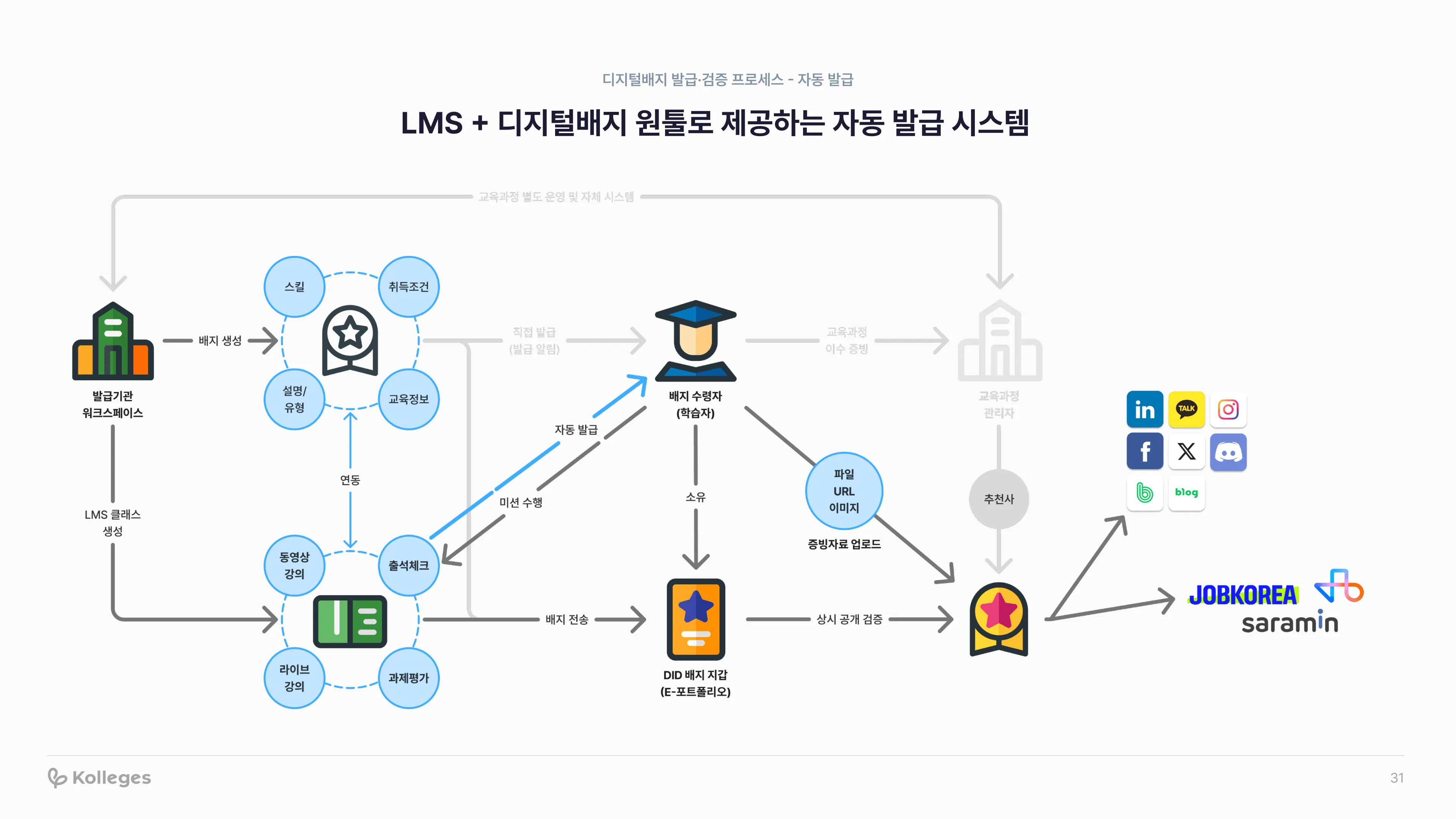
The greater operational burden in AID isn’t the issuance itself but “organizing competency-level evaluation results and then issuing the right badges per learner based on those results.” Even at 50 learners, Excel and email start to break down.
In practice, the friction points usually fall into four areas.
- 1 Where do you collect the practical assignments and group projects learners submit?
- 2 Where does the instructor or evaluator enter the evaluation result (pass/fail)?
- 3 Based on the entered results, who decides which learner receives which badge, and how is that automated?
- 4 After issuance, how do verification, sharing, and SNS exposure connect?
Kolleges handles these four steps inside a single badge home page. The learner submits per-session practical assignments (e.g., Power BI dashboard creation, Runway AI visual content) and group projects through the badge home page. On the same screen, the instructor enters pass/fail at the competency level.
When the entered evaluation results meet the pre-designed issuance conditions - for example, when “Data Analysis and Visualization Competency = Pass” is satisfied - the system automatically selects and issues the relevant badge for each learner. Composite conditions, like the integrated badge in Bundled Courses (“completion of all three courses plus passage of the certification evaluation”), can also be defined in the issuance rules in advance.
After the program ends, per-learner issuance data is reusable as program-outcome reporting data. Metrics such as completion rate by job track and competency, average completion hours, and integrated-badge issuance rate no longer need to be tallied separately by the program office.
The downstream effect after issuance is also significant. When learners share badges via SNS, resumes, or LinkedIn, the program name and operating university name are naturally surfaced alongside. For the Youth Startup Academy completion badges, more than 70% of graduates are using them on external channels - designing AID in the same direction captures post-program publicity as well.
Frequently Asked Questions
Q1. Should we design the digital-badge system before the AID program starts?
The cleanest approach is to set the badge units during the job-analysis and required-competency stages. Course evaluation sheets and badge-issuance conditions then align as one flow. Even if the program is already underway, it’s not too late - you can reverse-map evaluation items to design the badge structure.
Q2. If a single learner completes multiple job tracks or courses, how are badges issued?
Competency badges and course badges are all issued separately, and once integrated-badge conditions are met, the integrated badge is issued in addition. Because metadata records the program name, year, and cohort together, the learner can track stepwise growth history in their own e-portfolio.
Q3. Can issued digital badges carry over into next year’s AID program?
Badges issued under international standards such as Open Badges 3.0 retain the issuer and year as data, so they are managed alongside new badges as the learner’s cumulative record. Even after the program ends, badges do not disappear - learners can continue using them in resumes, LinkedIn, and portfolios.
Designing the AID Program’s Digital Badge System - Together
Designing the digital-badge system for AID 30+ Intensive Camps and Bundled Courses is the work of building an asset that remains with the learner after the program ends. Drawing on experience operating job- and competency-unit badge issuance at more than 200 universities, public institutions, and education companies, Kolleges supports badge-system design tailored to the AID program structure, alongside project evaluation and automated issuance.
Get a free customized badge-system design for your university
Frequently asked questions
Want to turn learning outcomes into verifiable assets?
From issuing to verifying and amplifying, see it for yourself with Kolleges.
Request a Kolleges demoRelated posts

A 10-Point Digital Badge Design Checklist for Your Institution
Badge programs fail not from bad technology but from skipping design-stage decisions; this 10-point checklist helps institutions build badges that recipients actually use and share.

What is the AID 30+ Intensive Camp? 2025 Selected Universities and Program Areas
In 2025, 20 Korean universities run the Ministry of Education's AID 30+ Intensive Camp - short-form AI and digital upskilling for working adults, with verified digital badges as proof of competency.

Inside Korea's 2026 AI·D Intensive Programs for Working Adults
Korea's 2026 AI·D intensive programs require universities to build digital badges into curriculum design, evaluation, and outcome diffusion from day one - not treat them as post-completion paperwork.