
What is the AID 30+ Intensive Camp? 2025 Selected Universities and Program Areas
In 2025, 20 Korean universities run the Ministry of Education's AID 30+ Intensive Camp - short-form AI and digital upskilling for working adults, with verified digital badges as proof of competency.
With AI and digital transformation accelerating faster than ever, employees, business owners, and freelancers already in the workforce now risk falling behind in productivity and career competitiveness unless they pick up new skills.
But reality is busy. It’s hard to invest time in long-form programs, and it’s not easy to find training that connects directly to real work.
To address this, the Ministry of Education and the National Institute for Lifelong Education launched a national program: the AID 30+ Intensive Camp.
2025 marks a turning point - the participating universities and program offerings have expanded, providing adult learners with substantive digital capabilities.
In this post we cover what the AID 30+ Intensive Camp is, the 2025 selected universities, representative training areas, and the role of digital badges in proving these outcomes.
What is the AID 30+ Intensive Camp?

The AID 30+ Intensive Camp is a short-form, intensive practical digital training program of four weeks or less aimed at adults aged 30+.
It’s a hands-on program designed for rapid AI and digital skill acquisition with immediate workplace application, overseen by the Ministry of Education and the National Institute for Lifelong Education.
✔ Who is it for?
-
Working adults aged 30+
-
Self-employed and small business owners
-
General office and field-job workers
-
Adult learners who need to acquire new technical skills
✔ How is it delivered?
-
Blended learning combining online and offline
-
Project-based hands-on instruction
-
Industry partnership assignments included
-
A “build-and-apply” learning structure, not just lectures
✔ How are learning outcomes certified?
Every graduate receives a Digital Badge.
This isn’t a simple certificate of completion. It’s a verifiable digital credential containing:
-
Learning content
-
Project outcomes
-
Acquired skills
-
Evaluation criteria
It proves not just “I took the course” but “this is what I can do.”
2025 AID 30+ Intensive Camp Selected Universities and Representative Program Areas
As of 2025, 100 universities nationwide are included in the AID system, and 20 of those have been selected to operate the intensive camp.
Below we introduce three universities whose programs map clearly to their regional industries.

🏫 Konyang University - Digital Practical Training Tailored to Chungnam Regional Industries
Konyang University operates digital training with high practical applicability for manufacturing, defense, and marketing professionals across the Chungcheong region.
Representative program areas
-
Manufacturing equipment data analysis
-
Marketing automation and analysis
-
Military simulation-based information systems
Features
-
Heavy emphasis on practical projects
-
Partnerships with NAVER Cloud and the Daejeon Chamber of Commerce and Industry
-
Hybrid online + offline delivery
The structure allows learners to test and apply skills immediately on the job, producing significant real-world competency gains.

🏫 Kyungil University - Digital Transformation for Social Welfare
Kyungil University delivers AI and automation training specialized for the social welfare sector.
Target audience
- Workers at regional social welfare institutions
Curriculum
-
Generative AI applications
-
RPA (Robotic Process Automation) for administrative efficiency
Features
-
Practical curriculum grounded in social welfare field needs
-
Close partnerships with regional affiliated institutions
The content centers on practical work - welfare administration, report writing, data management - yielding immediate productivity gains on the job.

🏫 Dongwon Institute of Science and Technology - Practical Training Available After Work and on Weekends
Located in Yangsan, Gyeongnam, Dongwon Institute of Science and Technology (Dongwon ITT) has earned high satisfaction scores with its evening/weekend-focused hybrid delivery, designed around the schedules of working adults.
Representative program areas
-
Excel automation powered by generative AI
-
Marketing automation using ChatGPT
-
Predictive maintenance and data analysis for manufacturing
Strengths
-
Nine practical courses in total
-
Composition that directly benefits the self-employed and SMB workers
-
Strong emphasis on hands-on generative AI practice
These are skills that translate directly into productivity gains and revenue growth - drawing particularly strong interest from smaller businesses.
The AID 30+ Education System - Why It Matters

AID 30+ is not just vocational education.
It’s a core national project to pivot Korea’s adult learning system toward digital.
The Ministry of Education operates universities under the following structure.
| Type | Number Selected | Key Focus |
|---|---|---|
| AID 30+ Intensive Camp | 20 institutions | Intensive digital training for working adults 30+ |
| Digital Transformation Focused Junior Colleges | 30 institutions | Field-based practical training |
| AID Course Package Universities | 20 institutions | AI·Digital course packages |
| MOOC Leading Universities | 15 institutions | Expansion via open online courses |
| Match-up Consortia | 5 | Industry-collaborative practical courses |
| Digital Innovation Cyber Universities | 10 institutions | Remote-based adult-tailored education |
Through this system, adults can access highly accessible digital education regardless of location or circumstance, and have their outcomes formally certified.
The AID Career Jump Pass and the Importance of Digital Badges
Completing AID 30+ training opens up - via the Career Jump Pass -
-
Job changes
-
Career pivots
-
Role expansion
-
Re-entry into the workforce
-
a variety of paths where you can prove your competencies.
At the center sits the Digital Badge.
The value digital badges deliver
In other words, if AID 30+ delivers the learning,
digital badges are the proof tools that turn that learning into opportunity.
How is Kolleges used?
Kolleges is a digital badge platform that helps universities operating AID 30+ programs run:
-
Digital badge issuance
-
Learning outcome management
-
Credential history records
-
Employment-linked use cases
-
easily and systematically.
Learners can use their issued badges immediately on LinkedIn, portfolios, and career documents,
making them competitive assets in actual job placement and career transitions.
The future of adult learning moves from “digital competency” to “digital certification”
AI and digital skills are becoming essential across every industry.
And we’ve entered an era where proving what you can do with those skills matters more than how much you know.
The AID 30+ Intensive Camp is the country’s flagship program for helping adult learners rapidly acquire the competencies they need in the digital transformation era.
And the most credible way to prove that outcome is the Digital Badge.
Together with AID 30+, Kolleges will continue
expanding opportunities for adult learning,
elevating the value of learning histories,
and supporting more learners as they build paths to career transitions and growth.
Frequently asked questions
Want to turn learning outcomes into verifiable assets?
From issuing to verifying and amplifying, see it for yourself with Kolleges.
Request a Kolleges demoRelated posts
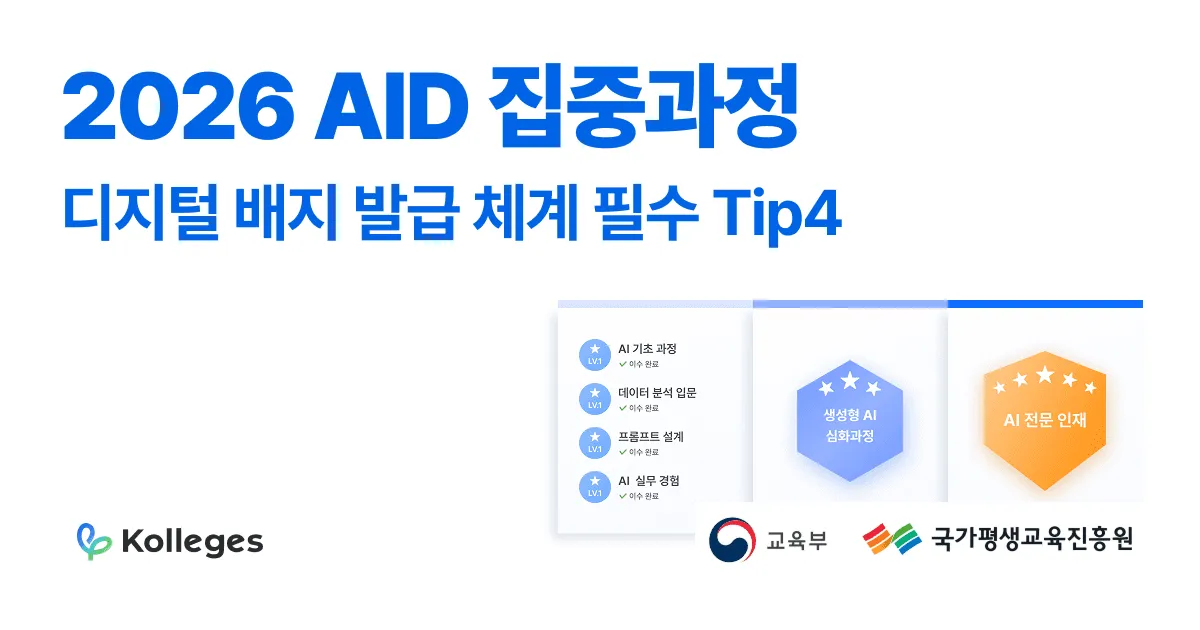
Designing the Digital Badge System for AID 30+ Intensive Camps and Bundled Courses
Design competency, course, and integrated badges for AID 30+ and Bundled Courses with the right metadata and automated issuance rules to satisfy both program evaluation and learner utility.
Inside Korea's 2026 AI·D Intensive Programs for Working Adults
Korea's 2026 AI·D intensive programs require universities to build digital badges into curriculum design, evaluation, and outcome diffusion from day one - not treat them as post-completion paperwork.

What Is the RISE Project? Seoul's Selected Universities and Key Strategic Directions
Seoul selected 35 universities under RISE to align higher education with regional industry needs, investing 76.5 billion KRW across five strategic priorities including AI talent development.