
Inside Korea's 2026 AI·D Intensive Programs for Working Adults
Korea's 2026 AI·D intensive programs require universities to build digital badges into curriculum design, evaluation, and outcome diffusion from day one - not treat them as post-completion paperwork.
What university industry-academia foundations, lifelong learning centers, and faculty should check now to raise selection odds
1. The Big Picture: Recurrent Education for Working Adults - Short, Intensive, Evenings and Weekends
This program supports recurrent education for working adults who use weekday evenings and weekends for short, intensive learning that they can apply directly to their jobs. “Make a good lecture and you’re done” is not the model.
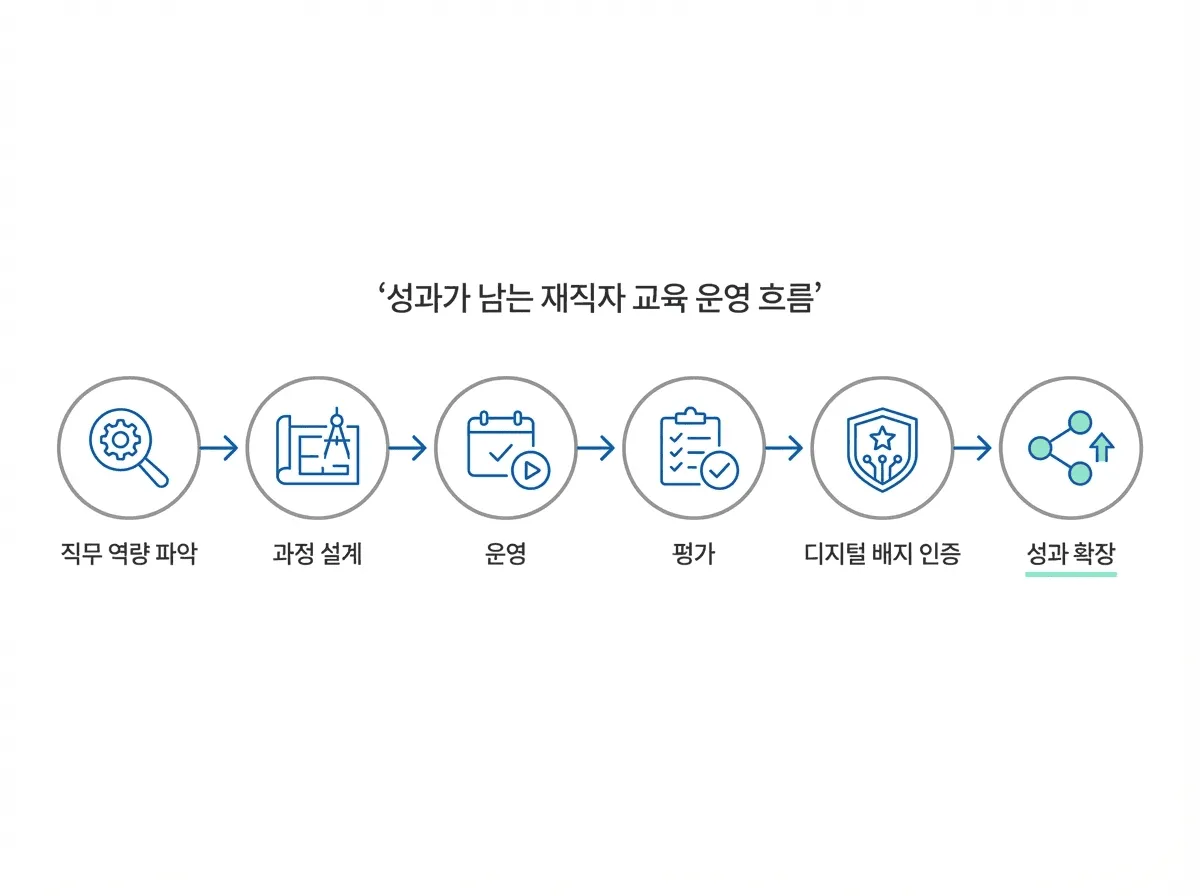
The flow required is consistent: identify job competencies → design the curriculum → operate → evaluate → credential (digital badges) → diffuse outcomes.
From the perspective of industry-academia foundations and lifelong learning centers, the reviewers look at three things:
-
Did you substantiate job demand grounded in regional industry?
-
Did you design a structure where outcomes accumulate and are shared?
-
Is the execution capacity with partner organizations (companies, associations, public bodies) visible?
2. Comparing the Two Tracks: Intensive Camp vs. Bundled Courses
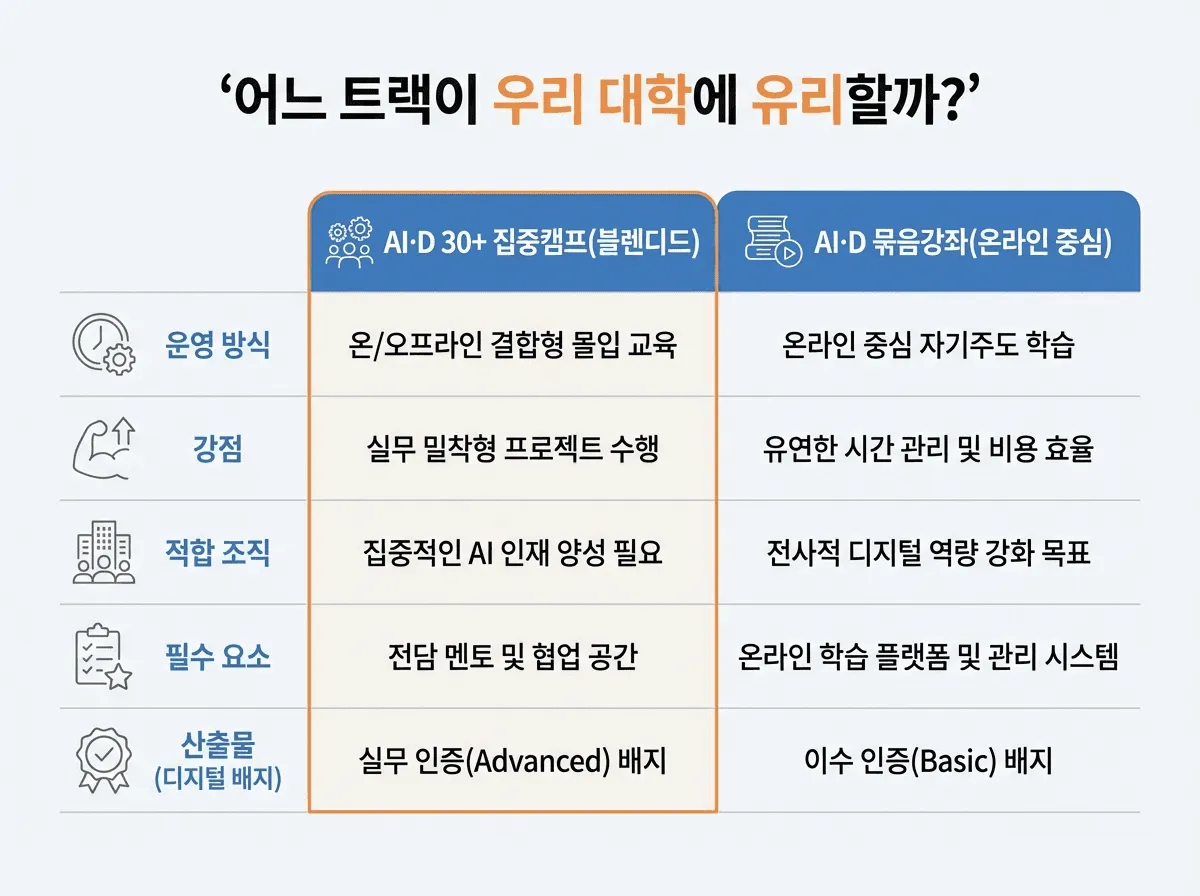
A. AI·D 30+ Intensive Camp (blended)
A short, intensive format of around four weeks, with on/offline operation. With roughly one to two universities per region and a total of about five universities selected, competition is relatively fierce.
The core is offline practice, mentoring, and project-based evaluation. Outcomes are issued and managed as digital badges.
Best fit for: universities with the physical practice space, equipment, and mentor pool in place; organizations confident in designing project-based job training linked to regional industry.
B. AI·D Bundled Courses (online-centric)
Roughly three courses grouped by job-area core competencies, delivered online. Course-level budgets are fixed, which favors universities that already have an online course library.
The key is to present a completion roadmap structured as foundations-application-advanced, and to connect course-level badges to an integrated badge earned upon full completion.
Best fit for: universities with established remote/online lecture-production capacity; organizations able to redesign existing courses into a bundled structure with credentialing.
3. Why Digital Badges Matter in This RFP
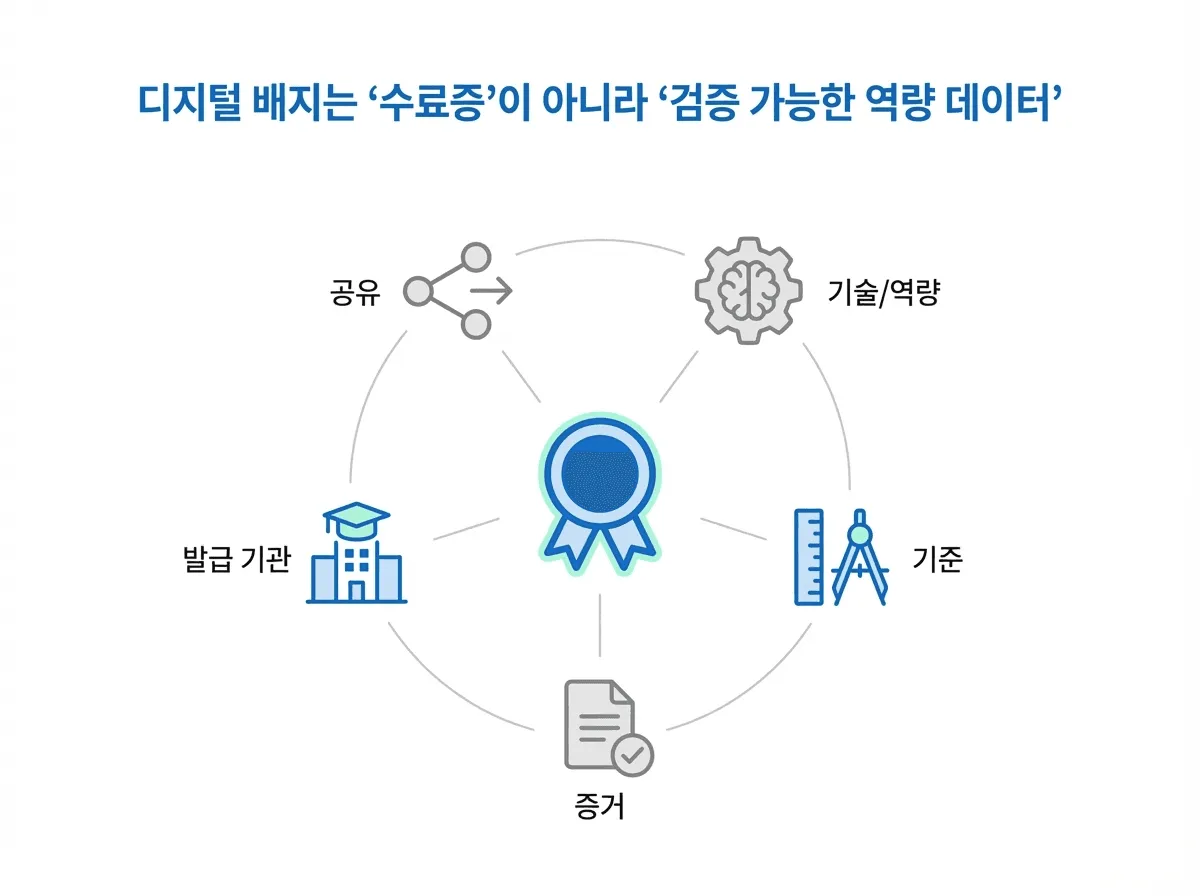
The RFP is explicit: completion outcomes are to be evaluated, and digital badges are to be issued and managed in the name of the university president. A well-designed badge captures four things:
- What competency, with what evaluation criteria, with what evidence, verified by whom
When this structure actually works, a virtuous cycle forms.
-
Learners: less cost to explain their competencies during career moves, promotions, or project staffing.
-
Universities: outcome diffusion and next-cohort recruiting connect naturally.
-
Companies and associations: completion is trusted as evidence of capability.
Treating digital badges as “post-completion paperwork” only adds to the operational burden. They have to be embedded into the course design from the start for outcomes to look different.
4. Read the Evaluation Criteria in Reverse and the Proposal Writes Itself
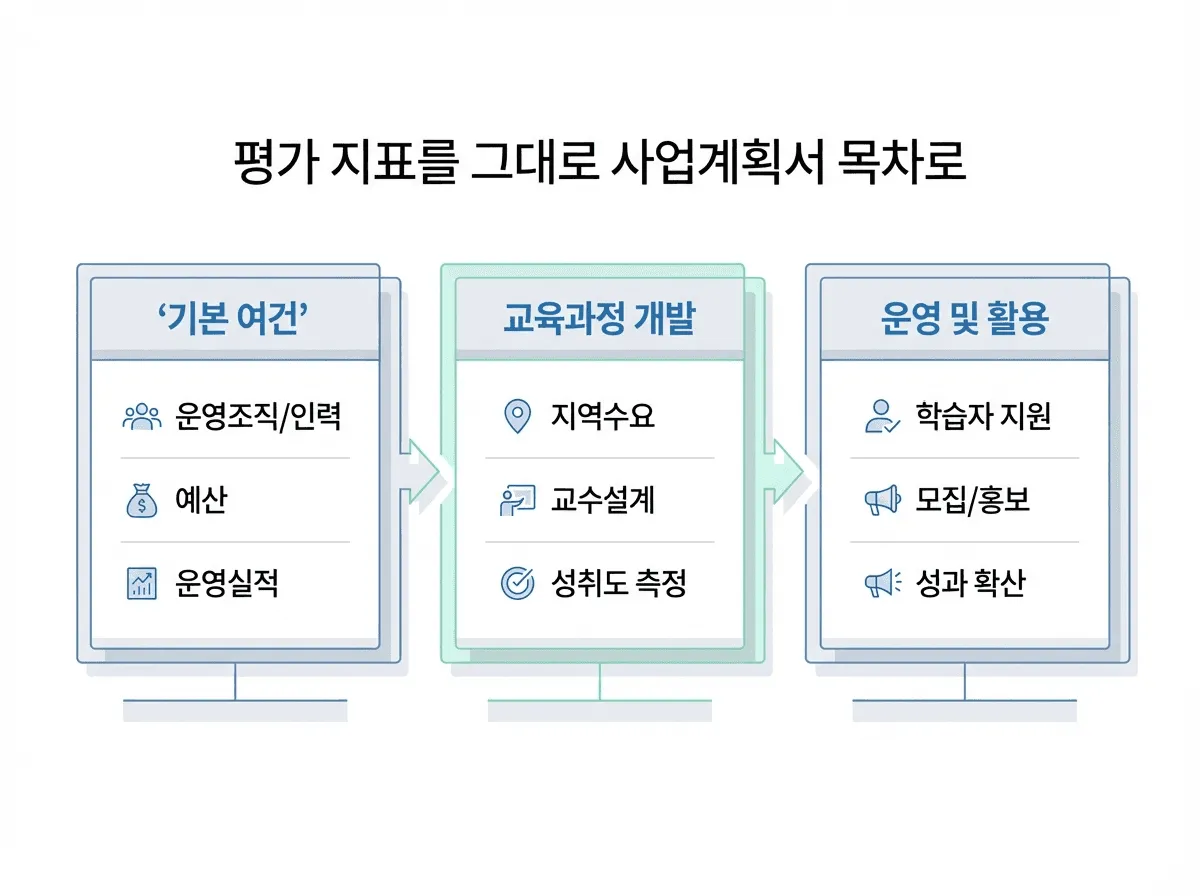
(1) Basic Conditions: Operating Org, Staff, Budget + Past Performance
“We’ve taught AI courses” is less persuasive than concrete documentation of operational experience with working adults, cases of preventing dropout, and a track record of running projects and mentoring.
(2) Curriculum Development: Regional-Industry Rationale + Instructional Design + Achievement Measurement
Digital-badge design is a powerful weapon for this section. The very structure - “which skill, evaluated how, results in which badge” - is the achievement-measurement plan.
(3) Operations and Utilization: Operations Management + Learner Support + Outcome Diffusion
Outcome diffusion is not a press release. When a sharing flow happens naturally at completion - a badge verification page, a portfolio link - operational outcomes become visible.
5. A 10-Item Execution Checklist
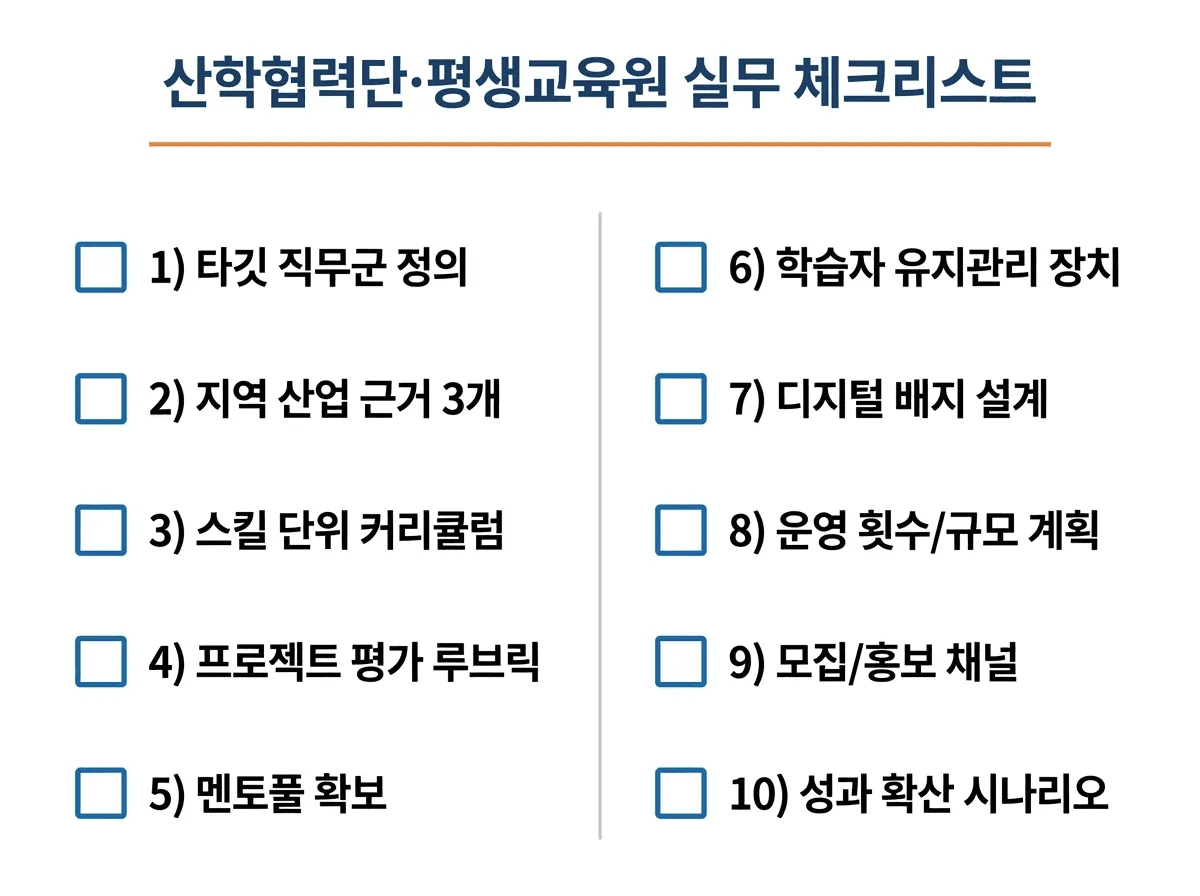
- 1 Define the target job groups - Finalize the job categories and tracks, centered on 30+ working adults
- 2 Three pieces of regional-industry evidence - One industry statistic, one company interview or demand letter, one prior partnership track record
- 3 Decompose the curriculum into skill units - Redesign learning units for a short, intensive format
- 4 Project-evaluation rubric - Summarize deliverable criteria (quantitative and qualitative) on a single page
- 5 Secure a mentor pool - Clarify field-mentor roles, time, and compensation in advance
- 6 Learner-retention flow - Pre-assessment → module quizzes → formative evaluation → final evaluation
- 7 Digital-badge design - Per-course vs. integrated badge, define metadata (skills and evidence)
- 8 Cohort operating roadmap - Frequency and size, including online and offline sections
- 9 Recruiting and outreach channels - Concrete list, including corporate HR, associations, local governments, alumni networks
- 10 Outcome-diffusion scenario - A one-pager on ‘where the graduate’s outcomes live, who uses them, and how’
6. Four Design Principles That Make Digital Badges an Outcome Engine
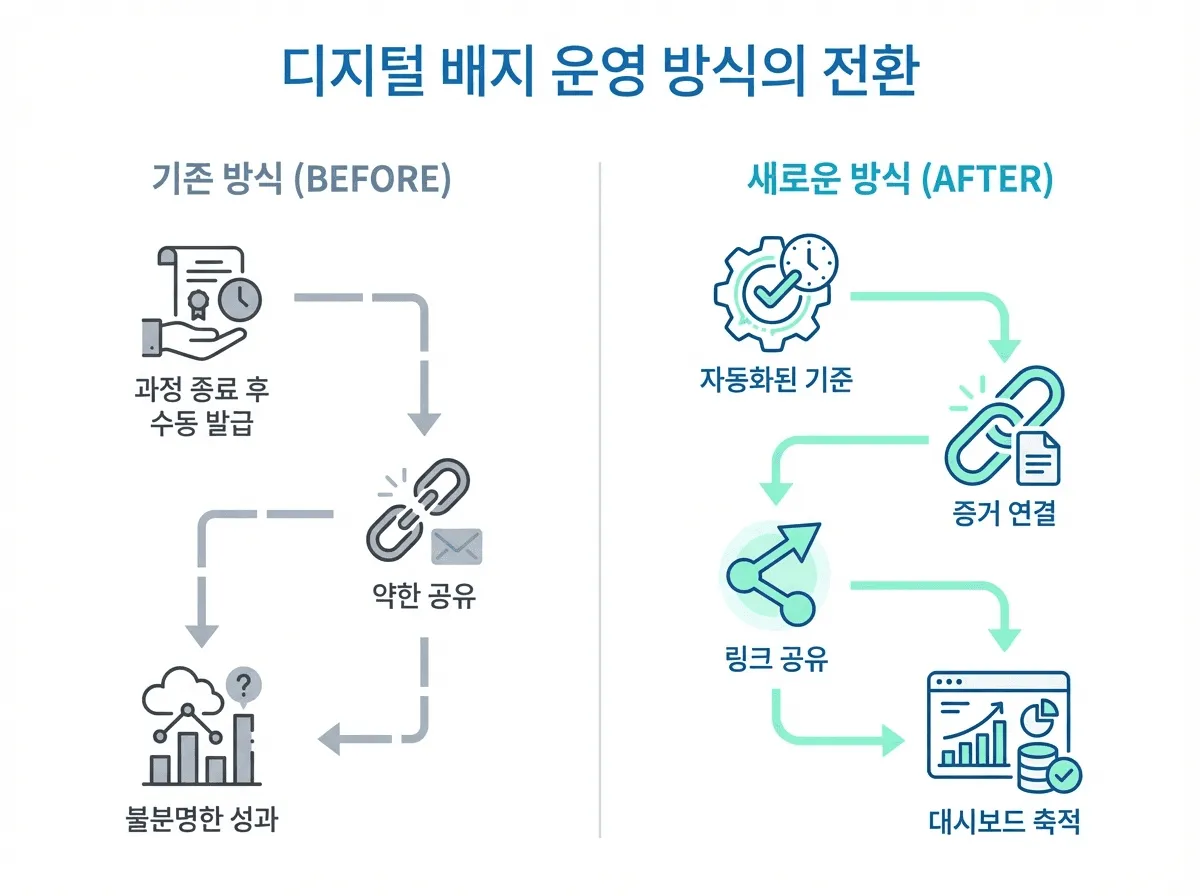
-
Automate issuance criteria - when assignments and evaluation criteria are met, the issuance process triggers consistently
-
Connect evidence - include project-deliverable links and evaluation sheets in the badge metadata
-
Fix the sharing path - provide a verification page that graduates can share by link immediately
-
Build an institutional outcome dashboard - reflect competency-acquisition trends in the next cohort design
Wrapping Up: What Matters More Than Selection Is Whether Outcomes Persist
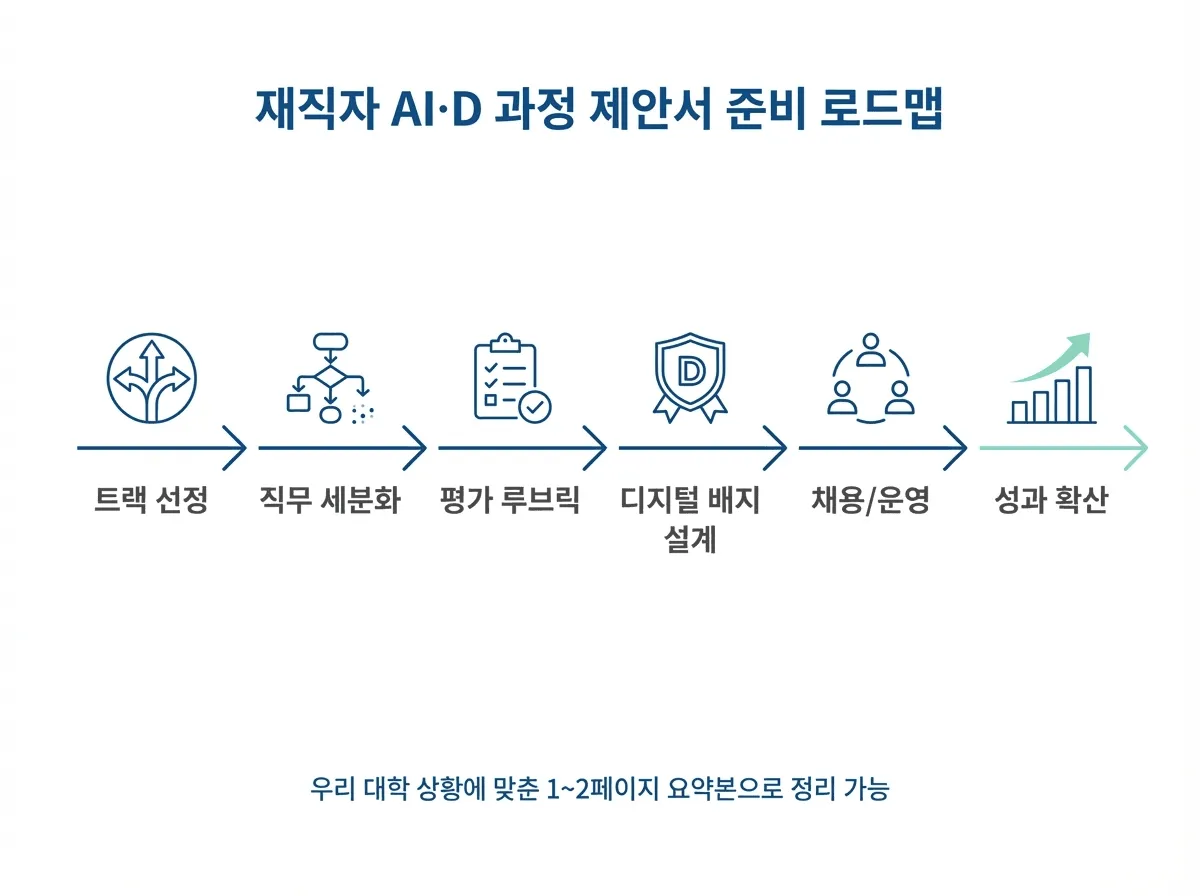
This RFP is a funding opportunity, but it is also an opportunity to redesign recurrent education around outcomes. The core of the preparation is one thing.
Complete the education not as content, but as verifiable competency data.
We can help you organize your courses and industry-academia projects against the evaluation criteria and decide how to connect digital badges to your course design. Get in touch.
Frequently asked questions
Want to turn learning outcomes into verifiable assets?
From issuing to verifying and amplifying, see it for yourself with Kolleges.
Request a Kolleges demoRelated posts
What is the AID 30+ Intensive Camp? 2025 Selected Universities and Program Areas
In 2025, 20 Korean universities run the Ministry of Education's AID 30+ Intensive Camp - short-form AI and digital upskilling for working adults, with verified digital badges as proof of competency.
What Is AI Literacy: The New Baseline Skill for Practitioners in 2026
AI literacy - the capacity to understand, apply, and critically evaluate AI outputs - is now the baseline work skill across all job roles, not just technical ones.

What's Changing in Korea's 2026 Youth Policy
Korea's 2026 youth policies ramp up AI education, regional employment incentives, and startup support, making verifiable experience credentials a decisive competitive advantage.