
Digital Badge Market Size 2025: 320M Issued, 1.7M Badge Types Live | A 1EdTech Report Analysis

The 2025 Badge Count report (1EdTech + Credential Engine) shows 320M digital badges issued globally - a 13x rise since 2018 - with 1.7M live badge types and 74% of badges shared via social media.
Digital badge market size 2025: an era of 320M issuances and 1.7M live badge types
The education is over, but the achievement doesn’t stick.
A certificate gets issued, but what the person can actually do scatters. As a result, individuals end up explaining themselves every time, and institutions, even as they prepare the next cohort, face the same questions again.
The way to break this loop is surprisingly simple.
Leave the achievement as “verifiable, shareable data.”
That’s exactly why the digital badge market is drawing attention now. As of 2025, digital badges are no longer an experiment - they have become a global standard.
This article uses data from 1EdTech and Credential Engine’s Badge Count 2025 to walk through how big the digital badge market has grown - clearly, using only the key numbers.
The 5 key numbers in the 2025 report on digital badge market size
1️⃣ Total badge achievements issued worldwide: 320,489,690
According to the combined responses of 24 digital badge platform providers, 320,489,690 digital badges have been issued worldwide.
Put simply, the number itself shows that digital badges are no longer at “experimental stage.”
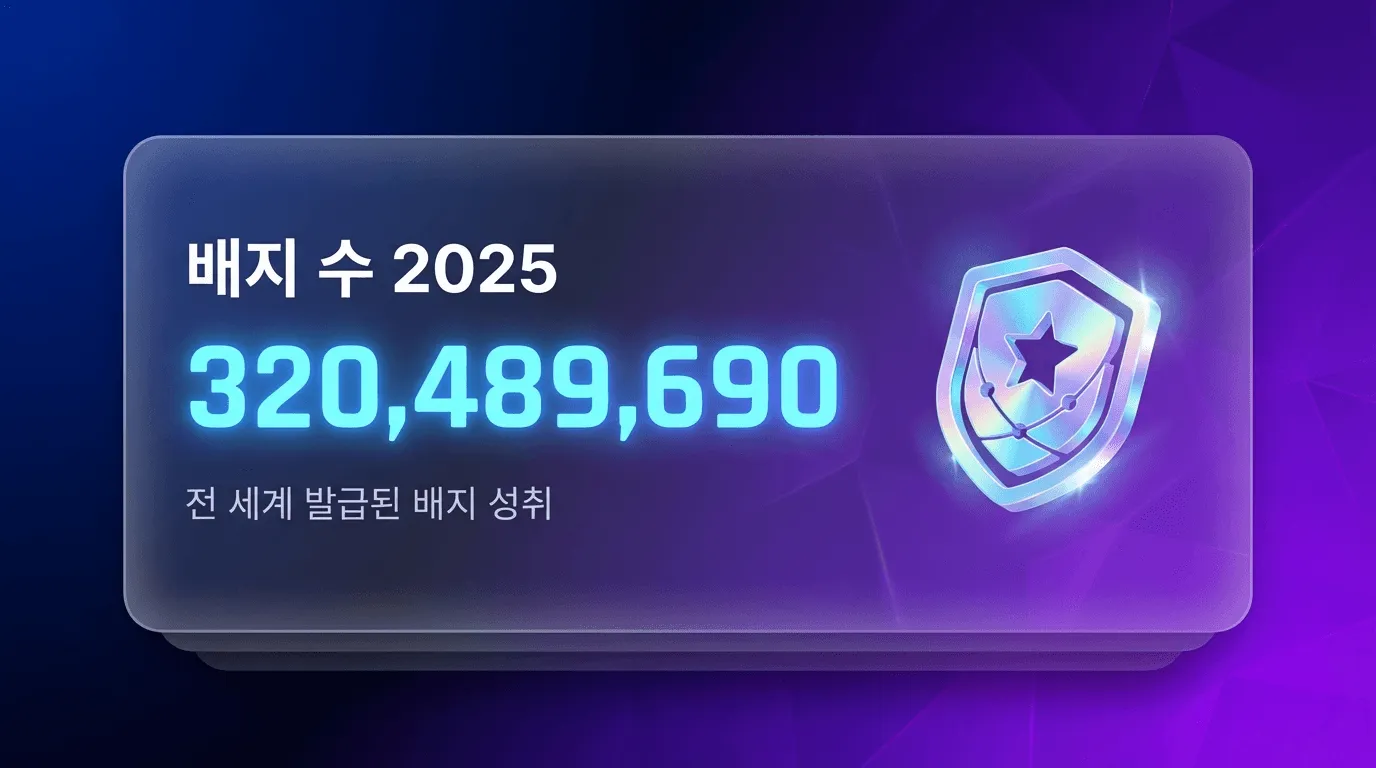
As of 2025, global badge achievements issued are reported at the 320M scale.
This scale goes beyond simply “a lot” - it is evidence that digital badges are working as a real means of verification in the education, credentialing, and hiring ecosystem.
2️⃣ Growth rate: from 24.1M in 2018 to 320.4M in 2025
The digital badge market is growing at a steep slope. Annual issuance (awarded) by year:
-
2018: 24,100,000
-
2020: 43,300,000
-
2022: 74,700,000
-
2025: 320,400,000
That’s a roughly 13x+ increase compared to 2018.
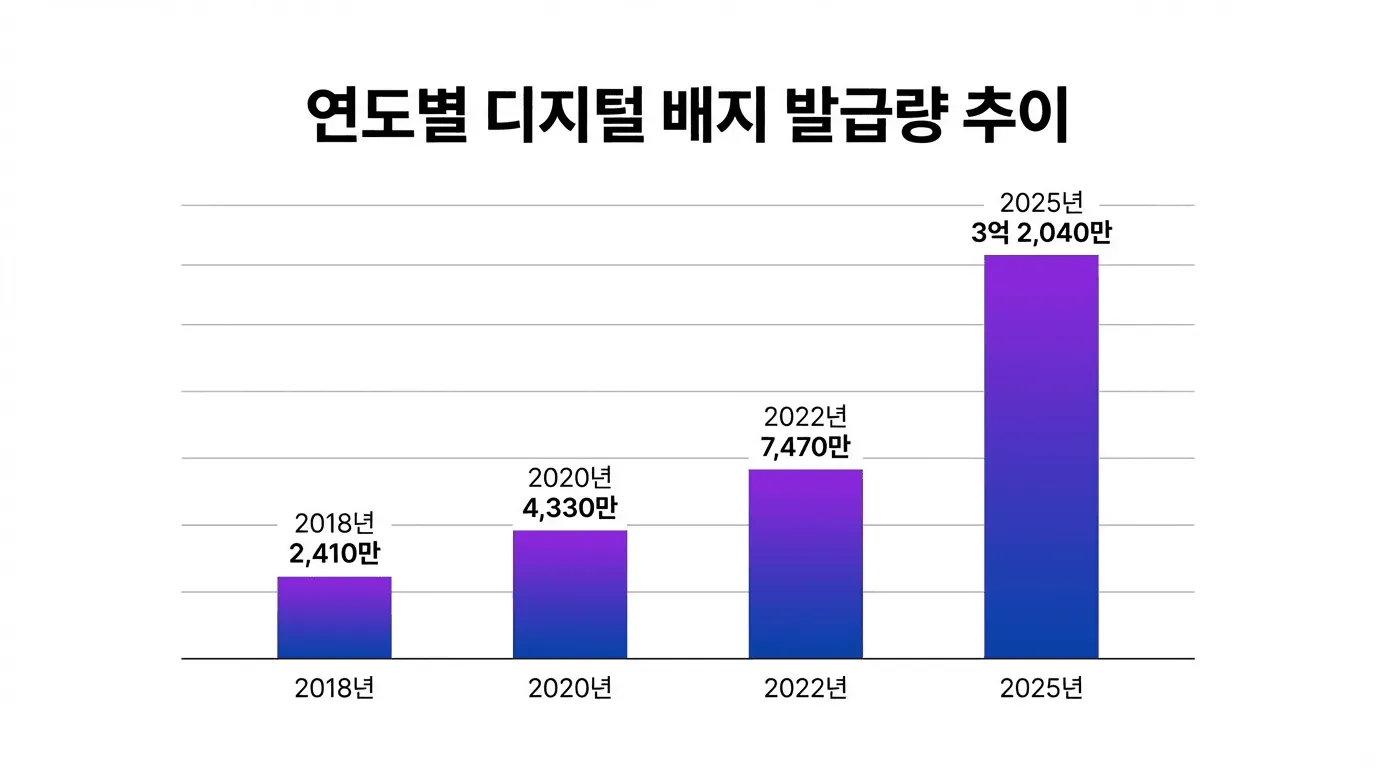
Issuance expands sharply in 2025.
What this trend means is clear.
The digital badge market isn’t growing “a little at a time” - it’s growing fast enough to change how things are actually run.
In particular, after 2020, demand for remote education and online certification exploded due to the pandemic, and digital badges began establishing themselves as essential infrastructure at companies, universities, and government agencies.
3️⃣ The number of live badge types is also surging: 1,708,774
The number of digital badge types currently in operation worldwide is reported at 1,708,774.
In other words, separate from the “number of issuances,” there are over 1.7M distinct badge designs / catalog entries in existence.
(For reference, the number of badge types in the United States alone is reported separately as 1,022,028.)
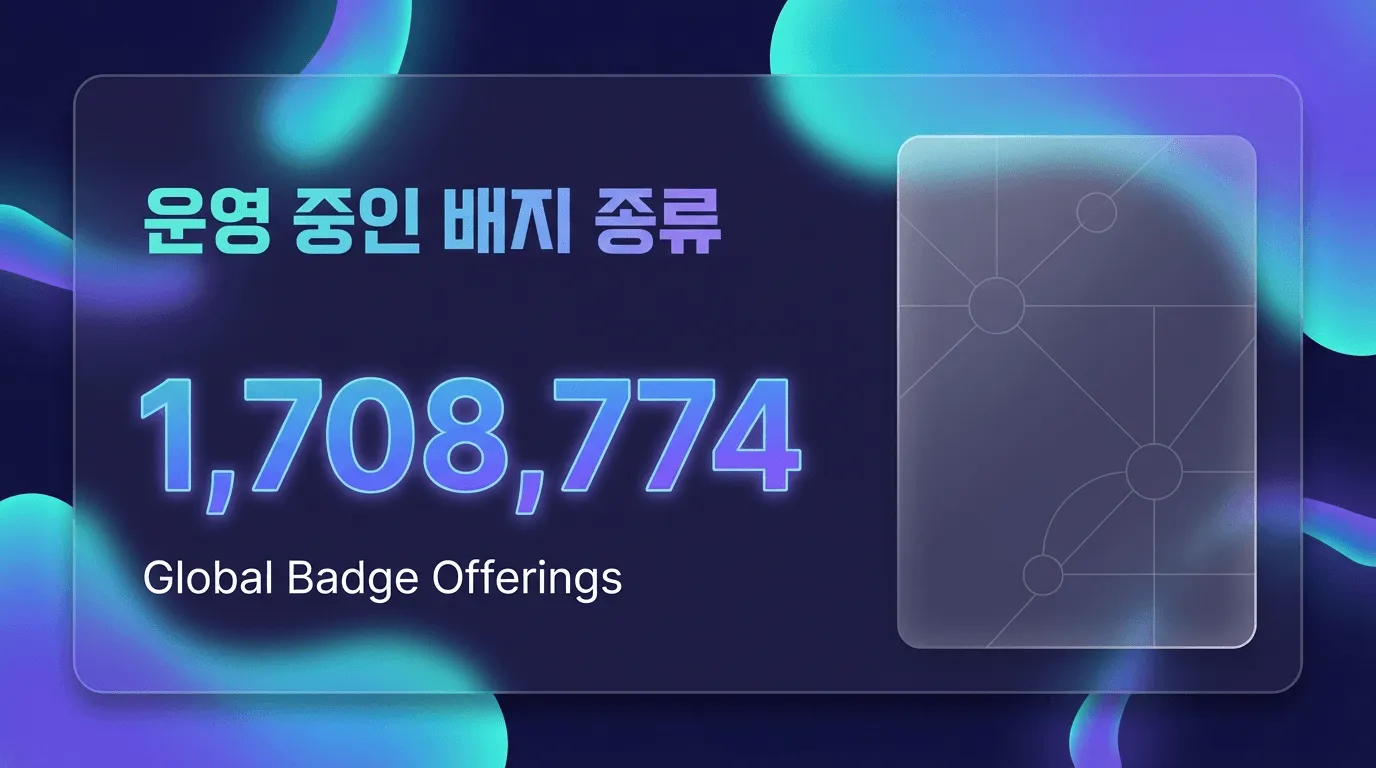
This figure shows that the digital badge market has grown not just in issuance count but also from the perspective that applications and badge designs have exploded.
It is evidence that programs which used to end with “one certificate” are now shifting to fine-grained badge systems segmented by competency and stage.
4️⃣ Top sharing channel: social media, 74%
The channel where digital badges are most often shared is social media, at 74%.
Next come digital wallets / e-portfolios at 68%, and email at 37%.
The conclusion is simple.
Digital badges aren’t done at “issuance” - they are a structure whose value grows from the moment they are shared. That’s why, when evaluating the digital badge market size, you have to look at issuance volume together with the distribution channels.
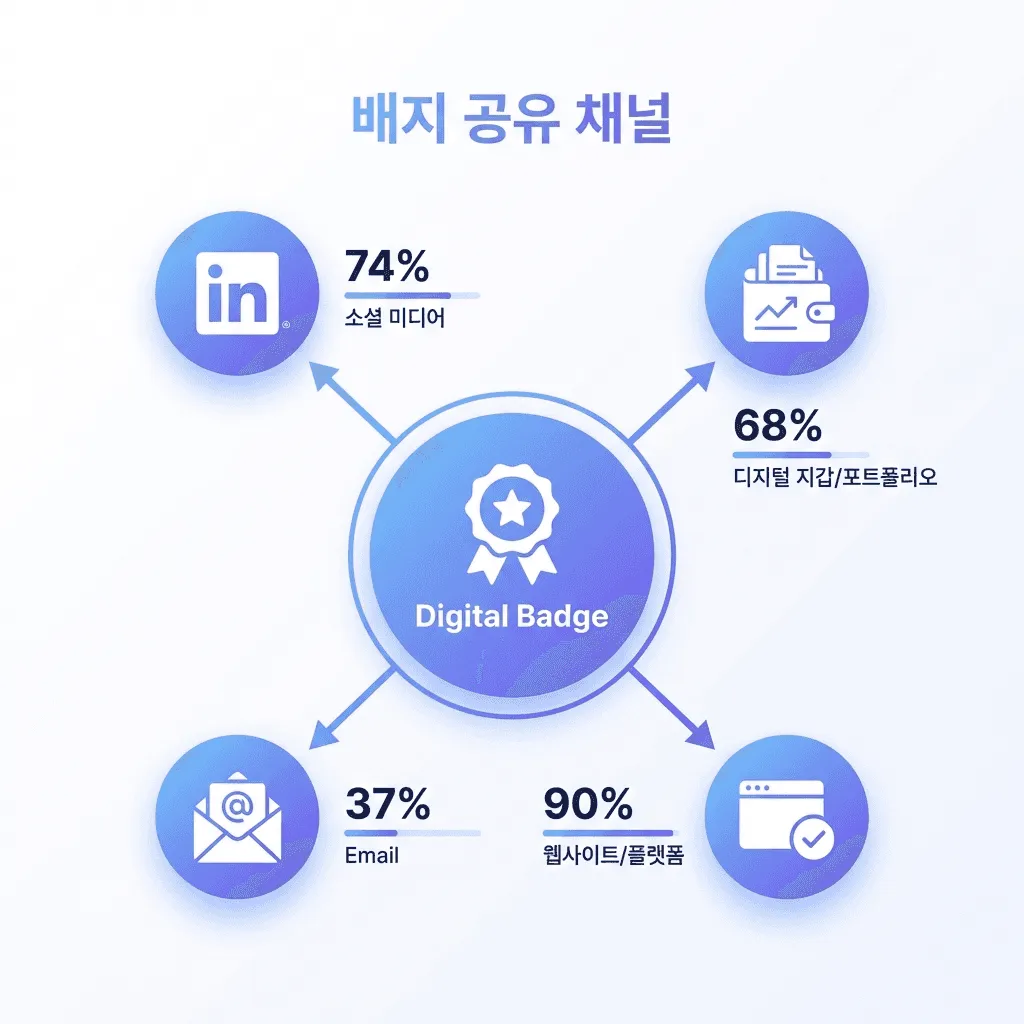
In particular, social sharing centered on LinkedIn shows that digital badges are functioning as a real means of verification in the employment and job-change market.
5️⃣ Issuer scale: 97,714
The organizations actually issuing digital badges (schools, institutions, associations, companies, public agencies, etc.) - i.e., issuers - total 97,714 worldwide.
The report also notes that the same issuer may use multiple platforms, so “duplication is possible.”
Even so, one thing is clear.
The base of issuers has already broadened significantly.
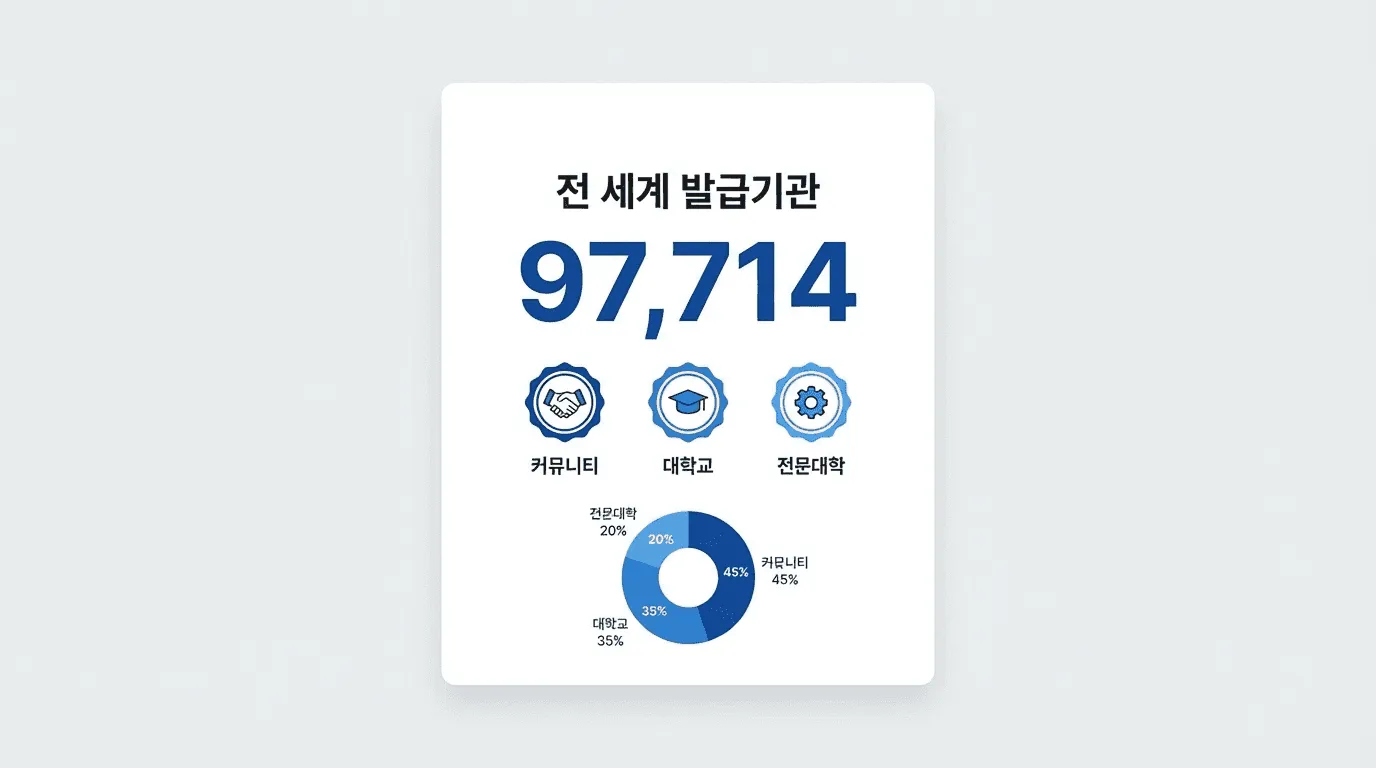
A diversifying base of issuers means digital badges are spreading across the board, not confined to specific industries or fields of education.
What “direction of expansion” do the numbers reveal?
Badge Count 2025 also shows which achievement types digital badges most often encode.
The achievement types respondent platforms most often answered they “issue most” are overwhelmingly two:
-
Skills / competency demonstration: 90%
-
Short micro-credentials: 81%
The direction this implies is clear.
Digital badges spread fastest in modes that break small achievements into pieces and record and verify them often, rather than capping a single big qualification.
That’s why digital badges work particularly strongly in the following areas.
✅ Educational institutions: extracurriculars, field practicum, capstones - activities where outcomes are varied and need to be explained ✅ Corporate training: in-house completion, role certification, partner certification - processes where short achievements repeat
In short, the core direction of digital badge expansion is splitting up achievements and certifying them, not certifying “completion.”
Three takeaways that matter in practice
1) As issuance grows, “operations” becomes the bottleneck first
In an environment where the digital badge market grows to the scale of 320M issuances, what determines success isn’t “do we have an issuance feature” but “how stably do we run operations.”
In particular, as issuance grows, these tasks explode all at once:
-
Recipient eligibility checks (who is eligible to receive)
-
Reissuance and revocation handling (responding to errors, omissions, and changes)
-
Inquiry handling (questions from graduates, institutions, and companies)
-
Authenticity checks (operating the verification page and verification links)
In other words, operational design comes before “issuance” for digital badges.
If you don’t design an automation structure in the early stages, the more issuance grows, the more the recurring operational work for the responsible person grows exponentially.
2) If sharing is social-driven, design must shift to “sharing” as the standard
The fact that the report’s top sharing method is social at 74% means digital badges actually function as a means of verification used in the hiring and job-change channel.
But if institutions handle digital badges only as “completion processing,” they get issued - but sharing doesn’t happen naturally.
-
If there’s no share button, or
-
the verification page is hard to read, or
-
the badge doesn’t clearly contain “what was done,”
learners feel no reason to spread it. As a result, you miss the core opportunity for expansion.
3) Standard migration (Open Badges 3.0) isn’t something to “clean up later”
The report explains that Open Badges 2.0 was replaced by Open Badges 3.0 in 2024, and that at the survey time (mid-2025), 40% of respondent platforms were issuing OB 3.0 at least partially.
So if you don’t account for standards compatibility in your initial design, you’ll later have to rebuild metadata or redesign the structure - significantly increasing cost and time.
Digital badges are hard to modify after issuance. It is important to design for international standards (Open Badges 3.0) from the start.
The question is no longer “should we adopt?” - it’s “how should we design for expansion?”
What the 2025 report shows is not a passing trend.
The digital badge market size has already reached the levels below, and sharing has settled around social channels.
So the future core is these three:
1️⃣ Which competency unit to design badges around 2️⃣ How sharing happens after issuance 3️⃣ How to operate in a structure that scales without operational burden
Achievement gains real power not when you explain it, but when it can be shared in verifiable form.
This is the timing to go beyond “whether to adopt” digital badges and design for expansion.
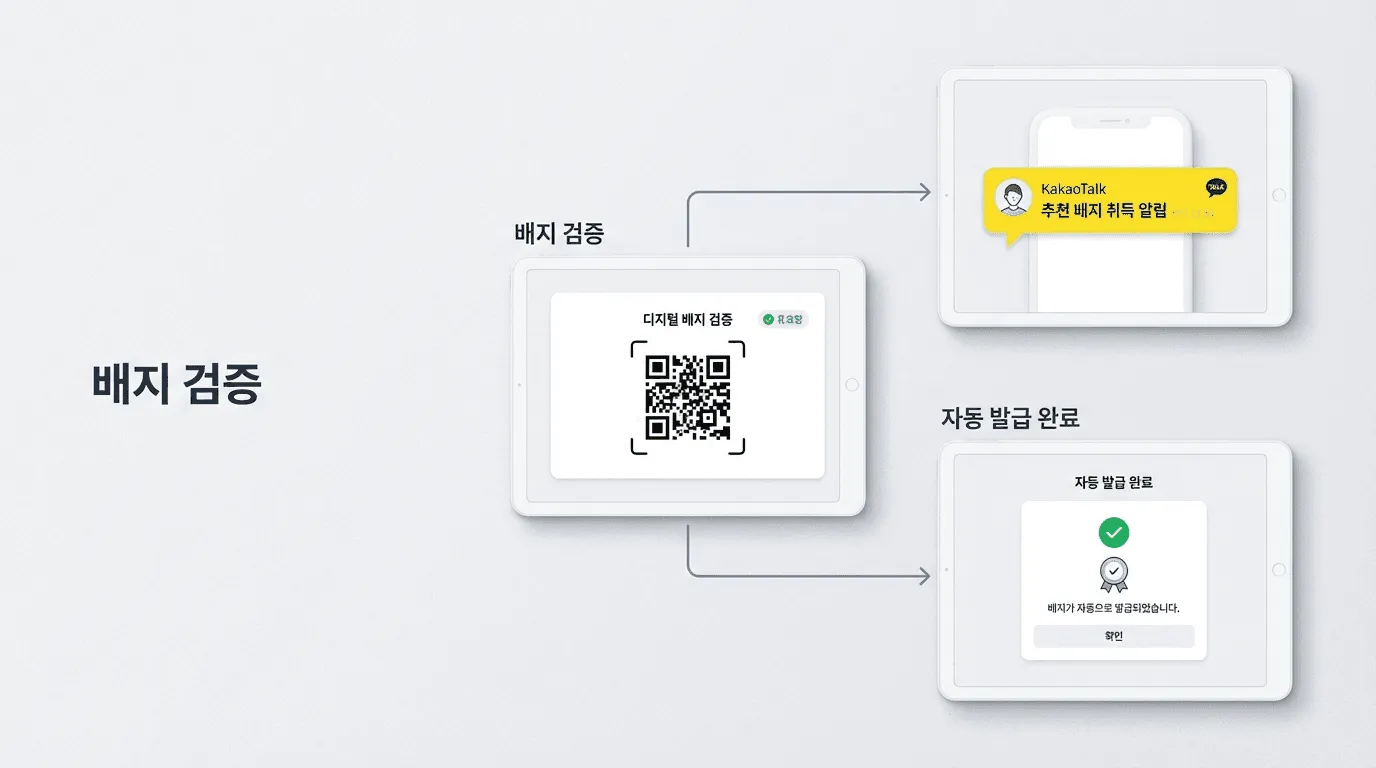
Kolleges builds the structure so “expansion” actually happens
Designing for expansion ultimately means not stopping at creating a badge, but making “the next action” follow automatically.
Kolleges supports this flow as features.
📋 Badge taxonomy consulting
Starting from the institution’s programs and outcome indicators, we organize which badges to design around which competency units.
🔔 Recommended badges + automated promotion notifications
When you mark key badges as “recommended badges,” notifications encouraging acquisition are sent automatically to graduates and participants, creating an “issue → re-engage” loop.
📱 Auto-share to 8 social channels
LinkedIn, KakaoTalk, Instagram, Discord, Facebook, X, Naver Band, Naver Blog - outcomes are shared in a single click so they spread externally fast.
⚙️ Automatic badge issuance
By pre-configuring class creation and completion / outcome criteria via the Kolleges LMS, badges are issued automatically when conditions are met, sharply reducing the operator’s repetitive work.
Frequently asked questions
Want to turn learning outcomes into verifiable assets?
From issuing to verifying and amplifying, see it for yourself with Kolleges.
Request a Kolleges demoRelated posts

How Global Companies Deploy Digital Badges: IBM, Salesforce, and Google
IBM, Salesforce, and Google show that digital badges drive measurable outcomes - from 70% higher program participation to 1M+ career-changing credentials - when built on open standards with sharing and verification infrastructure.
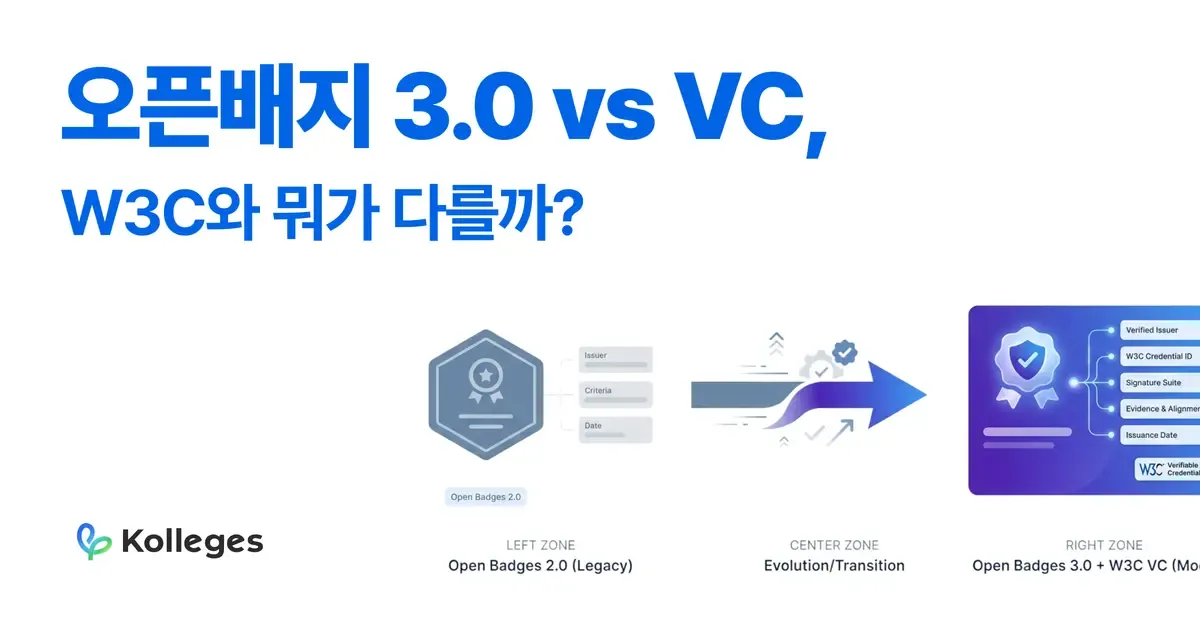
The complete Open Badges 3.0 guide: how it differs from W3C Verifiable Credentials
Open Badges 3.0 wraps W3C Verifiable Credentials with an education-specific metadata layer, replacing platform-dependent verification with cryptographic signatures that let learners own and selectively disclose their credentials.
2025 Certification Trends: Which Credentials Actually Help You Get Hired
A job-function breakdown of 2025's most employable certifications - IT/data, office, engineering, and ESG/safety - with difficulty, prep time, and how digital badges make each credential verifiable to employers.