
How Global Companies Deploy Digital Badges: IBM, Salesforce, and Google
IBM, Salesforce, and Google show that digital badges drive measurable outcomes - from 70% higher program participation to 1M+ career-changing credentials - when built on open standards with sharing and verification infrastructure.
As of 2025, the global digital badge market has surpassed roughly $312 million. According to 1EdTech’s 2025 Badge Count, more than 320 million badges have been issued worldwide - more than four times the 2022 total. A Credential Engine report notes that over one million distinct digital badges are in circulation in the U.S. alone.
Behind those numbers are real organizational decisions. IBM, Salesforce, and Google haven’t merely experimented with digital badges - they have operationalized them as core infrastructure for talent acquisition and learning performance management. And the results show up in concrete metrics.
IBM - One Badge Connecting Education, Hiring, and Marketing
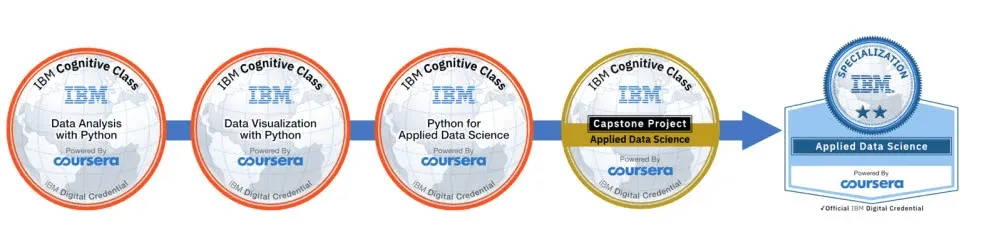
IBM is one of the earliest and most aggressive adopters of digital badges. An idea that started in a Raleigh, North Carolina conference room in 2015 has since expanded into over 2,500 badge activities across 195 countries. Cumulative issuance now exceeds 3 million.
What’s interesting is why IBM launched the program in the first place. The starting point was a very practical question: “How can we attract more big data developers?” In an increasingly competitive market for technical talent, IBM needed a way to signal “verified skills” as an alternative to degrees.
The results exceeded IBM’s own expectations. 87% of program participants reported higher engagement with IBM, and education programs that introduced badges saw a 70% increase in participation versus those without. Certification exam pass rates climbed 57%, and product trial downloads rose 64%.
LinkedIn profiles featuring badges receive 6x more views, and IBM gains about 2.5 million social media impressions per 10,000 badges issued. IBM internally values this at “several million dollars in marketing value.”
The benefits go beyond learner experience. Inside IBM, employees holding badges had lower voluntary attrition, and technical sales staff with certification badges hit revenue targets at higher rates than peers without them. 72% of managers report using badges as a form of employee recognition.
Honestly, this is the point many organizations miss. If you treat a badge as nothing more than the digital version of a paper certificate, you won’t see these effects. The core of IBM’s case is that badges created a flywheel: learner motivation → skills certification → external sharing → brand exposure → hiring and sales performance.
Salesforce Trailhead - An Ecosystem Built on Gamification and Badges
Salesforce’s approach is somewhat different from IBM’s. Trailhead, unveiled at Dreamforce in 2014, is a free online learning platform whose core design principle is gamification. Learners earn badges and points for completing modules, accumulating them to advance in rank.
The origin was a very practical problem. Millions of developers build apps on the Salesforce platform, but Salesforce lacked the resources to train them systematically. Traditional educational materials simply couldn’t keep up with the pace of technology change.
When Trailhead launched, Salesforce set a target of 100,000 badges issued annually. Reality far outpaced that goal: the first 200,000 users earned more than 1.2 million badges. 93% of Salesforce professionals surveyed have used Trailhead, and the average user has earned roughly 200 badges.
The response in AI-related learning is particularly noteworthy. Since mid-2023, Trailhead has issued more than 2.6 million AI-related badges, and Salesforce has reported gaining millions of hours of work productivity thanks to employee AI upskilling.
What Trailhead demonstrates is the equation “badges = motivation engine.” As people raise their scores, climb ranks, and share their accomplishments on LinkedIn, they naturally progress to deeper learning. With this structure, Salesforce built a self-directed learning ecosystem without separate training marketing budgets - an ecosystem that in turn expands the talent pool in a virtuous cycle.
Google Career Certificates - Digital Credentials That Lead to Real Employment
What makes Google’s case interesting is that it positions badges and digital credentials as “alternatives to degrees.” The Google Career Certificates program is designed to help learners build job competencies in IT support, data analytics, cybersecurity, and UX design within 3-6 months, with digital credentials issued via Credly upon completion.
Seven years after launch, the program has surpassed 1 million completers globally, with more than 350,000 in the U.S. alone. According to Google’s 2025 Impact Report, more than 70% of U.S. completers experienced a positive career change - a new job, promotion, or pay raise - within six months of completion.
Another striking figure: 91% of career-focused learners reported a tangible benefit from the program, and surveys put the average pay raise at 46%. Google has gone further, building an employer consortium of more than 150 companies that directly connects completers with hiring firms.
It’s also significant that Google has established a $100 million Career Certificates Fund to expand access for low-income households and military families. It demonstrates that digital credentials are not just “certificates” - they are tools driving real economic mobility.
What These Three Companies Have in Common for Korean Institutions
IBM, Salesforce, and Google - different industries, different approaches. But in how they use digital badges, common patterns emerge.
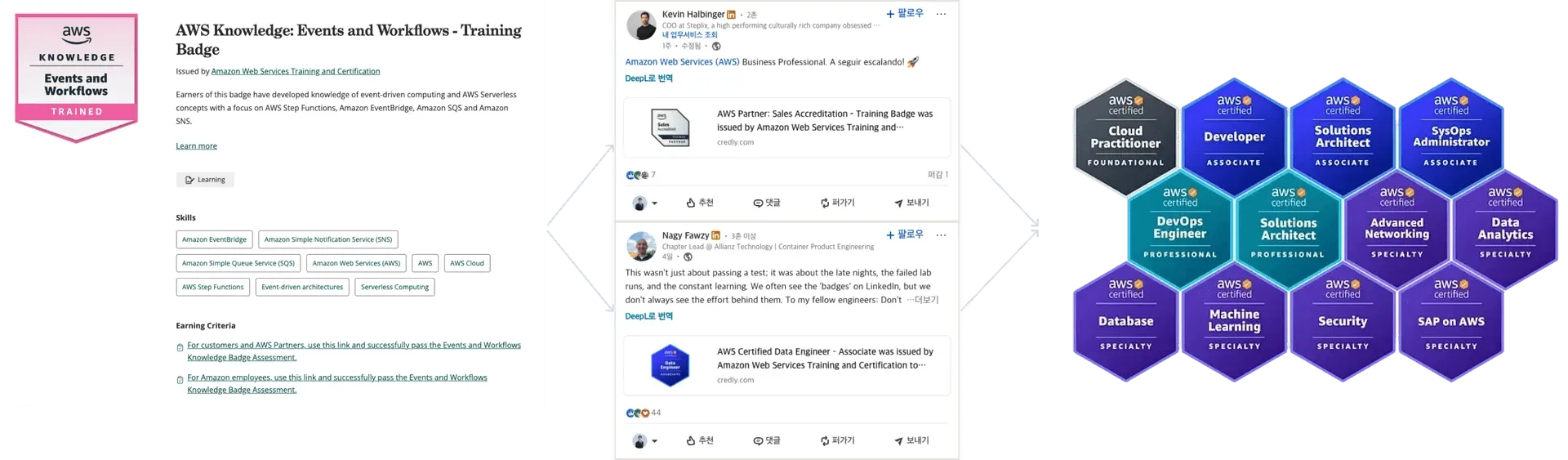
- 1 They didn't stop at issuance - They built structures where learners share badges on social media and resumes, and where employers can verify them. Badges become personal assets for learners while the issuing institution's brand spreads alongside them.
- 2 They accumulated and applied data - They tracked who earned which badge, how often it was shared, and what behavioral changes followed - using that to improve their programs. They managed the flow after issuance, not just issuance counts.
- 3 They designed for international standards and interoperability from the start - Verification platforms like Credly, the Open Badge standard, and LinkedIn integration fundamentally raised both the credibility and the utility of badges.
The same patterns apply directly to Korean institutions. University continuing education completion certificates, training completion records from public institutions, bootcamp completion badges - whatever the context, the core principle is identical. When educational outcomes exist as verifiable, shareable data rather than as PDF files, they become real “results” for both learner and institution.
Frequently Asked Questions
Which global companies have adopted digital badges?
The leading examples operating at scale are IBM, Salesforce, and Google. IBM has issued more than 3 million badges since 2015, Salesforce runs a gamification-based badge system through its Trailhead platform, and Google’s Career Certificates program has produced over 1 million completers worldwide.
What concrete outcomes can you expect from adopting digital badges?
In IBM’s case, education program participation rose 70% and certification exam pass rates climbed 57% after badges were introduced. 87% of learners reported higher engagement with the organization, and LinkedIn profiles featuring badges saw a 6x increase in views. For Google, more than 70% of completers experienced a new job, promotion, or pay raise within six months.
Can Korean institutions also adopt digital badges?
Yes. More than 200 institutions in Korea - universities, public agencies, and education companies - already operate digital badge programs. A domestic solution like Kolleges enables automated issuance and management of badges based on 1EdTech international standards, with support for integration with existing LMS systems.
Frequently asked questions
Want to turn learning outcomes into verifiable assets?
From issuing to verifying and amplifying, see it for yourself with Kolleges.
Request a Kolleges demoRelated posts

Digital Badge Market Size 2025: 320M Issued, 1.7M Badge Types Live | A 1EdTech Report Analysis
The 2025 Badge Count report (1EdTech + Credential Engine) shows 320M digital badges issued globally - a 13x rise since 2018 - with 1.7M live badge types and 74% of badges shared via social media.

Why Are Universities Abroad Actively Adopting Digital Badges?
Leading global universities like Harvard and Tampere are using digital badges to verify competencies and power micro-degree systems, signaling a shift Korean institutions should act on now.

Automated Outcome Sharing, Built with Digital Badges | When Completion Leads to the Next Course
Digital badges automate outcome sharing by turning every graduate share into an ongoing discovery loop - complete with custom ad banners, recommended next courses, and one-click sharing to 8 social networks.