
Why Are Universities Abroad Actively Adopting Digital Badges?
Leading global universities like Harvard and Tampere are using digital badges to verify competencies and power micro-degree systems, signaling a shift Korean institutions should act on now.
“From Harvard to European universities - the change points in global higher education”
From Harvard, LSE, and NTNU to Tampere University. Through case studies of universities abroad using digital badges, we introduce the micro-degree strategy domestic education institutions should be paying attention to right now, along with examples of the Kolleges solution in action.
Digital badges are already becoming “the standard” at universities abroad.

It’s now an era of proving learning with digital badges, not certificates.
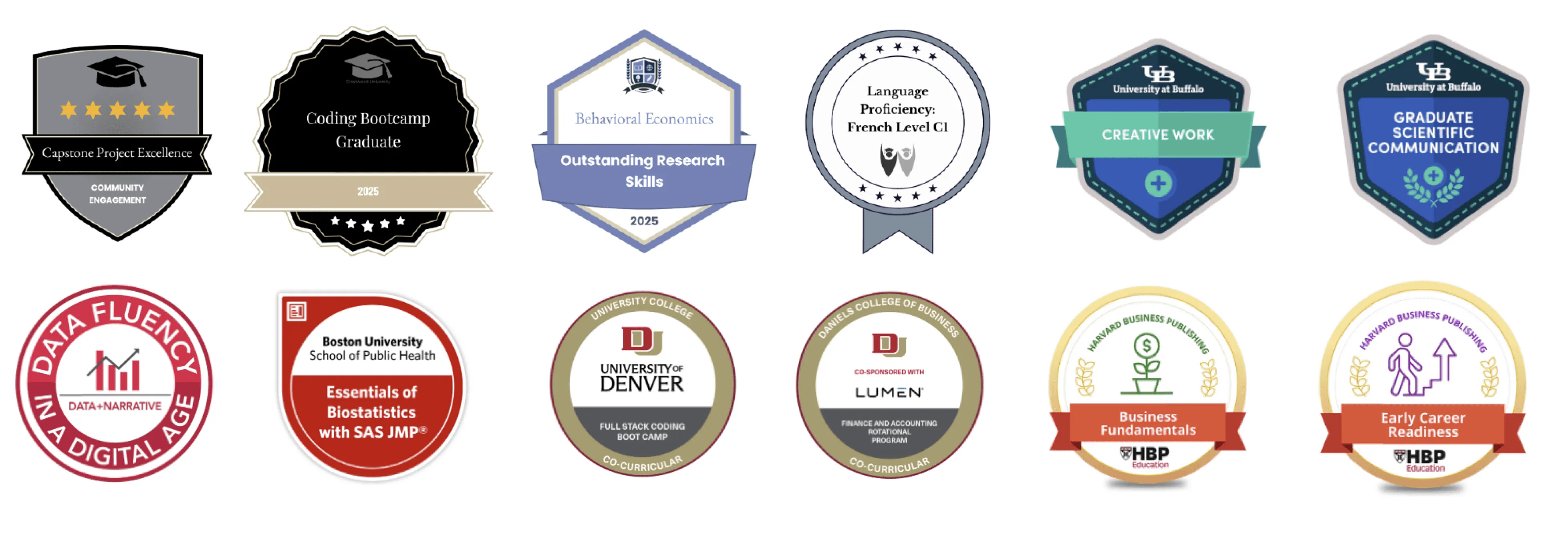
Harvard University, MIT, the London School of Economics (LSE), the Norwegian University of Science and Technology (NTNU), and Finland’s Tampere University - leading universities worldwide are proving learning journeys through digital badges.
Digital badges, linked with Micro Degree systems, are establishing themselves as a more flexible and customized way to certify education.
[Case 1] Harvard University - Digital Badges that Certify Leadership Competencies

Harvard Division of Continuing Education (DCE) provides digital-badge-format completion certificates to graduates of its Certificates of Leadership Excellence program.
-
Each badge includes information such as completion content, duration, and issuing institution
-
Easily embeddable in LinkedIn, resumes, email signatures, etc.
-
Authenticity verifiable with a single click
Harvard uses digital badges not just as a simple certificate of completion, but as a tool that captures both leadership competencies and brand value.
[Case 2] London School of Economics (LSE) - Badging E-Learning
LSE issues microbadges to learners who complete its online courses.
When students click on a badge, they can see what was covered in the course, so they can specifically showcase their digital skills. The badges are especially active in short-term programs in finance, data, and policy analysis.
[Case 3] Norwegian University of Science and Technology (NTNU) - Linked to Education Innovation Projects
NTNU introduced a digital-badge-based competency verification system in its teacher training program.
Students can store the professional competencies they acquire during teaching practicums in the form of digital badges, and build career portfolios on that foundation. These badges are used not only to verify teacher qualifications, but also as supporting materials during hiring.
[Case 4] Tampere University - Integrating Micro Degrees and Badges
Finland’s Tampere University has fully integrated digital badges with its micro-degree system.
Each badge represents a single subject or specific skill, and combining multiple badges leads to recognition as a micro-degree.
This structure strengthens learners’ choice and flexibility, and over time, it presents an alternative to the traditional degree system.
Why Digital Badges Are Drawing Attention
-
Verifiable and visual proof of completion
-
Easily shareable across SNS, email, and other channels
-
Practical material immediately usable in hiring processes
-
Flexible career design linked to micro-degree structures
Digital badges have moved beyond simple certification to become a means of branding and sharing learning.
The Change Korean Education Institutions Should Be Watching Right Now
As leading global higher education institutions
-
Improve learner satisfaction
-
Differentiate their education programs
-
Build micro-degree certification systems
through the active use of digital badges, domestic education institutions should also be strategically considering digital badge adoption in line with this trend.
Kolleges Is the Starting Point of Korea’s Digital Badge Innovation
“A single badge proves the value of education.”
Kolleges provides
-
Customized badge design tailored to each curriculum
-
Clickable embedded metadata
-
An automated issuance and management system
-
A structure suited to adopting a micro-degree framework
as Korea’s leading digital badge solution.
In particular, Kolleges is now being adopted even by the Harvard Executive Program currently being run in Korea, which is using Kolleges to issue digital badges.
Like Harvard, like Europe. Your education can now also be proven with a badge.
Start educational innovation through digital badges, right now, with Kolleges.
Frequently asked questions
Want to turn learning outcomes into verifiable assets?
From issuing to verifying and amplifying, see it for yourself with Kolleges.
Request a Kolleges demoRelated posts

Korea's Global Education Strategy: Where Does It Stand Today?
As Korea pursues 300,000 international students by 2027 and expands Asian joint programs like CAMPUS Asia, digital badges have become essential infrastructure for proving learner outcomes across borders.

University Branding and Learner Credentialing in One: Five Ways Universities Use Digital Badges
Universities are deploying digital badges across curricula, extracurriculars, industry partnerships, staff development, and admissions branding to prove educational value and raise institutional profile.

How Do Korean Universities Operate Their Microdegree Programs?
Four Korean universities - Sejong, Korea, Dankook, and Chung-Ang - show how short-credit microdegree programs pair with digital badges to turn learning outcomes into verifiable proof.