
University Branding and Learner Credentialing in One: Five Ways Universities Use Digital Badges

Universities are deploying digital badges across curricula, extracurriculars, industry partnerships, staff development, and admissions branding to prove educational value and raise institutional profile.
“Beyond a certificate - a smart strategy for raising the brand value of an educational institution.”
Why are universities paying attention to digital badges?
A growing number of universities and educational institutions are accelerating their adoption of digital badges. It is not simply about replacing certificates of completion. Badges are a new way to visualize educational outcomes and objectively prove learner competencies.
Blockchain-based badges in particular are tamper-proof, and they are highly practical because graduates can easily attach them to LinkedIn, resumes, and portfolios.
When a university’s educational philosophy and curriculum are packaged into a single “badge” and shared externally, the badge becomes an effective branding tool for the institution.
Five ways universities use digital badges

- 1 Certifying completion of formal and non-formal curricula - Digital badges are most fundamentally used as proof of completion for courses or programs. Examples include general electives, extracurricular programs, and teacher certification courses. Replacing paper certificates with blockchain-based badges makes verification easy even after graduation and dramatically reduces administrative workload.
- 2 Credentialing student activities and building an extracurricular portfolio - When a variety of extracurricular activities - student council, clubs, study abroad, internships - are issued as digital badges, each student's learning and growth history can be managed systematically. Breaking competencies down with a micro-credential approach makes the badges especially valuable for student portfolios.
- 3 Industry-academia programs and co-issued credentials - When a university runs joint industry-academia projects with corporations or research institutes, it can co-issue digital badges. For example, learners who complete an ‘AI Talent Camp’ run with an AI company can receive a joint university and company badge, capturing both learner credibility and corporate branding effects.
- 4 Faculty and staff training and professional development - Digital badges are well suited not only to students but also to faculty and staff development programs. Teaching workshops, education-informatization training, international conference participation, and similar activities can be badged to manage internal training history systematically and broadcast staff expertise externally.
- 5 Admissions marketing and external branding - Badges are not just personal credentials - they can also be a way to broadcast a university's brand externally. An ‘○○ University AI Competency Badge’ intuitively communicates what content the university delivers and what kind of talent it produces. Badges have high utility across admissions marketing, industry-academia collaboration, research partnerships, and more.
What to consider when adopting digital badges
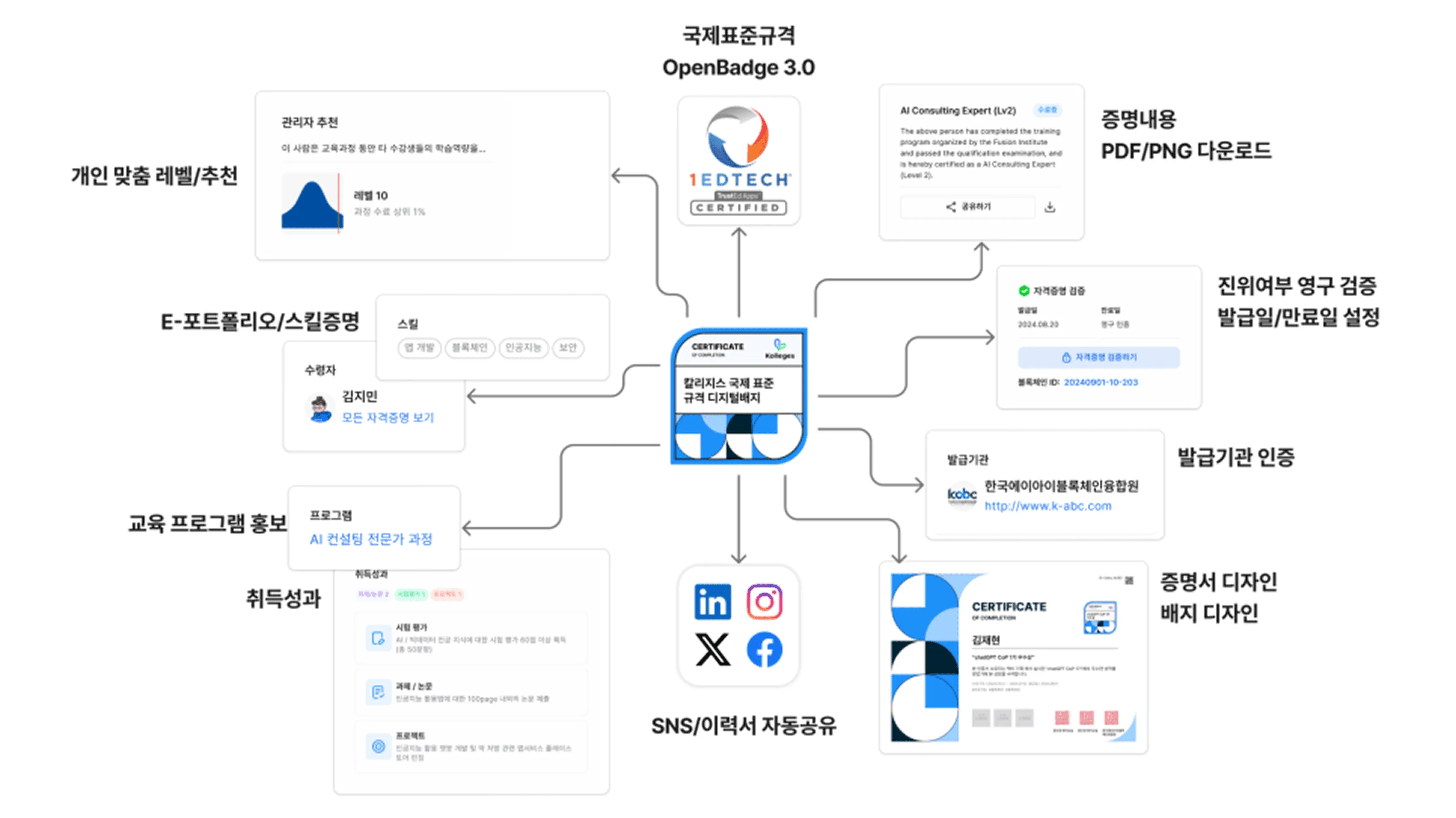
When a university adopts badges, why Kolleges?

Kolleges is more than a badge issuance system.
- It is blockchain-based, so badges cannot be forged or tampered with.
- Badges are stored securely with IPFS and DID.
- A learner’s digital badge portfolio page is also generated automatically.
Kolleges also supports customization aligned with a university’s unique CI design and brand colors, so every badge can carry the institution’s identity.
Major Korean universities and public institutions are already running their digital badges through Kolleges, realizing both educational innovation and administrative efficiency.
Prove your university’s educational competitiveness with digital badges, today
Learning outcomes need to be proven. That proof starts with a digital badge.
With Kolleges, every program, activity, and educational philosophy at your university is connected through a single badge.
Considering digital badges for your institution? Request a consultation through Kolleges today.
Frequently asked questions
Want to turn learning outcomes into verifiable assets?
From issuing to verifying and amplifying, see it for yourself with Kolleges.
Request a Kolleges demoRelated posts

The Strategy of Universities with High Employment Rates: Digital Badges That Convert Student Experience Into Outcomes
Digital badges turn invisible student experiences - extracurriculars, capstone projects, overseas programs - into verifiable, shareable competency credentials that employers can trust instantly.

Building a Digital Badge System: How Should It Differ from a Simple Certificate of Completion?
A digital badge system succeeds only when universities define measurable competencies and earning criteria before choosing any platform, transforming badges from mere certificates into verifiable credential structures.

Cheongju University Adopts Kolleges Digital Badge Learning Recognition System
Cheongju University piloted digital badge-based learning recognition in four intensive programs, enabling students to share verified project portfolios directly with employers.