
The future of digital badges: how Open Badges 3.0 is changing the credentialing standard

Open Badges 3.0 upgrades digital badges from embedded PNG metadata to a full Verifiable Credentials model - making them machine-verifiable, portable worldwide, and tamper-proof without relying on any central server.
The digital badge we made - is it actually valid on other platforms?
As digital technology advances rapidly, many educational institutions and companies are converting their certificates into digital badges. But simply turning a badge into an image doesn’t make it an internationally recognized credential. For a digital badge to become a genuinely meaningful credential, it needs a structure that follows international standards and verifiable technology.
That’s why Open Badges 3.0 (OBv3) emerged. Kolleges has fully implemented this international standard, and is officially issuing OBv3-certified digital badges as the first to do so in Korea.
Open Badges - what are they?
Open Badges is an international standard created by 1EdTech (formerly IMS Global) - a digital credentialing framework usable by educational institutions and companies worldwide.
The earliest versions had a simple structure that embedded JSON data into a PNG image, but starting with Open Badges 3.0, a major overhaul shifted the foundation to Verifiable Credentials (VC).
-
Authenticity can be verified by machines,
-
usable anywhere in the world,
-
and internationally trusted as a digital credential
-
that’s the evolution.
Open Badges version comparison
| Version | Structure | Description |
|---|---|---|
| OB 1.0/2.0 | Image + JSON | Credentialing info embedded in a PNG image or linked via JSON |
| OB 3.0 | VC-based (JWT or LD signature) | DID-based identity + VC model + JWT or LD signature + distributed storage |
Global organizations are adopting OBv3
Many global institutions are already officially issuing digital credentials through Open Badges 3.0.
| Organization | How they use it |
|---|---|
| IBM, Microsoft, Google | Issue OB-based badges through Credly and are migrating to OB 3.0; manage technical skills and education completion records transparently both inside and outside the company |
| Boeing | Issues digital badges to employees who complete internal training; operates an industry-grade trusted competency credentialing system |
| NASA | Issues OB-based badges in STEM education, Space Apps hackathons, and more; spreading achievement-based credentialing culture worldwide |
| Europass (EU) | Issues degree, completion, and qualification information in OBv3 format; users attach these to digital wallets or resumes for automatic verifiable credentials |
The credibility and usability of digital badges is expanding to a global standard through Open Badges 3.0.
How has Kolleges implemented OBv3?
Kolleges faithfully follows the OBv3 standard and issues digital badges containing the following key information.
| Field | Field name | Example |
|---|---|---|
| Issuer info | issuer | Club name, DID, email, URL, etc. |
| Recipient | credentialSubject | User DID |
| Achievement content | achievement | Gukgung Level 1 completion, description, criteria, etc. |
| Issuance date | issuanceDate | 2025-07-01 |
| VC declaration | context, type | OBv3, VerifiableCredential, AchievementCredential |
The structure is easy for humans to understand while being designed so systems can automatically verify authenticity.
How are Kolleges digital badges verified?
What’s essential to a digital badge is guaranteeing who issued it, that it hasn’t been tampered with, and that anyone can independently verify it.
Kolleges achieves this through the following four steps.
| Step | What happens? |
|---|---|
| Attach the digital signature | Place the badge data in a JWT (the digital signature container) and ‘stamp’ it using RS256. |
| Record the public key location | Record the location of the key (public key) in the JWT's internal kid field. |
| Open the key vault | Publish the public key at the /.well-known/jwks.json path so anyone can access it. |
| Distribute the file safely | Upload the badge to IPFS so that if the content changes, the CID (address) changes too, locking it to its content. |
Through this, Kolleges digital badges are designed for verification without any central server or login.
OBv3-certified issuance solution, Kolleges
Kolleges officially passed the OBv3 international certification test. Registered with 1EdTech as an official Open Badges 3.0 certified issuer, Kolleges is qualified to issue digital credentials in line with international standards reliably.
Want to verify a Kolleges badge?
- 1 Download the badge using its IPFS address (CID).
- 2 Open the JWT and see the issuer, recipient, and achievement content at a glance.
- 3 Fetch the public key (verification key) from the link the kid provides.
- 4 Use that public key to confirm whether the digital signature is valid.
- 5 If the result is valid, the badge is an unaltered, genuine Kolleges badge.
This way, Kolleges digital badges can be verified by anyone, at any time, with just a single file - without any central server or Kolleges login.
Kolleges, designing the future of digital badges
Open Badges is the starting point of trusted “verifiable credentials,” and it requires a structure with international portability and technical stability.
Kolleges meets all these criteria, with
-
OBv3 structural design
-
digital signatures and distributed storage
-
DID-based verifiability
-
and international certification already completed -
a complete digital badge platform.
Digital credentials must now become “real, verifiable” credentials. Build that future with Kolleges.
Frequently asked questions
Want to turn learning outcomes into verifiable assets?
From issuing to verifying and amplifying, see it for yourself with Kolleges.
Request a Kolleges demoRelated posts
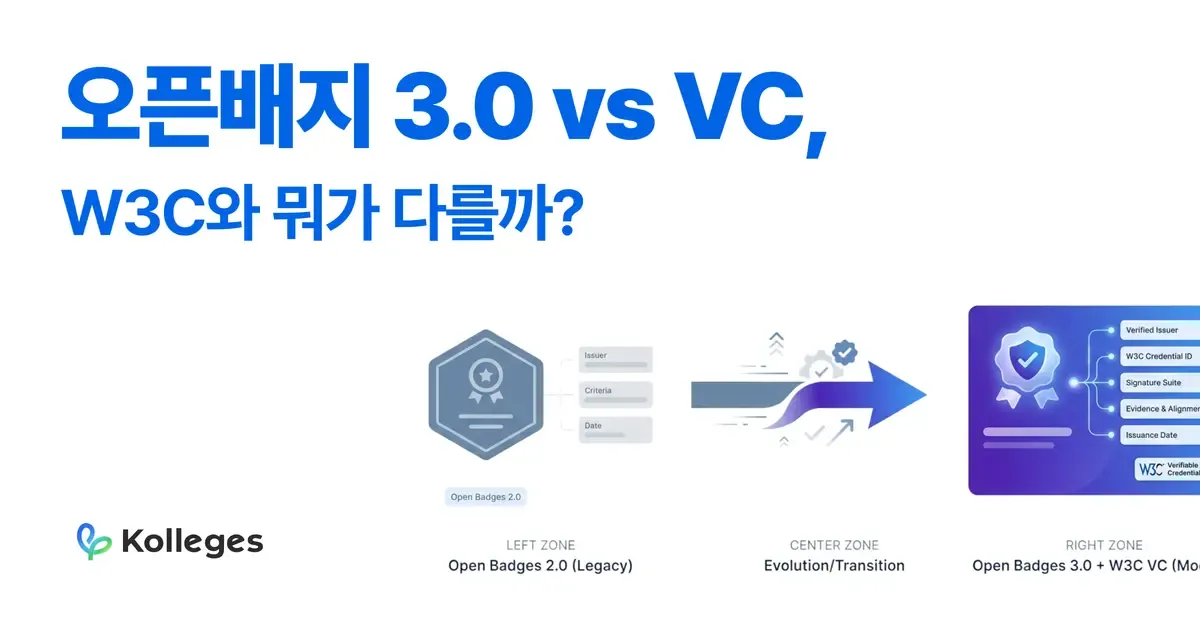
The complete Open Badges 3.0 guide: how it differs from W3C Verifiable Credentials
Open Badges 3.0 wraps W3C Verifiable Credentials with an education-specific metadata layer, replacing platform-dependent verification with cryptographic signatures that let learners own and selectively disclose their credentials.

Three Core Advantages of Open Badges as an Essential Tool for Credible Credentialing
Open Badges outperform paper certificates by combining tamper-resistant, data-based verifiability, instant online sharing, and sequential career record-keeping in a single globally-standardized credential.

5 Advantages of Digital Badges: Future-Ready Certification That Transforms Education and Careers | Kolleges
Digital badges built on blockchain and DID technology offer tamper-proof credibility, LinkedIn sharing, personalized learning tracking, reduced admin costs, and global English-language certification support.