
How Do Korean Universities Operate Their Microdegree Programs?

Four Korean universities - Sejong, Korea, Dankook, and Chung-Ang - show how short-credit microdegree programs pair with digital badges to turn learning outcomes into verifiable proof.
🎓 Changing university education - the microdegree is the answer
Amid rapidly shifting industry structures, university education is also evolving in new ways. At the center of this shift is the microdegree.
A microdegree is an education format that certifies practical competencies in a specific field through a short, intensive curriculum and small credit unit. Moving away from traditional major-centric programs, it offers flexible learning experiences aligned with each student’s career path and industry demand.
Today we look at how major Korean universities are running their microdegree programs, and the role digital badges can play within this current.
🏫 Sejong University - Microdegrees segmented by type
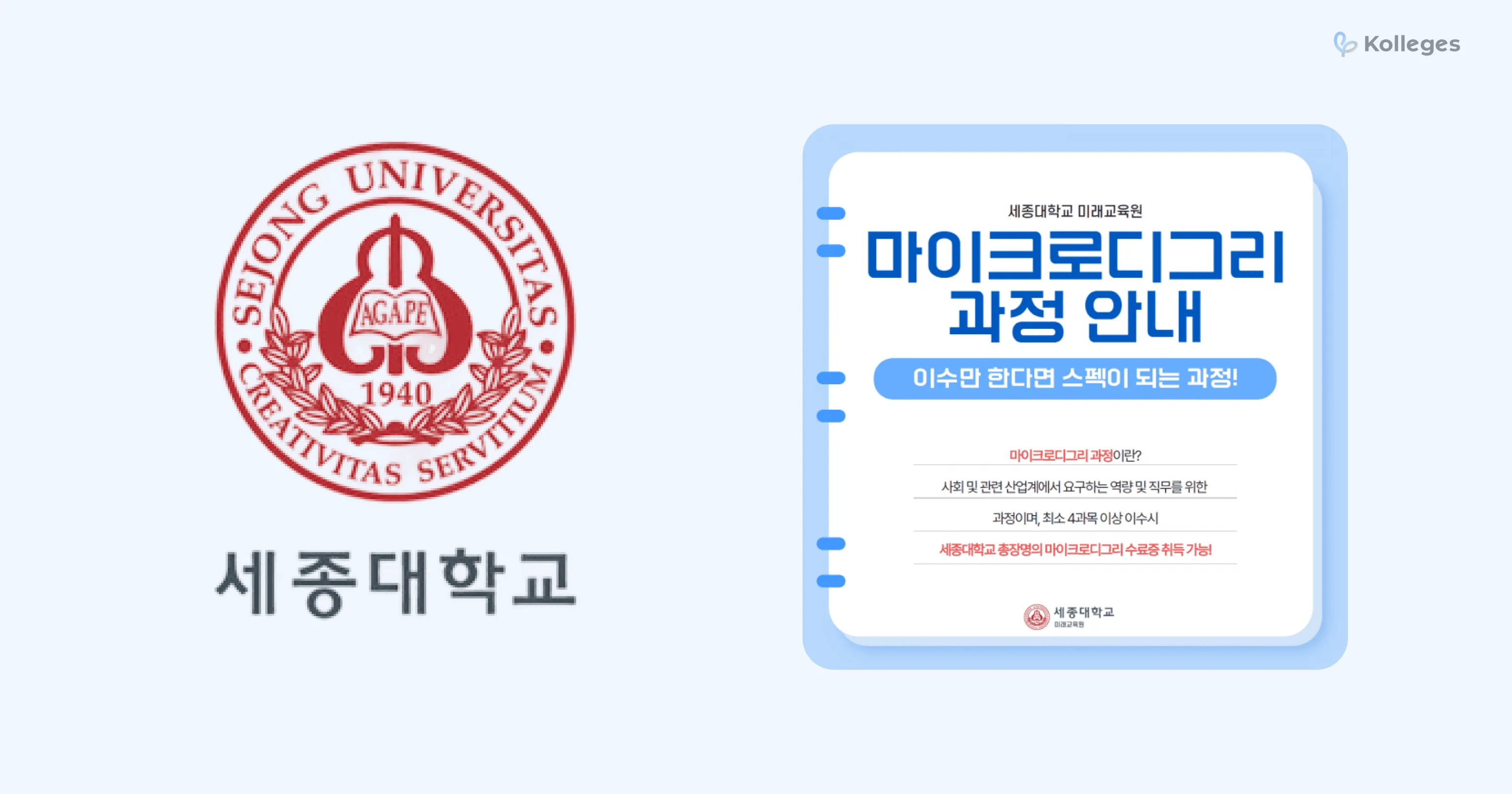
Sejong University is one of the leading examples of systematically operating microdegrees. It runs various degree programs ranging from 9 to 15 credits, with clearly defined types.
-
Major track: career and employment direction within a major
-
Convergence-linkage: a new field that links two or more majors
-
Industry-academic linkage: practice-centered education reflecting industry demand
-
University-shared: scalability through curriculum sharing between universities
Applications are processed through the student’s home department, and certified completers receive a microdegree completion certificate. At the school level, program design and outcome analysis are actively supported.
🏫 Korea University - Free completion, then certification
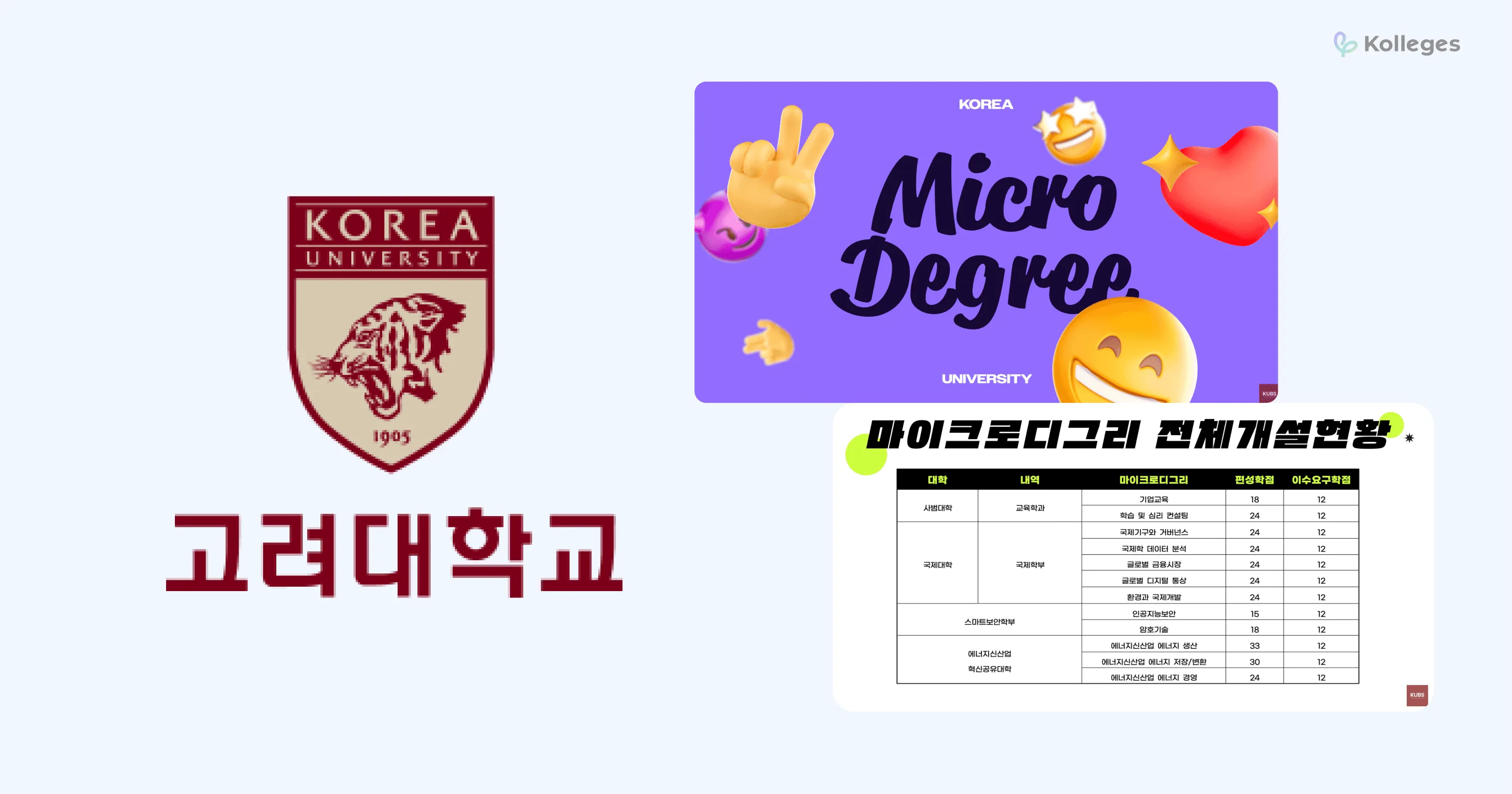
Korea University runs its microdegrees in a more flexible way. Without a separate pre-registration, students complete designated courses and receive certification once they meet the requirements.
-
Operates various interdisciplinary major programs (e.g., Semiconductor Process Equipment Convergence Major, Smart Eco City Convergence Major, etc.)
-
A single student can complete two or more microdegrees concurrently
-
Built on existing courses, ensuring accessibility and practicality
A certificate issued separately from the degree complements the student’s portfolio.
🏫 Dankook University - Multi-major-linked “micro majors”
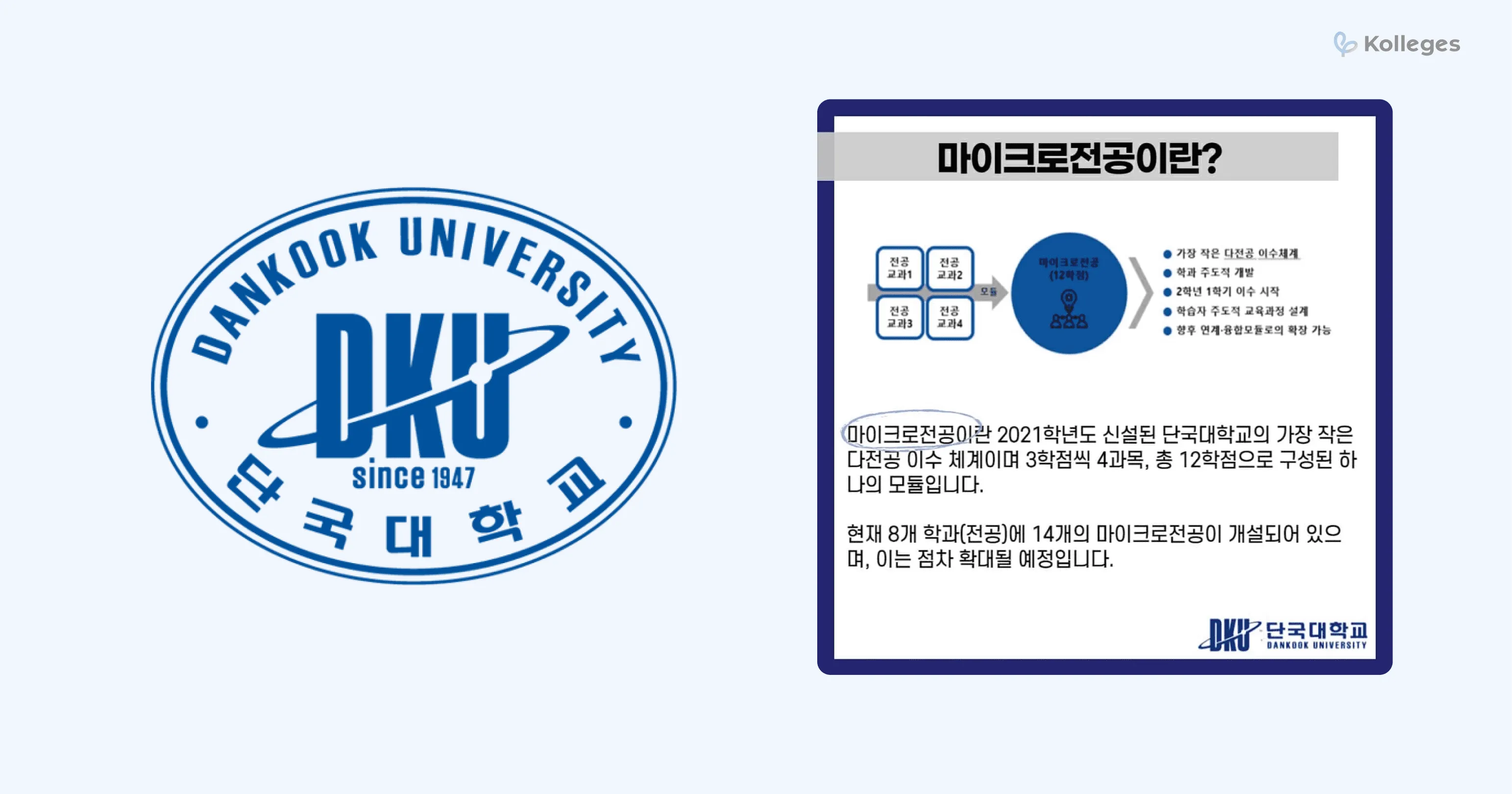
Dankook University runs microdegrees with a “modular structure,” and one of its distinctive features is that they are open to students from other majors.
-
Modular composition based on multiple majors
-
Certification issued upon completing 9 to 12 credits
-
Motivation system linked to scholarships
Because they can be used like a minor, these flexible tracks are particularly effective at encouraging self-directed learning.
🏫 Chung-Ang University - An XR-focused track centered on immersive media
Chung-Ang University offers a microdegree focused on immersive media technologies. The Virtual Convergence College and the industry group of the Innovation Convergence College jointly run a practice-centered, specialized curriculum.
-
Curriculum across beginner to advanced levels
-
Diversified across immersive-media content production, fundamentals, and business
-
Open to participants regardless of major; tied to entrepreneurship competencies
It is a meaningful case in that it proactively reflects future industry demand.
📊 The core value of microdegrees
Microdegrees deliver new opportunities for both students and institutions through the following strengths:
In particular, when combined with industry-academic practical experience, global cooperation networks, and local-community-linked platforms, microdegrees can maximize the brand value of a university.
✨ They become even more complete when paired with digital badges
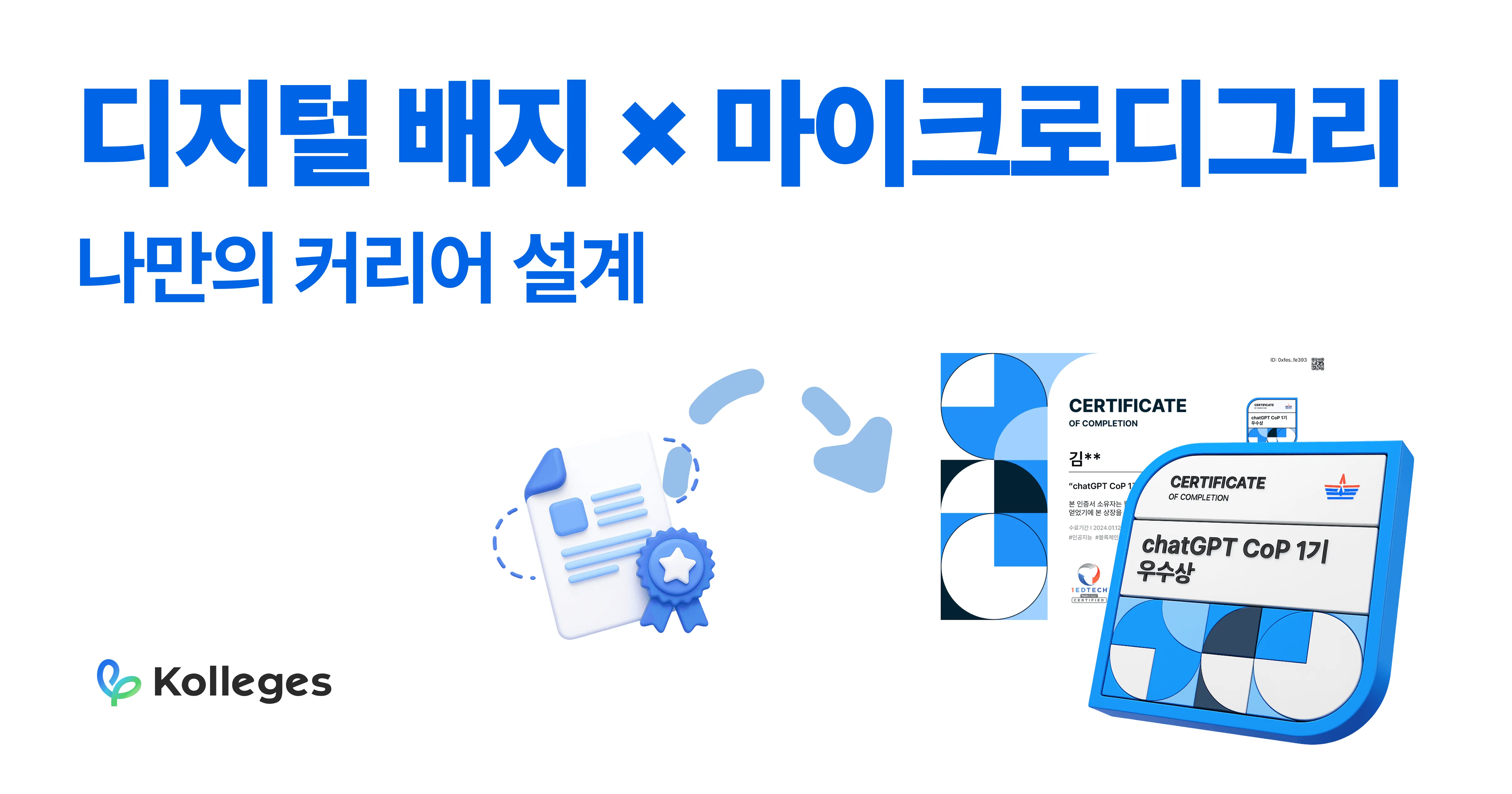
When you connect a microdegree program with digital badges, the outcomes of education turn into “visible proof.”
-
Issue verifiable online badges as a record of completion
-
Use them officially on résumés, portfolios, and SNS
-
Naturally promote the institution’s brand externally
-
Build a highly trustworthy digital credentialing system
It is no longer enough to simply show that you “took the course.” What matters now is clearly proving “what abilities you have.”
🔐 Microdegree + Digital Badge = a core strategy for the future of education
Kolleges supports Korean education institutions in running microdegrees that are more trustworthy and more easily connected, through our digital badge solution.
-
Build digital credential systems
-
Custom education-badge design and automatic issuance
-
Dashboards for learners and administrators
-
SNS integrations with Naver, Kakao, LinkedIn, and more
Take your microdegree programs one step further with Kolleges, now. 💡 Education where real “outcomes” are proven can start today.
👉 Read: 5 Ways Universities Use Digital Badges
👉 Apply for a free badge consultation and receive a discount
Frequently asked questions
Want to turn learning outcomes into verifiable assets?
From issuing to verifying and amplifying, see it for yourself with Kolleges.
Request a Kolleges demoRelated posts
The Beginning of the Microdegree Era for Practical Workplace Competency
Microdegrees offer short-form, industry-aligned certification that pairs with tamper-proof digital badges to give graduates verifiable, portfolio-ready proof of workplace competency.

Why Are Universities Abroad Actively Adopting Digital Badges?
Leading global universities like Harvard and Tampere are using digital badges to verify competencies and power micro-degree systems, signaling a shift Korean institutions should act on now.

Building a Digital Badge System: How Should It Differ from a Simple Certificate of Completion?
A digital badge system succeeds only when universities define measurable competencies and earning criteria before choosing any platform, transforming badges from mere certificates into verifiable credential structures.