
What Is AI Literacy: The New Baseline Skill for Practitioners in 2026
AI literacy - the capacity to understand, apply, and critically evaluate AI outputs - is now the baseline work skill across all job roles, not just technical ones.
When we sit down with companies and institutions, the same question keeps coming up.
“Is this employee someone who can work with AI?”
What matters now is not the ability to “operate” AI tools,
but the capacity to read, understand, and apply AI to solve problems aligned with the work itself.
AI is no longer the domain of a small set of developers or data specialists.
From decision-making to planning, document creation, analysis, and communication,
the ability to use AI is becoming a core practitioner skill that will directly reshape how we hire and how work is organized.
In this article, we lay out
the concept of AI Literacy with precision,
why it has become an essential skill across every job role today,
and the shared traits of people with high AI literacy - all in one flow.
🔎 What Is AI Literacy?
Building on the concept articulated by the Korea AI Literacy Association, AI literacy can be defined as follows.
In other words, it is not the use of a particular technology, but a combination of linguistic, interpretive, and problem-solving abilities.
Concretely, it includes the following.
-
Understanding the basic principles of how AI works
-
The ability to verify and apply results
-
The ability to combine AI appropriately for a given work goal
-
The ability to interpret and reconstruct AI-generated output
-
The ability to identify AI-related ethical, security, and copyright risks
AI is no longer just a piece of software. It has settled in as a communication tool and a work partner.
So AI literacy is best understood not as technical proficiency but as literacy for collaborating with AI.
✏ Why AI Literacy Has Become an Essential Skill Now
AI adoption is no longer “the story of a particular industry.”
According to the D-Finite report, companies worldwide are concentrating AI adoption in the following areas.
-
Data analysis
-
Customer support and automation
-
Improving marketing performance
-
Software development
-
Workforce operations and HR
-
Strategy and planning
Korean companies in particular place their largest expectations on workflow automation and productivity gains using GPT, Claude, and Copilot.
🔍 The bottleneck is not the pace of AI adoption, but the shortage of people who can actually use it.
Many companies share the same struggle.
-
“We’ve adopted AI, but our employees can’t really use it.”
-
“We have the tools, but we’re not getting the efficiency gains.”
-
“We don’t know how to evaluate AI proficiency.”
At the heart of this shift is not the tool but people’s capability -
specifically, whether there are people with AI literacy.
✅ The Sub-Skills That Make Up AI Literacy
AI literacy can be broken down into four broad capabilities.
① Cognitive Understanding
-
A foundational understanding of how AI works, how data flows, and the limits of models
-
Judging which problems AI is good at and which it is weak on
-
Evaluating accuracy, bias, and risk in AI outputs
② Application Skill
-
Prompt construction
-
Using AI to structure work outputs - documents, reports, planning materials, analyses
-
Automating repetitive tasks
-
Designing new workflows with AI
③ Problem-Solving with AI
-
Combining multiple AI tools to suit the goal
-
Reworking AI outputs into decision-quality material
-
The ability to define for yourself “why use AI here at work”
④ Ethics and Data Safety
-
Protecting personal information, copyrighted material, and confidential data
-
Judging the authenticity of AI-generated content
-
Managing dependency on AI
In short, AI literacy is not the ability to operate features.
It is the ability to integrate AI into the full arc of solving a work problem.
📌 Traits of People with High AI Literacy
Pulling from research, interviews, and field cases,
people with high AI literacy share the following traits.
① They Are Strong at Structuring Problems
They do not just ask AI to “make something.”
They lay out context → goal → conditions → expected outcome clearly.
② They Don’t Use AI Output As-Is
Strong AI users
take AI’s draft, verify it, restructure it, and finish it as their own deliverable.
③ They Have No Fear of New Tools
They start with the question, “What value can this tool give me?”
and then quickly learn the features they need.
④ They Have a High Sense of Data, Security, and Copyright
They clearly understand that “risk management” is the most important element of AI use.
⑤ They See AI as a “Collaborator,” Not a “Replacement Tool”
AI is not something that takes a person’s job, but
a tool that extends a person’s capability.

📢 AI Is Not Technology - It Is a Language, and Capability Must Be Demonstrated
Many experts say it like this.
AI is no longer the capability of a few developers. It is a new language required across every job role.
What matters is not understanding the language deeply, but
the ability to read, write, and apply AI to produce real outcomes -
that is, AI Literacy.
In the job market in particular,
the deciding criterion is no longer “Have you used AI tools?”
but “What work outcomes have you produced with AI?”
In planning, marketing, education, operations, HR, and other non-developer roles,
the ability to use AI has already become an essential work skill,
and companies more quickly evaluate and prefer talent with high AI literacy.
There is one more important change.
How do you prove this capability?
This is where Digital Badges play a powerful role.
Not a simple completion certificate, but
a credentialing format that shows, with concrete data, which education was completed and which AI proficiency was acquired.
Recently, Kolleges
issued digital badges to graduates of the Maeil Business Newspaper AI Director program.
These badges are not simply proof that “I took the course.” They record, with concrete outcome data,
-
AI analysis and strategy-building capability
-
Hands-on experience with AI tools
-
Problem-solving in corporate project-based settings.
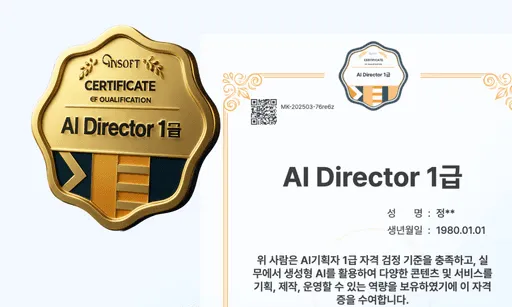
Graduates connected these badges to LinkedIn, portfolios, and resume pages,
presenting their AI capability in a fully “visible” form,
and companies could click the badge to verify the education content and outcomes immediately on the verification page.
In an era where AI literacy matters,
what matters as much as “having” AI capability is whether you can “prove” it transparently.
The baseline skill of the future is now very clear.
Not someone who can use AI, but someone who can work with AI and prove it.
Kolleges plays the role of recording and connecting learners’ AI proficiency, applied experience, and achievements completely -
through a digital-badge credentialing structure that shows this capability most clearly.
Frequently asked questions
Want to turn learning outcomes into verifiable assets?
From issuing to verifying and amplifying, see it for yourself with Kolleges.
Request a Kolleges demoRelated posts
Public Education Is Changing: A Guide to Korea's 2025 Coding, AI, and Creative Education Policy
South Korea's 2025 national policy transforms coding, AI, and creativity from electives into core K-12 subjects, aiming for full adoption across all schools by 2027.

Why Practice-Based Education Raises Employment Rates
Practice-based experience only translates into hiring advantage when it is objectively recorded - digital badges embedded in an E-Portfolio give employers instant, data-rich verification of real-world competencies.
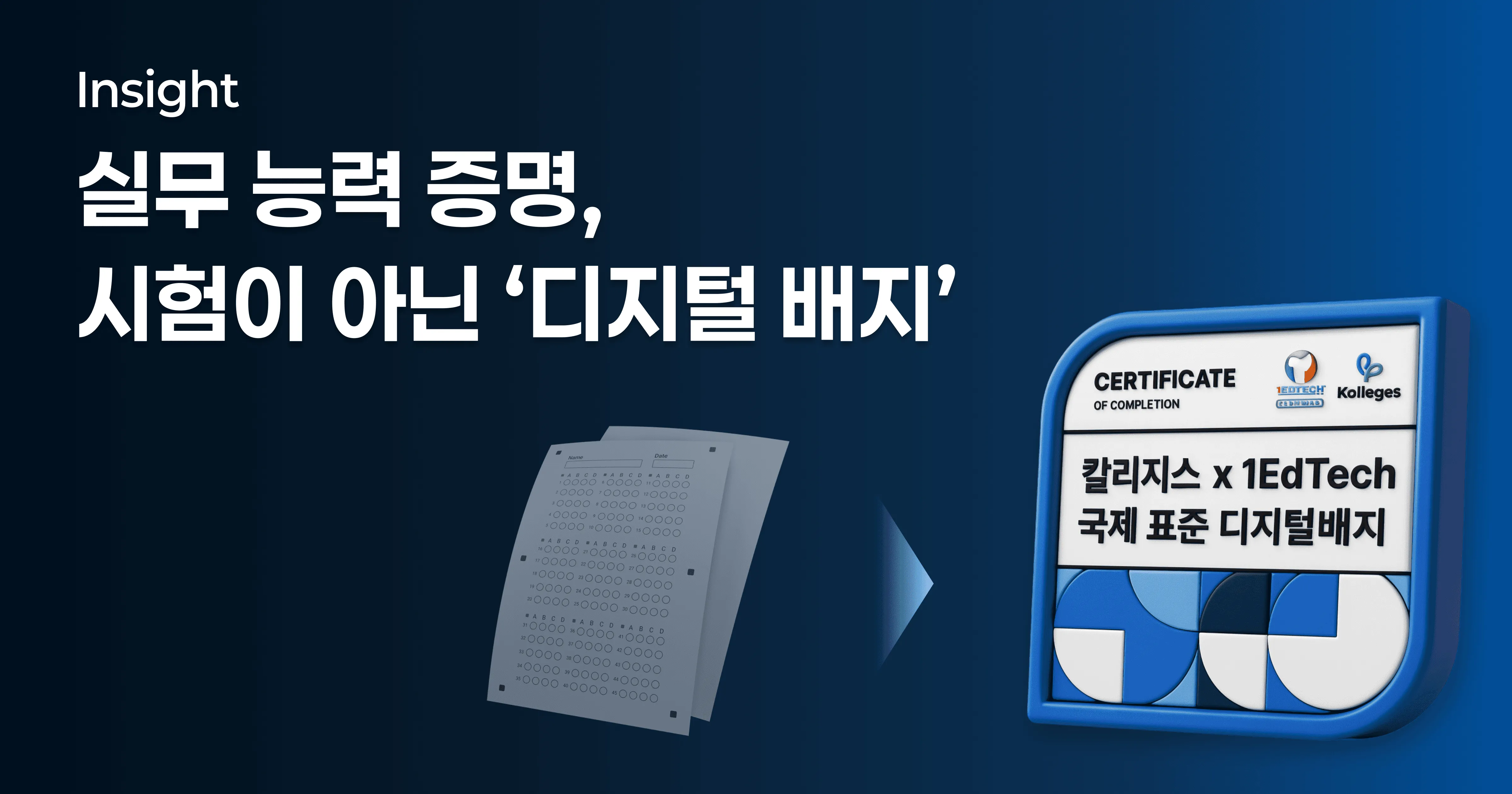
Proving Practical Skills with Digital Badges, Not Exams
Digital badges embed project links, tech stacks, and assessor sign-offs directly into verifiable metadata, replacing scattered files with a standardized proof of practical capability.