
From Certificate Issuance to Connection: The Next Step in Outcome Management
 Robin Yoon · Customer Success Team Published
Standards like Open Badges, CLR, and LER transform one-off certificate issuance into a connected, reportable flow of learning and employment outcomes.
Plenty of certificates, but why does outcome management fail?

Certificates have been issued steadily, but their use often breaks down at the project reporting or employment support stage. The reason is that every institution uses different systems and different certification methods, so the records don’t connect. That’s why recent global edtech trends are moving toward connection through standards, rather than tacking on more features.
The heavier operations get, the more standards come into focus
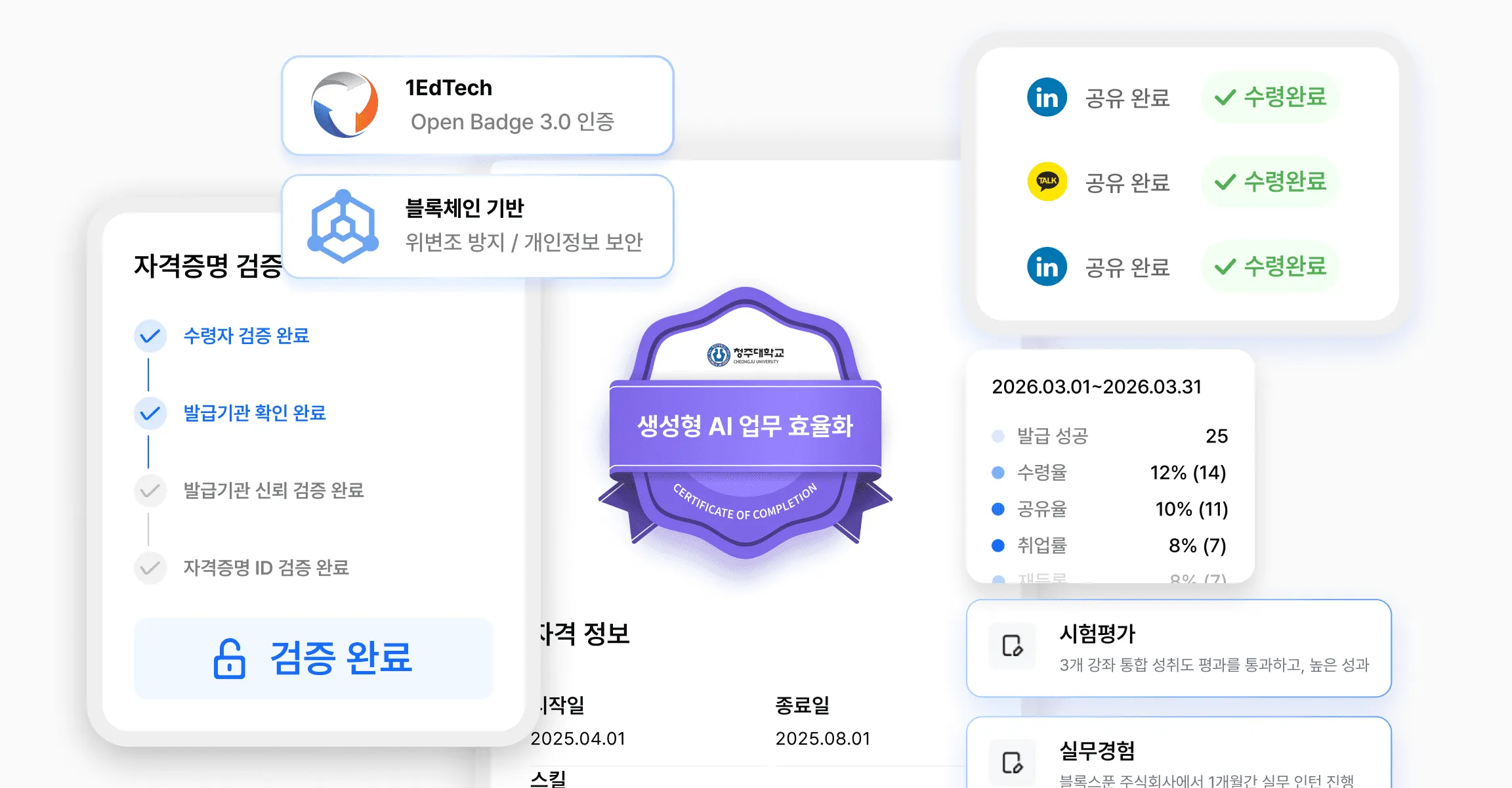
The reason is simpler than it seems. To make the work sustainable, education outcomes need to be created once and reused in many places. PDF certificates are easy to issue, but they’re hard to authenticate, share, or track afterward, which makes it difficult to roll them into outcome management data.
1EdTech revisited this trend at the 2025 Learning Impact conference. They emphasized the spread of open standards such as Open Badges, the CLR Standard, LTI, and OneRoster - and this isn’t tech-trend talk, but something tied directly to field operations. When records created in extracurricular programs, lifelong learning, and workforce education connect with other platforms, learners can more easily explain their outcomes, and institutions can more easily document results with numbers and evidence.
In the field, more time is still often spent on issuance work than on the certification itself. But a standards-based framework changes what happens after issuance. It lets you see, as one continuous flow, who learned what, where that record was used, and whether it led to re-enrollment or employment connections.
The more collaboration accumulates, the longer the records carry
What stood out in the announcement was that the standards aren’t run by one institution’s declaration. Over the past year, 1EdTech has collaborated with the Ed-Fi Alliance, the IEEE Learning Technology Standards Committee, and the DXtera Institute, and also joined the LER Accelerator coalition together with 12 institutions in higher education and workforce education.
LER is a record-keeping system that connects learning and employment. When universities, education institutions, and companies each create their own proof of evidence separately, learners have to explain the same outcomes multiple times. The other way around - when standards-based credentials are connected - experience accumulated on campus can naturally flow into employment portfolios or proof of job competencies.
There were also notable moves worth referencing in the adoption phase. The EdTech Quality Collaborative - composed of seven organizations including CAST, CoSN, Digital Promise, InnovateEDU, ISTE, and SETDA - is working to create quality indicators and a structure to verify whether products meet them. From an institution’s standpoint, a credible criterion matters more than a product brochure. Standards aren’t a language reserved for the tech team - they’re a mechanism that simplifies procurement, operations, and evaluation together.
Global expansion and AI point in the same direction
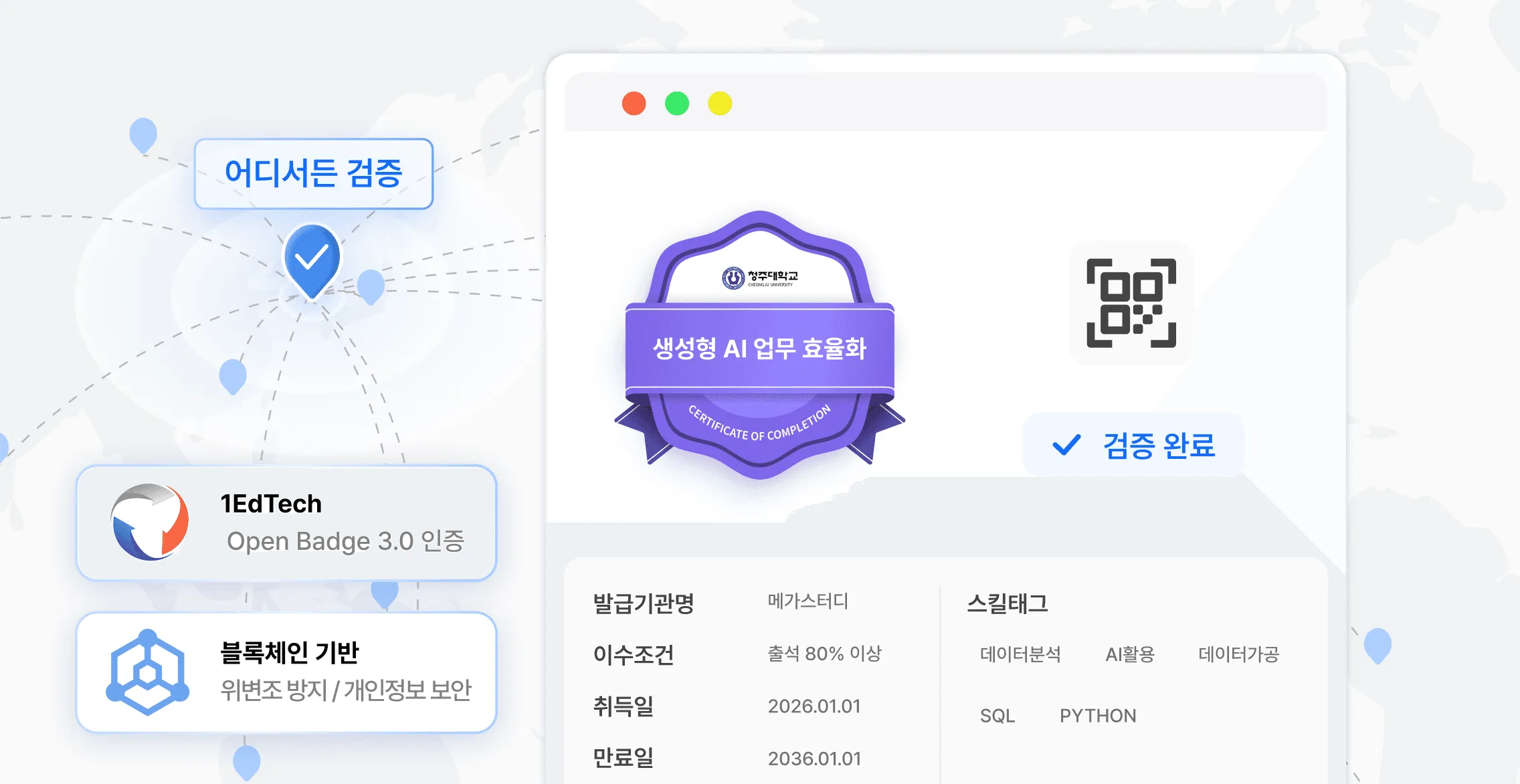
In Europe and Latin America, expansion is also accelerating. In Europe, resources have been invested in interoperability projects such as EDEH, QualityLink, and EduXS, while in Latin America, 1EdTech LATAM was launched together with IAAE. For institutions running international education initiatives or programs for international learners, this signals that the global compatibility of certification systems needs to be treated as a practical operational issue.
The numbers are also striking. The TrustEd Apps Management Suite has registered certification and data privacy profiles for over 12,600 applications, and the Uniform ID Framework has been applied across certified products. Real-time data binding has also entered the pilot stage. The more systems an institution has, the more impact this kind of change will have. Information has to flow without being cut off between platforms in order for reporting, analysis, and follow-up support to work.
AI should be viewed in the same context. 1EdTech said it has worked with Georgia Tech on the AI-ALOE project, developing a reference architecture for learning data pipelines using Edu-API, LTI, and Caliper. At Learning Impact 2025, they also unveiled a draft of the AI Data Context Standard, which defines how AI tools read and interpret learning data.
What matters isn’t whether you use AI, but what data you can trust and connect. If records are scattered, AI ends up making fragmented recommendations. Conversely, when verifiable outcome data accumulates, institutions can explain educational impact more clearly and propose more persuasive next steps to learners.
To turn education outcomes into a true operational asset, a connection structure has to come before issuance. The past year has clearly shown that interoperability is a greater competitive advantage than a polished certificate. When institutional reporting and learner proof begin running on the same record, certification stops being administration and becomes operational strategy.
What to check on the ground right now
Frequently asked questions
Q. We’re already issuing certificates, so why are operations still inefficient?
A. Issuance itself and downstream usage are different problems. The document goes out, but if verification, sharing, and tracking don’t follow, reporting data and learner proof end up running on separate tracks.
Q. Where do standards like Open Badges or CLR have the most immediate impact in practice?
A. The first thing that changes is connectivity. It becomes easier to manage outcomes from different programs - extracurriculars, lifelong learning, workforce education - as one flow, and external submissions and follow-up connections become far smoother.
Q. Does a record-keeping system like LER also connect to employment support?
A. Yes. It’s a structure that connects learning and employment, so on-campus activities and education outcomes are more likely to flow into a portfolio or competency proof without needing to be explained separately.
Q. When selecting a product, do we really need to check standards compliance?
A. In the long run, yes. It may seem convenient now, but if you’re locked into a specific system, the cost of migration, integration, and outcome management increases later.
Q. Do we need global compatibility even if we don’t have international initiatives or international learners?
A. Not only for international initiatives. In an environment where multiple platforms and institutions move together, interoperability heavily influences practical efficiency even for purely domestic operations.
Q. If we’re considering AI adoption, should we look at the outcome certification system first?
A. That order is more realistic. AI only works properly when the input records are organized, so building a trustworthy data structure first is what makes recommendations and analysis meaningful.
Wrap-up
If outcome certification stops at issuance, education data accumulates but is hard to use. Organizing digital badges and learning records around standards lets reporting, proof, and connections flow more naturally. If you’re curious how this could apply to your institution, feel free to talk with the Kolleges team.
Frequently asked questions
Want to turn learning outcomes into verifiable assets?
From issuing to verifying and amplifying, see it for yourself with Kolleges.
Request a Kolleges demo Related posts

Automated Certificate Issuance in Just a Few Clicks
Kolleges automates certificate issuance end-to-end - upload an Excel participant list, set optional completion conditions, and the system generates and delivers every certificate in bulk with no manual editing.

Boosting University Competitiveness Through Education Administration Automation
Automating university administration - from graduation checks to event attendance - saves over 90% of staff time and enables real-time digital credential issuance.

Are More Digital Badges Always Better?
More digital badges only create value when each one is built on competency-driven design, outcome-based issuance, and real-world usability - quantity without that framework produces nothing but badge fatigue.