
Mother-Tongue Education: Why the Policy Exists but Doesn't Work in Classrooms

Mother-tongue education succeeds only when it starts in early grades, spans subjects, and is backed by coordinated teacher training and materials - not just official recognition.
Mother-tongue lessons - why does the policy exist but fail in the classroom?
Even when a language is recognized as official, it can still fall short in the classroom. When the language a child uses at home isn’t carried into school lessons, the child misses the most critical early window for reading and foundational learning. The case of Tamazight in Algeria shows exactly that scene.
UNESCO’s 2025 Spotlight Report on basic education in Africa delivers the same message. When children start school in a language they’re familiar with, reading comprehension takes root more solidly, and it also helps them learn other languages later. Cases from Burkina Faso, Ethiopia, Guinea-Bissau, and South Africa back up this pattern.
Official status and classroom reality move differently

In Algeria, Tamazight became a national language in 2002 and an official language in 2016. Yet in elementary school it remains at the level of an elective subject starting only from Grade 4. By that point, students have already been taught in Modern Standard Arabic, and in some cases French as well.
When the language enters this late and only as a separate subject, the strength of mother-tongue-based education weakens. It was supposed to anchor literacy in the early years of school and serve as a bridge into an unfamiliar school language. But when it remains a single subject rather than a language for learning other content, both students and parents tend to feel its importance is low.
The challenge is operations more than language
Standardization is also a hefty issue on the ground. School Tamazight tries to encompass several regional variants, which makes it hard to call any version completely familiar to anyone. It’s an attempt to broaden inclusivity, but teachers and students end up moving between familiarity and consistency every class.
The writing system is also complex. Latin script is widely used in textbooks and training, Tifinagh carries strong symbolic value, and some groups prefer Arabic script for continuity with the existing education system. This coexistence is culturally meaningful, but it makes textbook development and teacher training harder in actual lesson preparation.
The biggest bottleneck is teacher preparation. According to the report, it hasn’t yet been sufficiently integrated into the core curriculum of national teacher training institutions, and many teachers rely on short-term training. Without a tight link between integrated teaching guides, structured lesson plans, evaluation criteria, and grade-by-grade achievement pathways, the field ends up surviving through individual dedication.
When should it start, and how far should it carry?
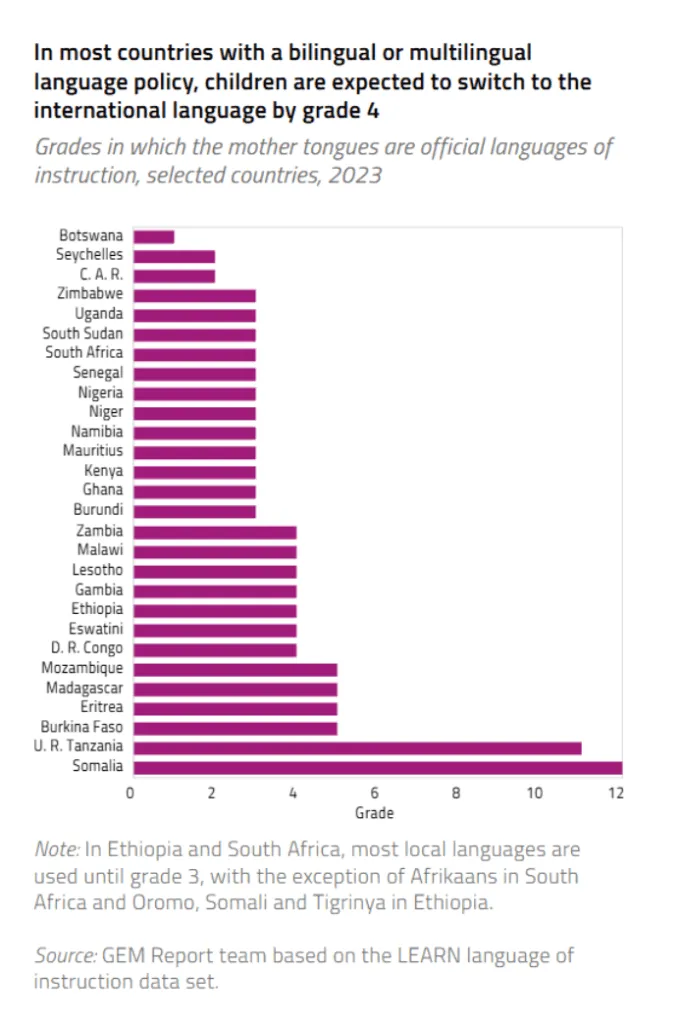
According to analysis in UNESCO’s 2024 Spotlight Report, 31 African countries - 57% of the total - have adopted a policy of teaching early literacy in the first language before transitioning to a second language. But 23 of these countries transition too early, before Grade 5. Even afterward, while regional languages may remain as subjects, they often don’t carry through as the language for learning core subjects.
This difference is fairly large. A language briefly studied and a language that serves as the foundation for learning play different roles. The Algeria case shows the same thing. Even with high official status, if the language isn’t connected to reading, writing, and subject learning from the early elementary grades, classroom-level change will inevitably be slow.
The conditions needed on the ground are clearer than you might think.

Policy text alone doesn’t change classrooms. Lessons, the next year of teaching, evaluation, and follow-up projects only continue when there’s a record of what was actually taught and what level was reached. In that context, approaches like outcome certification or digital badges can make the system visible. They allow you to see not just whether someone participated, but what learning experiences and competencies were accumulated.
The success or failure of mother-tongue education depends less on whether the language has been recognized, and more on whether it has entered the first few years of school instruction. When the starting point is late, when the subject is separated from other content, and when teacher preparation is missing, even good policy can easily remain symbolic.
Frequently asked questions
Q. Why is starting from Grade 4 considered late?
A. The early grades of school are when the foundations of reading and writing are formed. If the language enters after this period and only as an elective, its role in supporting the learning foundation diminishes significantly.
Q. Isn’t teaching mother tongue as a subject enough?
A. No - when it’s only a subject, it tends to stop at learning the language itself. It only functions as a language of learning when it’s connected to core subjects like math and reading.
Q. In the Algeria case, was the biggest obstacle the standardization debate?
A. That’s one factor, but the bigger problem was the operating system. When teacher training, instructional materials, and evaluation standards don’t move together, policy struggles to take hold in the classroom.
Q. Do other African countries show similar limitations?
A. Yes. Quite a few countries have adopted first-language-based policies, but many transition to a second language too quickly. As a result, the early effects often fail to carry through.
Q. How can the results of these policies be confirmed?
A. What matters more than simple participation numbers is which lessons were completed and what level was reached. Only when learning stages and achievements are recorded can you judge whether the policy actually worked.
Q. How can digital badges change mother-tongue education?
A. They help leave a verifiable record of what was completed and what was achieved on the ground. Institutions can more easily explain their operational results, and learners gain evidence to carry their learning experience into the next stage.
The reason good policy often stops at the classroom is usually that operations and records are missing. If you’d like to leave educational completion and achievement in a more concrete way, it may be worth a casual look at how Kolleges supports outcome management and connection to the next learning step.
Frequently asked questions
Want to turn learning outcomes into verifiable assets?
From issuing to verifying and amplifying, see it for yourself with Kolleges.
Request a Kolleges demoRelated posts

From Certificate Issuance to Connection: The Next Step in Outcome Management
Standards like Open Badges, CLR, and LER transform one-off certificate issuance into a connected, reportable flow of learning and employment outcomes.

When Grades Aren't Enough: How Do You Capture Student Competencies?
Transcripts capture scores but not skills - digital badges and CLR close that gap by connecting learning objectives through CASE to portable, verifiable competency records.

Korea's Global Education Strategy: Where Does It Stand Today?
As Korea pursues 300,000 international students by 2027 and expands Asian joint programs like CAMPUS Asia, digital badges have become essential infrastructure for proving learner outcomes across borders.