
Running University Digital Badges: The Difference a Portal and Co-issuance Make (A Daegu Haany University Case)
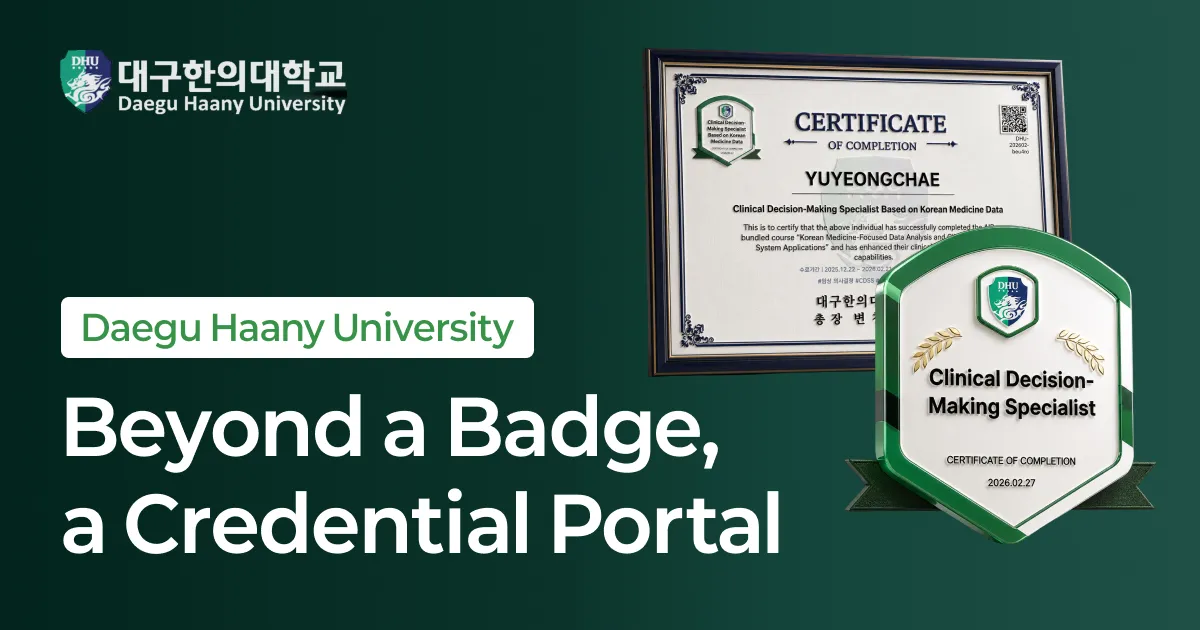
University digital badges come down to operational structure beyond badge design. We lay out the differentiators that professors, education-innovation offices, and industry-academia foundations should look at: the dedicated portal Daegu Haany University built on Kolleges, co-issuance where two institutions sign together, KOLLEGES VERIFIED verification, and automatic issuance.
When a university reviews digital badges, the first thing it looks at is the badge’s design and polish. A well-made badge matters as an asset that keeps the school brand alive for a long time. But once adoption is decided, the difference you feel at the operational stage splits at what comes next: where the issued outcomes gather (the portal), who certifies them with you (co-issuance), and how you make that issuer trusted (verification). Looking at the digital badge portal that Daegu Haany University, selected for Glocal University 30, built on Kolleges, you can see concretely how these three create different results.
Beyond badge design, a ‘certification portal’ where outcomes gather
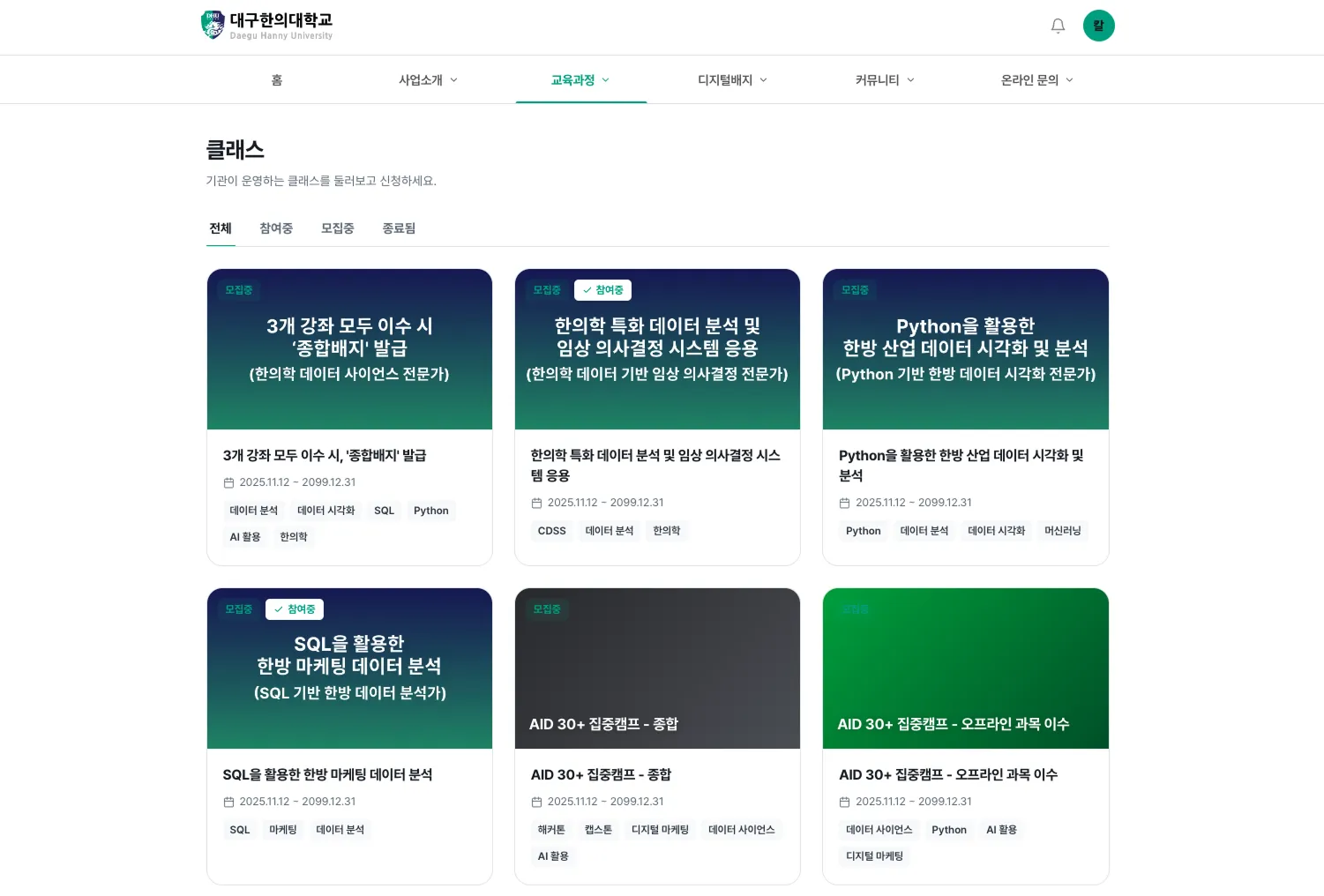
Polished badge design is a basic premise; the difference at the operational stage splits at where and how the issued outcomes gather. Daegu Haany University bundled its course catalog, issued credentials, verification, community, and inquiries into one place on a dedicated-domain portal (dhuaid.kolleges.net). The badge works not as a single file but as the institution’s certification hub.
The Daegu Haany University portal is not a mere badge locker. On the issuer page, the 7 issued credentials are visible at a glance, classified into qualifications and certificates of completion, and learners check whether they have received them on the same screen. The top menu places the course catalog (AID 30+ Intensive Camp, AID bundled courses), digital badges, a usage guide, and community together.
The difference becomes clear from an operational standpoint. If you deliver badges only as individual files, outcomes scatter; the portal aggregates every certification the institution issues in one place.
| Aspect | Simple badge issuance | Certification portal (Daegu Haany University) |
|---|---|---|
| Outcome storage | Badges delivered as individual files | Issued credentials aggregated in one portal |
| Institutional exposure | Centered on the badge image | A dedicated-domain, course, and community hub |
| Verification | Hard to confirm file authenticity | Issuer, co-issuer, and signature confirmed in stages |
| Re-engagement | No link to the next course | Connected via 'next step' course recommendations |
Multiple institutions certify one outcome together: the co-issuance structure
Co-issuance is a structure where two or more institutions participate in one digital credential as ‘lead’ and ‘co’ roles and sign it together. Daegu Haany University’s ‘AID 30+ Intensive Camp Comprehensive’ certification is issued jointly by two institutions, Daegu Haany University (lead) and Pureum Talent Development Institute (co), and both are confirmed on the verification screen. It can hold industry-academia or consortium outcomes on one credential.
This is where industry-academia foundations and education-innovation offices should pay attention. A university’s outcomes increasingly belong not to one department or one institution alone. For a capstone done with a company, a course co-run with an association, or the result of a project linked with a local government, ‘who certified it’ determines trust.
In the Daegu Haany University case, verifying the ‘AID 30+ Intensive Camp Comprehensive’ badge returns the result ‘two co-issuing institutions confirmed.’ Applying the same structure to an industry-academia project, a company and a university can put their names on one credential together and create a certification where both are verified.

Standards alone are not enough: a trust layer that verifies the issuer
International standards (W3C Verifiable Credentials 2.0, Open Badges 3.0) guarantee that a badge has not been altered after issuance. But ‘is that issuer real’ is a separate question. Kolleges adds a KOLLEGES VERIFIED grade that confirms the issuer’s email and contact, verifying the credential, the issuer, and the co-issuer in stages.
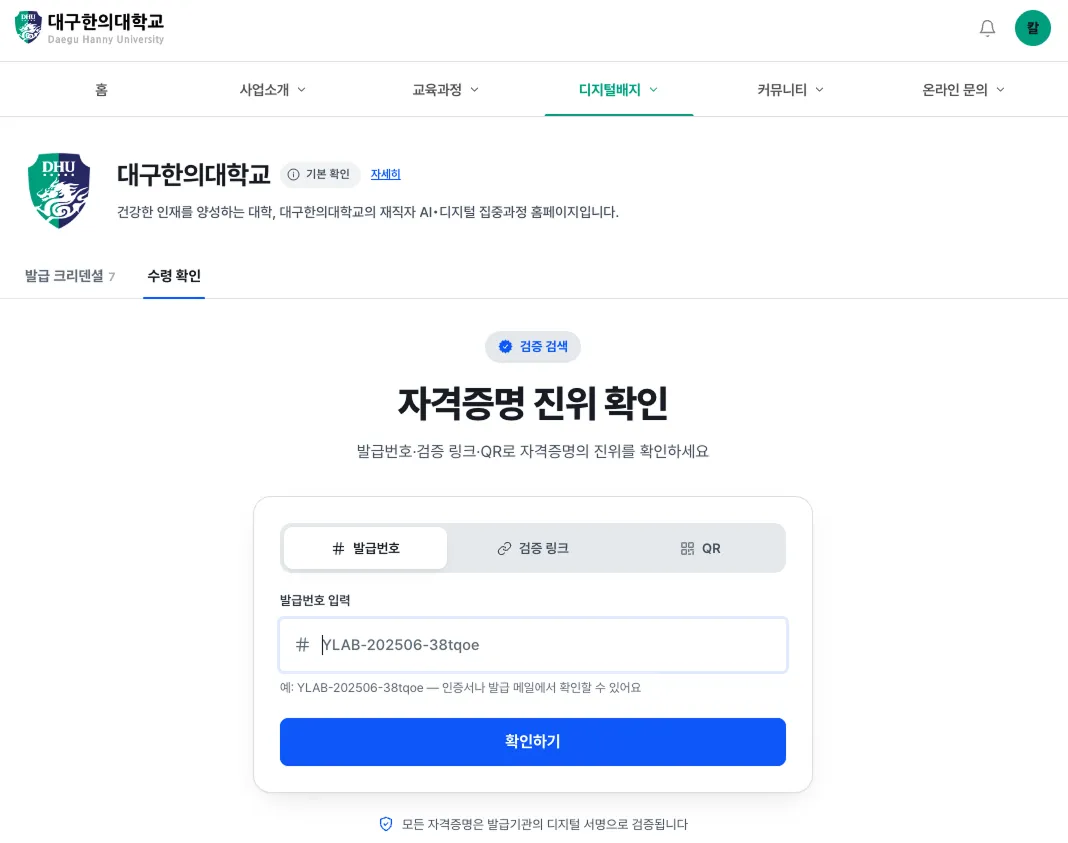
Standards compliance is now a basic premise of a digital badge. Daegu Haany University’s badges are also recorded with W3C VC 2.0 and Open Badges 3.0, cannot be altered after issuance, and the downloaded PDF carries the same verification QR and URL. Authenticity checks follow the 1EdTech Open Badges specification.
The differentiation sits on top of that. The verification screen confirms, in order, the recipient, the issuer, the credential ID, the issuer signature, and the co-issuer, and separately displays the issuer’s identity-verification status (KOLLEGES VERIFIED). It shows on one screen not only whether the badge is genuine but also whether the institution that issued it can be trusted.
From course to badge: issuance, automatically
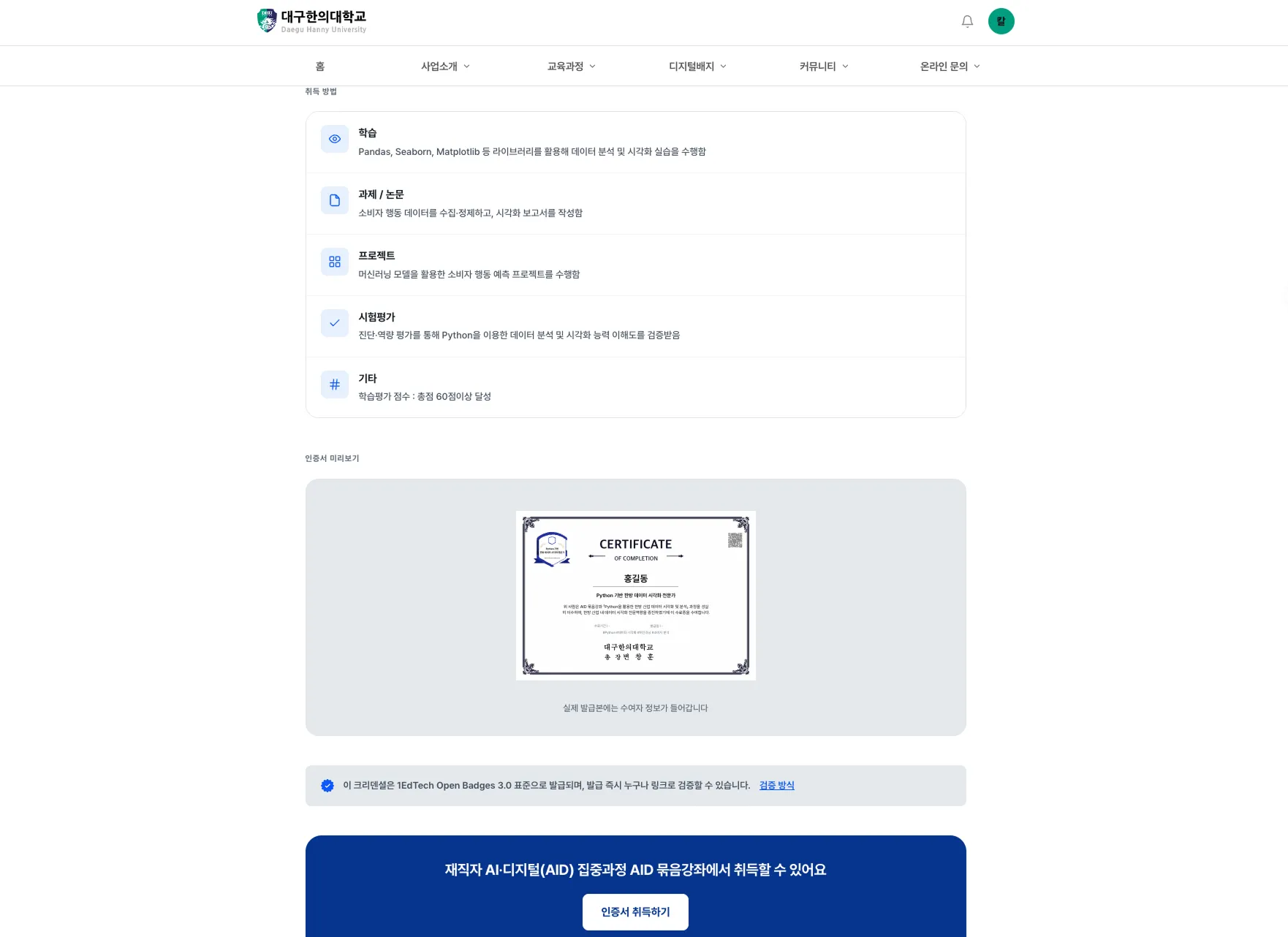
The Daegu Haany University portal is connected so that once you define issuance conditions on the course page, badges are issued automatically. Meeting criteria like a mission-completion rate triggers automatic issuance, and earning conditions are stated concretely, such as ‘project, hands-on experience, offline activity.’ Unit-course badges are bundled into higher certifications like ‘AID 30+ Intensive Camp Comprehensive.’
Automation is the key to reducing operational burden. The course page shows the badge to be issued together with the issuance conditions (mission criteria), and it is issued automatically to learners who meet the conditions. The less manual issuance there is, the more suitable it is for large-scale operation.
That the earning conditions are not vague also matters. The ‘AID 30+ Intensive Camp Comprehensive’ badge states as conditions a project designing an industry-specific product recommendation system with generative AI, hands-on experience planning an integrated marketing strategy with Korean-medicine, food, and beauty industry data, and an offline activity whose practical fit was validated by feedback from working experts. Skills are also tagged as AI, data science, capstone, and hackathon, meshing with the language of the hiring market.
It does not end at issuance: sharing, use, and the next step
A digital badge’s value comes not from issuance but from use. Daegu Haany University learners share credentials on their LinkedIn profile, social media, and as PDFs, and the portal recommends ‘next step’ courses to connect them to re-engagement. The recipient’s name is protected as a pseudonym before receipt, switches to the real name once received, and the certification is kept permanently.
On the credential screen, the buttons ‘Share this achievement,’ ‘Download,’ and ‘Add to LinkedIn profile’ sit side by side. Learners post outcomes in a verifiable form on resumes, portfolios, and LinkedIn, and that sharing in turn becomes promotion for the institution.
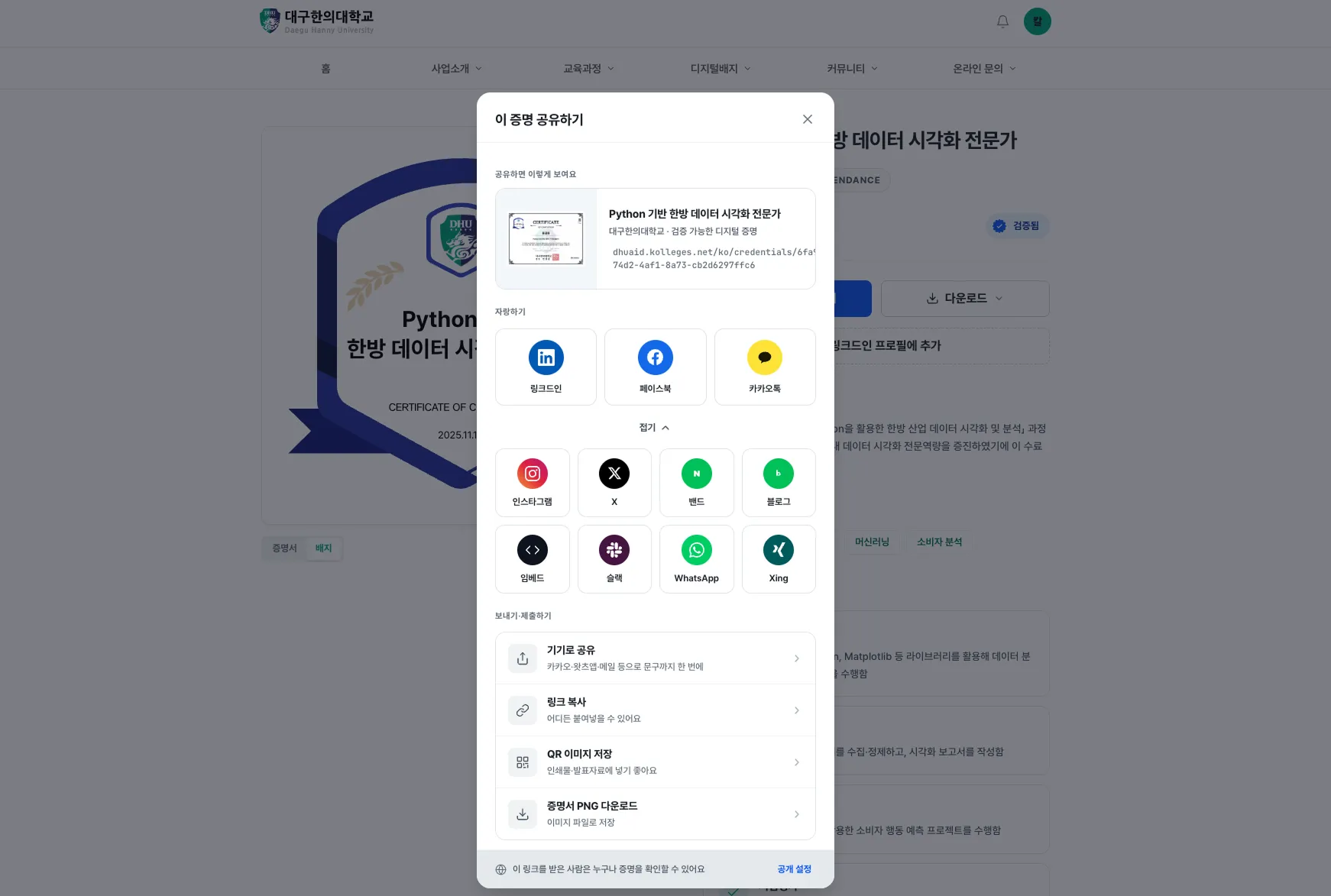
A re-engagement device is designed in too. Below the ‘comprehensive’ certification screen, the next course is presented, like ‘Next step: complete the AID 30+ Intensive Camp offline course.’ It is a structure where the issued badge becomes the entrance to the next learning. If you are a university staffer with the same concerns, it is worth checking first what changes by role.
A well-made badge is the basics; what makes the real difference on top of it is the structure of certification. Gather outcomes in one portal, certify them with multiple institutions, verify that trust in stages, and automate issuance to connect to the learner’s next step. The Daegu Haany University case shows what changes when a digital badge goes beyond ‘a single badge’ to become an institution’s certification infrastructure.
Frequently asked questions
Want to turn learning outcomes into verifiable assets?
From issuing to verifying and amplifying, see it for yourself with Kolleges.
Request a Kolleges demo
Related posts
When AI Takes Over the 'Doing': How University Majors and Digital Badges Are Changing
When AI takes over the 'doing' of a major, what should universities teach? Daegu Haany University, a Glocal University 30 institution and the only triple AID30 winner, redefines competency as domain knowledge to problem definition to AI execution to selection, and records the results as verifiable digital badges. An interview with Vice Director Park Seung-hee.

How to Connect RISE Performance with a Three-Tier Digital Badge Structure: A University of Seoul Case
The University of Seoul's RISE project team bundled the outcomes of 7 programs across 3 areas (industry-academia cooperation, AI, and convergence regional innovation) into 15 digital badges. This is the design behind a three-tier structure connecting unit badges through pathways to a comprehensive certification, turning scattered university achievements into verifiable one-line credentials.
Uhyeonmoon Gallery | Exhibition Records Once Lost When a Space Closed Now Live On as Digital Badges
Fifty-one young artists selected on a professor's recommendation. The exhibition ends, but the credential remains. An interview with Kim Sun-hak, CEO of Uhyeonmoon Professional Arts Organization.