
When AI Takes Over the 'Doing': How University Majors and Digital Badges Are Changing
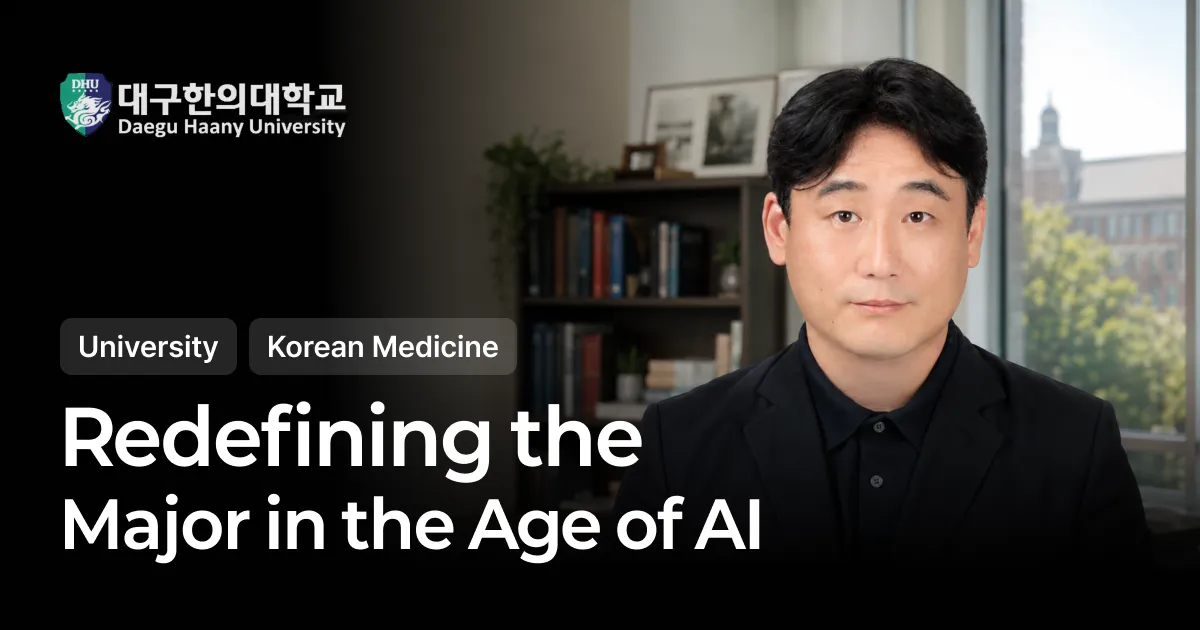
When AI takes over the 'doing' of a major, what should universities teach? Daegu Haany University, a Glocal University 30 institution and the only triple AID30 winner, redefines competency as domain knowledge to problem definition to AI execution to selection, and records the results as verifiable digital badges. An interview with Vice Director Park Seung-hee.
An interview with Park Seung-hee, Vice Director of the AID30 Intensive Camp Project Group at Daegu Haany University
Daegu Haany University is a K-MEDI specialized university with roots in Korean medicine. The first protagonist of the AI education this university now pours the most effort into was not students but ‘incumbent workers.’ Through the Ministry of Education’s AID30+ program, the project group taught AI to workers aged 30 and over and became the only group in the country to win the ‘AID30 triple crown’; it is now transplanting that experience into students. Digital badge issuance, which started last year with 8 types and about 400 badges, grows to over 1,000 this year. At the center of it, we met Park Seung-hee, Vice Director of the AID30 Intensive Camp Project Group, who is redefining ‘what a major means in the age of AI.‘

When AI takes the ‘doing’ of a major, what should a university teach?
Vice Director Park Seung-hee sees major competency as a combination of ‘knowing’ and ‘doing.’ In an era where AI takes over much of this ‘doing,’ the ability a university should cultivate is the ability to define problems on top of major knowledge and to judge and select from the results AI executes. The weapon for using AI well is, paradoxically, major knowledge (domain knowledge).
Until now, the backbone of university education has been general education and the major, and within that, major competency has been steadily strengthened. The demands of industry kept pulling on four-year major design, and one more layer was added on top: the variable of AI.
“Major competency held both knowing and doing together. But this ‘doing’ part is bound to be transferred, in part, to AI going forward. Before, the focus was on knowing a major well and performing it well; now, we’ve defined it as shifting like this.”
- Park Seung-hee, Vice Director
The ‘changed competency’ he laid out is closer to a workflow. It places the AI that handles execution in the middle, and arranges the abilities a person should have before and after it.
The ability to run this cycle, he says, must become every student’s foundation. He saw this change as already the reality of the hiring market.
U.S. companies have already all moved over and don’t look at anything else. Just ‘the portfolio of projects you carried out using AI.’ Korean IT companies are gradually moving this way too, and this will become universal.
Here his logic does not drift toward ‘you only need to handle AI well.’ If anything, he holds firmly to the opposite side.
“To have the problem-definition and decision-making abilities up front, you need what’s called domain knowledge. Without knowledge of the major, this doesn’t work. The more major knowledge you have, the better you can define problems correctly and judge correctly. So my goal is to build an education system where these go together.”
- Park Seung-hee, Vice Director
So the picture he draws is not ‘abandon the major for AI’ but a convergence that ‘puts AI on top of the major.’ This philosophy has already come down as a concrete university-level directive. Following the direction from Glocal University 30, Daegu Haany University has decided to attach an AI convergence track to at least 30% of every major, and began designing it this year.
Why incumbent workers came before students (the country’s only ‘AID30 triple crown’)
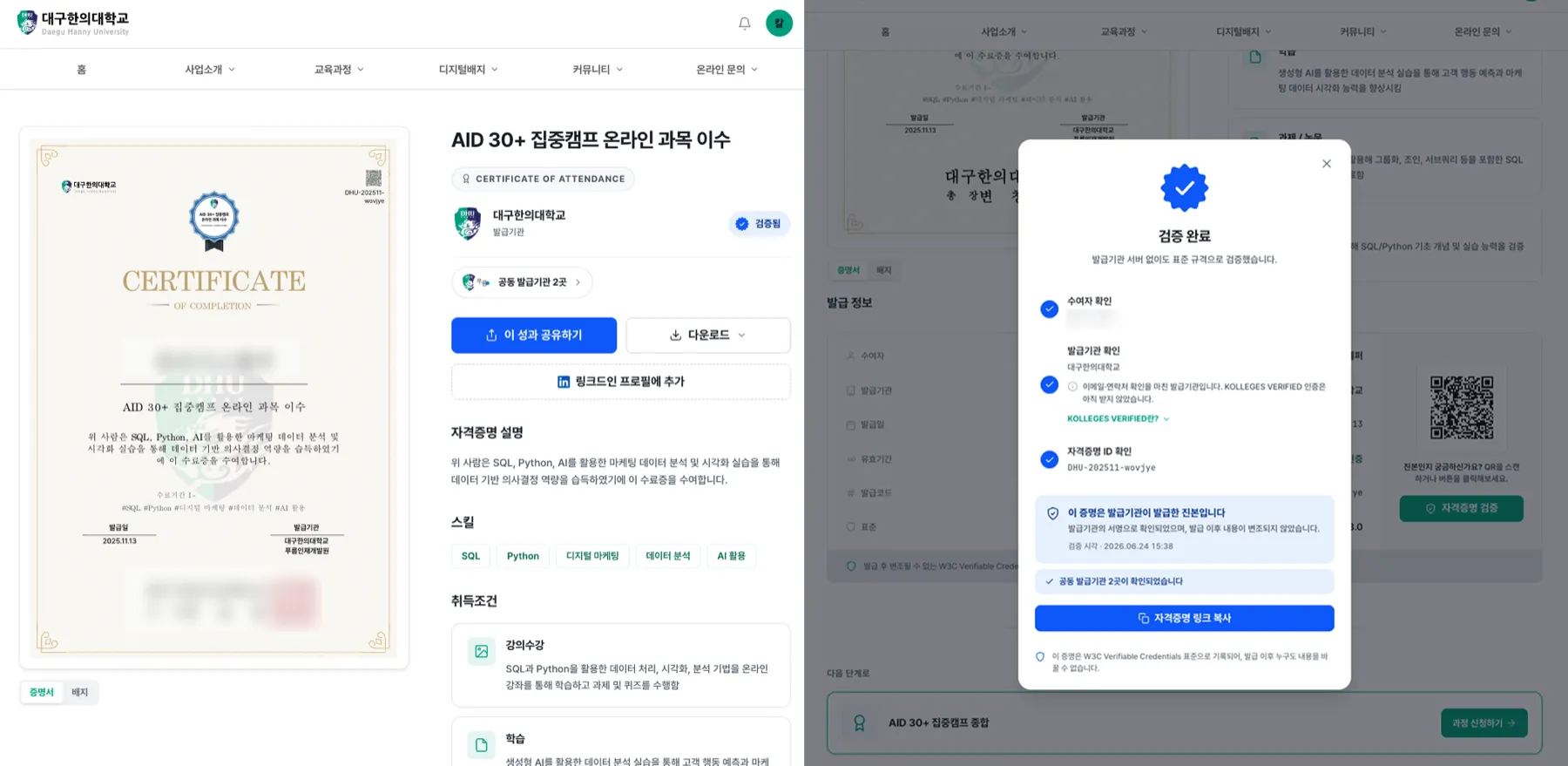
Daegu Haany University’s AI education was built from the start toward ‘incumbent workers in the field’ rather than ‘students on campus.’ That’s because the Ministry of Education’s AID30+ program is a national policy to build the AI capabilities of workers aged 30 and over. So the digital badges here emphasize proving the ‘ability to solve problems with AI on the job’ rather than simple completion certificates.
Daegu Haany University took on the Ministry of Education’s ‘AID30+ Intensive Camp’ as the representative for the Gyeongbuk region. The 2025 intensive camp received the top grade, S, in its annual evaluation, and with consecutive selections for the 2025 and 2026 bundled courses, it became the only institution in the country to win the ‘AID30 triple crown.’ The intensive camp is a 16-hour integrated course, run from July to December across 21 cohorts at a scale of 420 people.
“Limited to the AI program, since it targets incumbent workers rather than students, we had no choice but to design it for incumbents. It’s a course designed with a focus on how incumbent workers will use AI to solve various problems on the job.”
- Park Seung-hee, Vice Director
So the meaning of the digital badges this program issues also differs from a typical ‘completion certificate.’ The fact that the 2026 bundled courses were designed from the start in units of ‘work you can use right away in the field,’ such as ‘a solo AI-marketing course using vibe coding and generative AI’ and ‘practical marketing data use with Python,’ is in the same vein.
The digital badges we issue now, too, emphasize not simply that you attended something, but the ability to solve problems with AI on the job.
From incumbent workers to students (‘transplanting,’ not ‘spreading’)
Daegu Haany University chose the order of transplanting the education model it first validated in the AID program for incumbent workers into faculty, staff, and students. The project group calls this process ‘transplanting,’ not ‘spreading.’ It is a phased approach: run the ‘DHU Intensive Camp’ for professors, staff, and freshmen this summer first, and in the second semester, operate one entire major as an AX curriculum.
Last year the project group conducted research asking ‘how should we design AI education for our university’s students,’ and is now working out the implementation plan.
“Broadly it’s expansion, widening the target, but in our concept we see it as ‘transplanting.’ We’re transplanting the education we tried first on incumbent workers into students.”
- Park Seung-hee, Vice Director
He said President Byun Chang-hoon’s mission points the same way: not to end the AI education received through the Ministry of Education program with incumbent workers, but to cement it for faculty, staff, and students too. As a result, the AID project group came to serve as a kind of testbed within the school. Starting this summer, it runs the ‘DHU Intensive Camp,’ a university-member version of the AID30 intensive camp, for 80 professors, 80 staff, and 80 freshmen. In this 6-to-8-hour mini camp, professors and staff learn how to AX (AI-transform) core tasks to innovate their workflows, while freshmen internalize AI-based self-learning methods.
Beyond that, he revealed a plan to transplant the AID intensive camp’s AX education capability into regular courses in the second semester. Taking the Department of Clinical Pathology of Jang Jeong-hyun, head of the Educational Innovation Office and also the director of the AID30 Intensive Camp Project Group, as the designated department, the plan is to operate the entire major of clinical pathology as an AX curriculum in the second-semester general-education course ‘My Job, My Major Changed by AI.’ It is the first step of a phased modeling that, starting with a general-education course, will transplant the model validated by the project group into each major’s curriculum.
Why Daegu Haany University chose digital badges, and why Kolleges
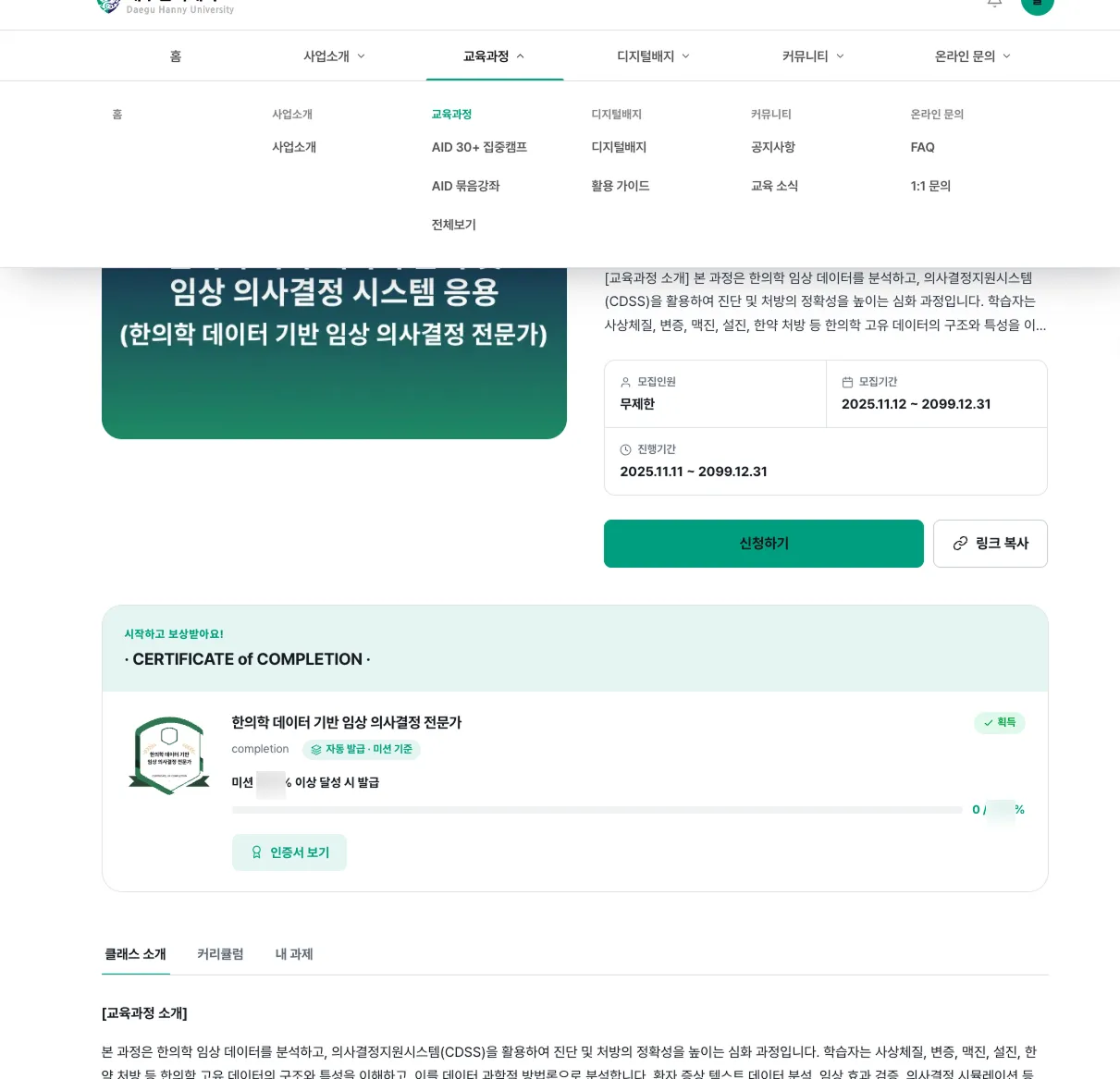
If a portfolio of projects carried out with AI becomes the evidence of competency, that competency must be recorded in a verifiable form. That’s why Daegu Haany University adopted digital badges in 2025. The project group surveyed nearly every vendor, but did not place cost at the center of its judgment. For a certification system tied to students’ careers, ‘can it be trusted’ came first.
The project group’s researchers had investigated nearly every digital badge vendor in detail. The option that remained at the end was Kolleges, and the reason was ‘trust.‘
Because it’s a system directly tied to students’ careers, whether the cost is high or low isn’t what matters. What matters is whether it can be trusted and how much utility value it can provide. After follow-up investigation, we could trust it 100%, and Kolleges was the only one that builds it custom for the school, almost like in-house development.
He intentionally pushed cost, which often becomes the top priority in a typical solution purchase, to the back. Behind that judgment was the recognition that a badge is not a mere image file but a vessel holding a student’s record and the school’s trust. The badges Kolleges issues follow the international 1EdTech Open Badges specification, supporting online authenticity checks and verification by external systems.
One year in: what was good and what remains homework
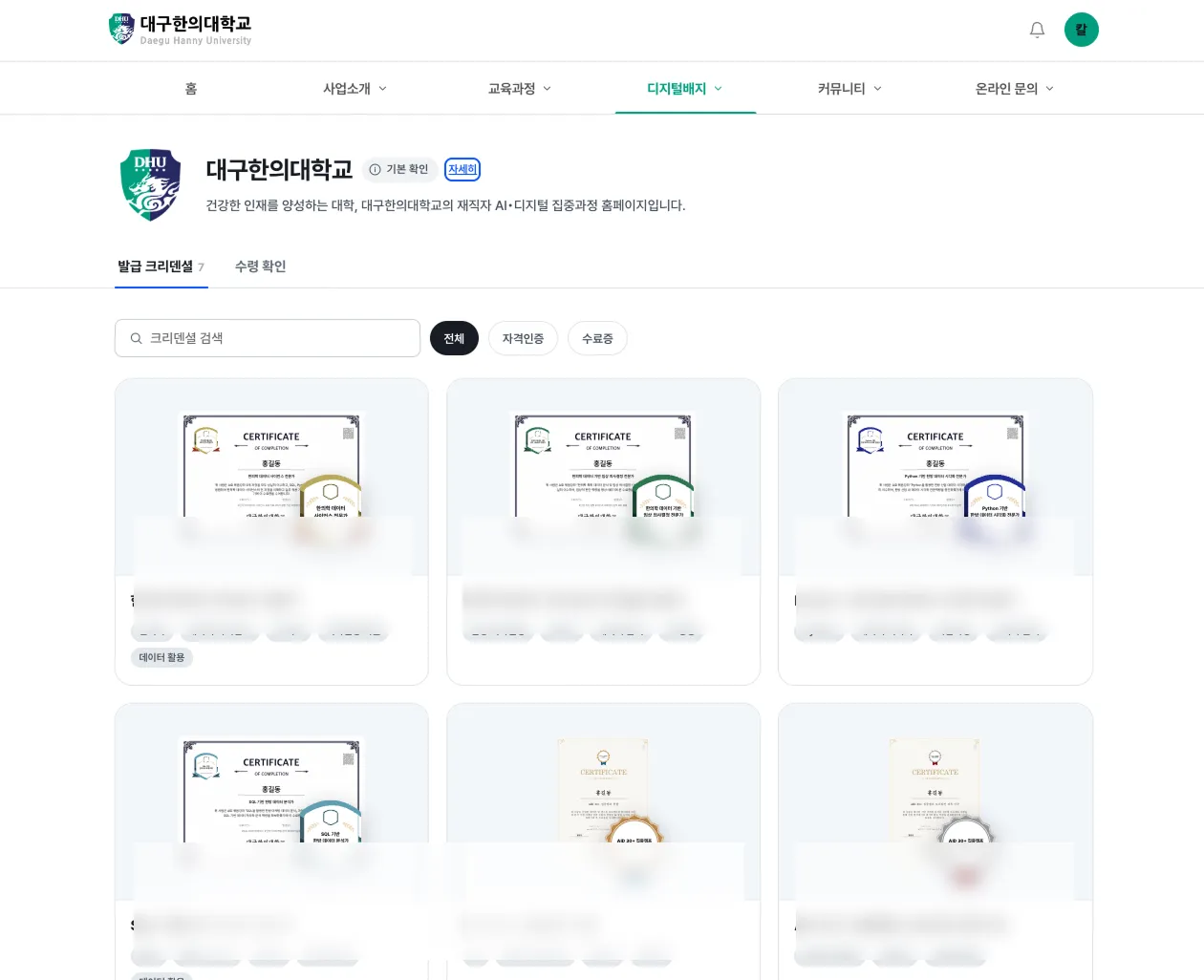
In its first year, what Daegu Haany University was most satisfied with was ‘design’ and ‘after-care.’ Badge design came with certificate design too, widening where students could use them, and templating allowed free edits. The decisive reason was attitude rather than features. The operating style of not abandoning it after the build but continuing to understand the school and propose what it needs led to trust.
The first thing they were satisfied with was design, but not simply for aesthetics. It’s because the school brand remains on a badge forever. Unlike a typical vendor that gives just one badge image, having both the badge and certificate design handled diversified where students could use them. Still, the decisive reason he felt he ‘chose well’ was the attitude after adoption.
“Usually, systems adopted by an LMS or a school get no attention at all once the build is done. But Kolleges even came to do an interview today, keeps trying to learn about our school in detail, tries to find what we need, and proposes it. So I trust them more.”
- Park Seung-hee, Vice Director
Not everything was smooth. That day, the project group expressed candid concerns about the ‘pathway’ feature launching at the end of June. This part is closer to ‘homework to solve together’ than a ‘solved boast.’
A pathway is a growth route that connects badges stage by stage. The project group pointed out that if a review is attached every time a stage goes up, operations become unmanageable, and that connecting courses from different fields, like coding-centered bundled courses and Korean-medicine, food, and beauty camps, into one is awkward. Kolleges drafted a motivation-oriented design where only recommendations, not reviews, are added, and will have it reviewed again.
“I’m not confident about reviews. If a review concept enters the stage progression, it’s too hard. Something like a motivation element, where you just pass that stage, that would be good.”
- Park Seung-hee, Vice Director
Ultimately, competency that companies recognize (what the badge aims to prove)
The main reason Daegu Haany University issues badges is so that companies recognize students’ competency in a structured way, and so that competency is verified in practice. The competency Vice Director Park values most is ‘whether one can combine AI with one’s own job competency to actually contribute to a company’s AX transformation.’ The badge is a language that presents that ability to companies in a structured form.
Daegu Haany University students pass through diverse majors such as the beauty field and clinical pathology and go on broadly to hospitals, medical-device developers, Korean medicine clinics, and pharmaceutical companies. That is why ‘how companies will recognize student competency’ becomes the badge’s starting point.
Whether companies can view our students’ competency in a structured way, and whether it can be used in actual practice, being verified, is the main reason we issue badges.
He expected the badge to extend into matching that connects companies and students, and further into industry-academia cooperation. He hopes it helps companies recognize student competency more credibly, and becomes a channel for schools and companies to seek competency-building or joint projects together.
“What I see as most important is whether one can combine AI competency with one’s own job competency to actually contribute to a company’s AX transformation. In the end, you have to build the work and skills companies need to be recognized in society.”
- Park Seung-hee, Vice Director
Here the picture from the start of the interview comes full circle and closes. In an era where AI takes the ‘doing,’ a person’s weapon is the ability to define problems on top of major knowledge and to judge results. A student proves that ability through real projects, and the last square, recording that proof in a form companies can recognize, is where the digital badge sits. For Daegu Haany University, a badge is not an ornament of completion but a language that presents, in structured form before companies, ‘what this student accomplished by commanding AI.’ The ‘major for the AI age’ that a university rooted in Korean medicine draws stood on the belief that those who know a major most deeply command AI best.

Frequently asked questions
Want to turn learning outcomes into verifiable assets?
From issuing to verifying and amplifying, see it for yourself with Kolleges.
Request a Kolleges demo
Related posts
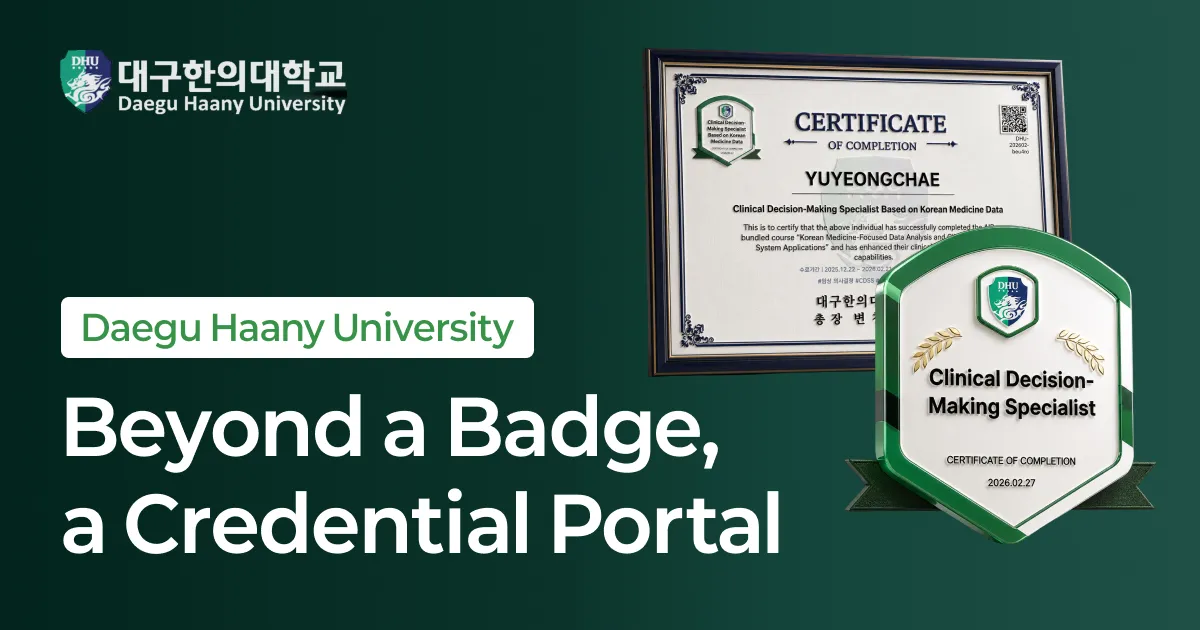
Running University Digital Badges: The Difference a Portal and Co-issuance Make (A Daegu Haany University Case)
University digital badges come down to operational structure beyond badge design. We lay out the differentiators that professors, education-innovation offices, and industry-academia foundations should look at: the dedicated portal Daegu Haany University built on Kolleges, co-issuance where two institutions sign together, KOLLEGES VERIFIED verification, and automatic issuance.
"Region, Industry, and University Thrive Together": President In-Seong Jang's Dongwon Institute of Science and Technology Opens the Next Stage of Regional Co-Prosperity with Digital Badges
Dongwon Institute of Science and Technology simultaneously rolled out Kolleges digital badges across three units, cutting national-program evidence work by 40% compared with paper certificates, and is now planning S/A/B grade differentiation to signal student competency to local employers.
Uhyeonmoon Gallery | Exhibition Records Once Lost When a Space Closed Now Live On as Digital Badges
Fifty-one young artists selected on a professor's recommendation. The exhibition ends, but the credential remains. An interview with Kim Sun-hak, CEO of Uhyeonmoon Professional Arts Organization.