
From no code to a first AI product: how UD IMPACT proves its 'AI startup education' across India and Indonesia
 Robin Yoon · Customer Success Team Published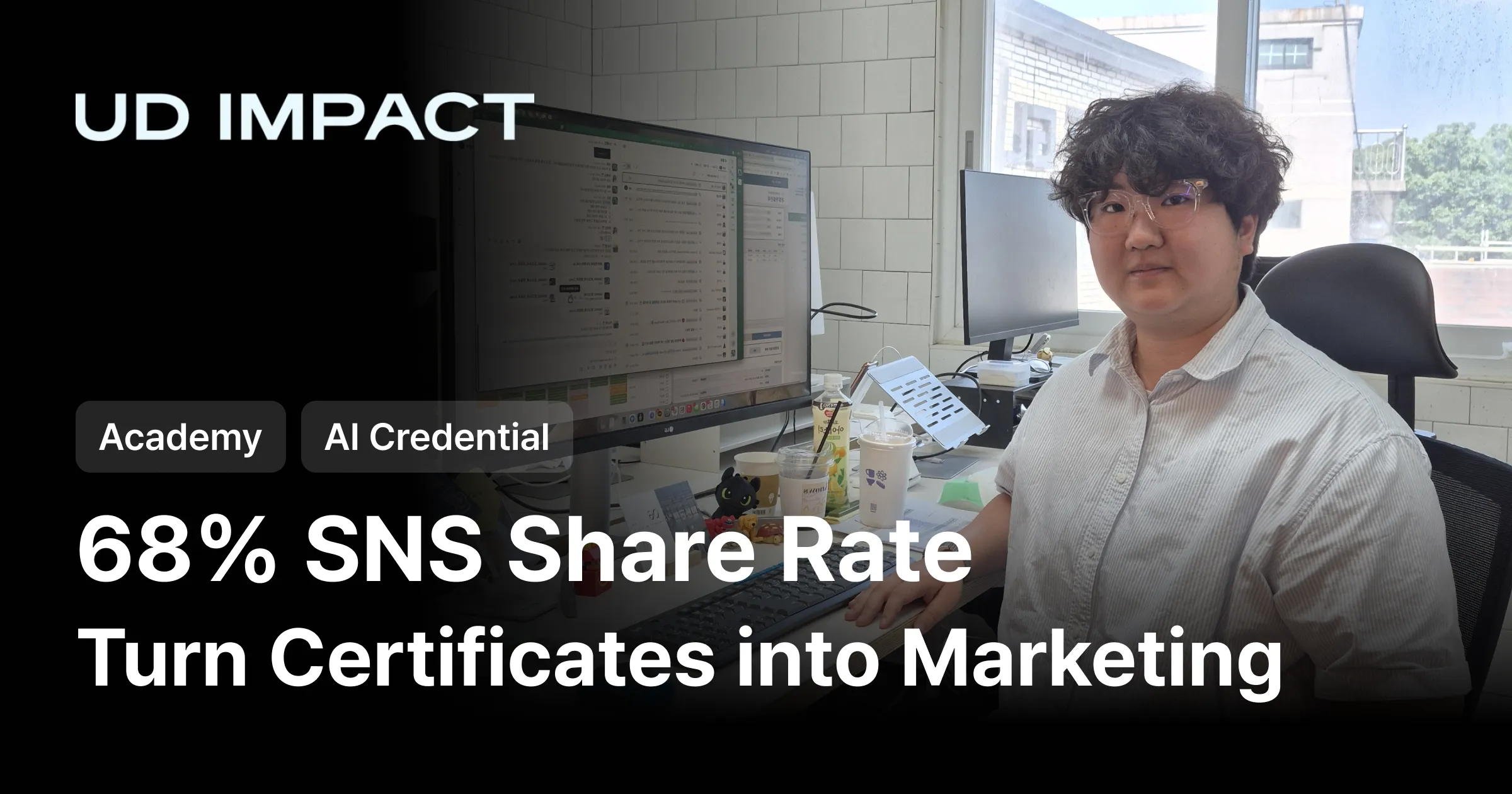
An interview on how UD IMPACT issued the completion proof for its India-Indonesia university AI startup course 'Action AI' as Kolleges digital badges - drawing 2,400 learners in two months in a free, no-code course and hitting a 68% social share rate on first issuance via API integration with its own LMS.
An interview with Choi Ri, Manager at UD IMPACT (underdogs)
UD IMPACT began in 2015 as underdogs, a hands-on startup-education brand, and has grown into a global ESG solutions company spanning entrepreneur training, social-value measurement, and AI-based talent education. It is now expanding its footholds beyond India and Japan into Indonesia. In under two months since launch, ‘Action AI Startup University’ drew roughly 2,400 learners across the two countries, and the share rate right after the first certificates were issued hit 68%. For students in environments where even computer penetration is low, UD IMPACT chose to hand them a verifiable digital badge instead of a paper certificate that can be printed and forged. We sat down with Choi Ri, the manager who planned and runs Action AI.

”The most common failure was a startup that only ever prepared” - 11 years of underdogs, becoming UD IMPACT
A company that has held onto a single word - Action - for 11 years
UD IMPACT started in 2015 as the startup-education brand underdogs, trained more than 30,000 entrepreneurs over 11 years, and has now expanded into a global impact platform spanning AI startup education and ESG measurement and assessment. The one principle it has never changed is ‘Action.’
Q. If you had to introduce UD IMPACT in one sentence, how would you put it?
“Building on 11 years of entrepreneur-training know-how since our founding in 2015, UD IMPACT is a leading Asian impact platform that spans everything from AI-based startup education to ESG measurement and assessment.”
- Choi Ri, Manager
There’s one principle the company has never changed, going back to its underdogs days: ‘Action.’ It defines its ideal entrepreneur with the word ‘Act-preneur’ - someone who turns slim odds into reality through action and sets off a chain of innovation.
Q. Why did you put the concept of ‘Act-preneur’ at the center?
“The failure pattern we saw most often in startup education was ‘ending up only ever preparing.’ Across thousands of participants, we confirmed that taking the first action - more than any idea or plan - grows a learner the fastest, and that philosophy became the design principle for every program.”
- Choi Ri, Manager
On top of that philosophy, the company has changed shape dramatically in recent years. It acquired Korea Social Value Assessment to move into ESG measurement and assessment, acquired F-Lab & Company to expand into AI talent mentoring, and set up local subsidiaries in Japan and India. It also developed and launched its own AI LMS purpose-built for startup education. It became the first certified social enterprise to attract Pre-IPO investment, and 16 alumni companies in the AI field - including Wrtn (₩130 billion in cumulative investment) - have raised a cumulative ₩143.9 billion, proving the results of its education in numbers. In the manager’s words, the company is now crossing from a ‘proving stage’ to a ‘scaling stage,’ and the stage for that expansion is Asia.
”The best startup-education company in Asia” - why India and Indonesia
Taking education they’d done plenty of at home to where opportunity is scarcer
UD IMPACT chose India and Indonesia as its first global stage for two reasons: it already had local subsidiaries and a coach network there, and it saw that where access to startup education is low, the impact education creates is greater.
Q. You launched Action AI in India and Indonesia rather than Korea. Was there a reason?
“Because we started as underdogs and are mainly a startup-education company, we’d done plenty of education at home, and we had a vision of sharing that experience with students abroad. We have a goal of becoming the best startup-education company in Asia, which turned our eyes overseas - and in the case of India and Indonesia, we have branches there and local coaches who can teach startup education, so we decided to do it together with them. That’s how we ended up running the education abroad.”
- Choi Ri, Manager
Neither market was picked by chance. In India, a partnership with TrueBalance (Balancehero) and a New Delhi subsidiary gave direct access to networks of top universities such as the IITs; in Indonesia, a Korea-UK-Indonesia global partnership running since 2017 formed the base. Within a coach network of more than 800 built over 11 years, coaches with global capabilities support the local learners.
On the difference between domestic participants and local university students, Manager Choi pointed to an ‘opportunity gap.’ Korean students already have some understanding of the startup ecosystem and role models, whereas university students in India and Indonesia have low access to startup education itself. In exchange, their hunger for change and their energy to act run high, and they’re strongly motivated by the very experience of ‘building, for the first time, a product with my name on it.’ The bigger the gap, the bigger the impact - that’s the calculation.
‘Your first AI product, with your name on it’ - even where computers are scarce: designing Action AI
Anyone, right now, a real deliverable
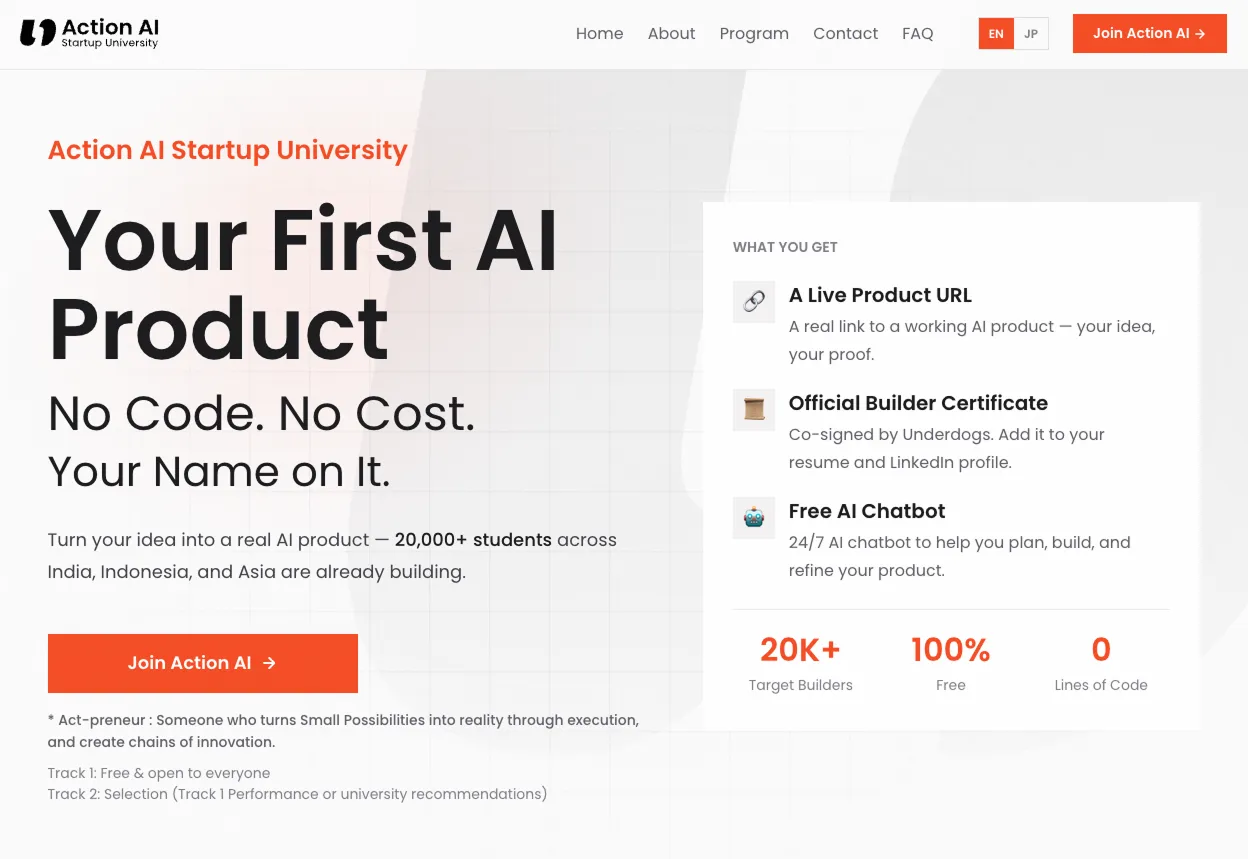
Action AI Startup University is a free program that lets you build your first AI product - with your name on it - with no code and no cost. In a 100% online setting, it draws out self-directed learning through a chatbot and worksheets, and learners produce real web-app deliverables with no-code AI tools such as Gemini and Lovable.
Action AI’s design principle is “anyone, right now, a real deliverable.” Build a product with no-code AI tools and no coding, flesh out ideas with free AI tools and no cost, and by the end of the course an AI product bearing the participant’s own name actually exists. But the reality this design ran into was no small thing.
Q. Why did local students have such low access to AI?
“In India, computer penetration itself isn’t high. The mobile environment isn’t great either, and the internet isn’t fast like ours. Here we’re usually split between using a Galaxy or an iPhone; there they use phones from brands you’ve never even heard of. So access to the internet and computers is low to begin with, which means access to AI is bound to be even lower.”
- Choi Ri, Manager
UD IMPACT didn’t provide hardware. In a 100% online course, it designed mechanisms that get students to keep themselves going.
Q. Any know-how for getting deliverables out of an environment like that?
“Since it’s 100% online, we put features like a chatbot into the LMS to encourage self-directed learning. As long as you have an internet connection - our program uses Gemini and Lovable - we created points for learners to think through and gave them as worksheets so they could implement exactly what they had in mind, and I think that worked rather well.”
- Choi Ri, Manager
Each tool has its own role. Gemini is for idea generation and market research; Lovable is the building tool for creating real web services with no code; Claude Code is for implementing features and refining content. It’s structured so students experience not ‘learning the tools’ but ‘solving problems with the tools.’ The course is staged: stage 1, ‘AI Essentials,’ removes the fear of AI tools, and later stages move into startup education where learners define a real problem and build a product.
“There were surely difficulties doing it on mobile, but because it’s training on building web apps, plenty of students did produce a working deliverable link and submitted it.”
- Choi Ri, Manager
It also discovered an engagement mechanism on the ground. After confirming that university students in India and Indonesia are motivated more strongly by the collective pride of ‘our university won’ than by individual achievement, it created ‘University Battle,’ a leaderboard by university rather than by individual rank. Participants began encouraging their teammates on their own.
2,400 learners in two months - the change observed on the ground
The self-efficacy of “I can build something with AI too”
In under two months since launch, the free Action AI course drew roughly 2,400 university students across India and Indonesia, and in Indonesia close to 1,000 students completed it all the way through. These are results from self-directed learning done on mobile, with no one forcing them.
The results showed up fast. As of now, 378 in India and 2,004 in Indonesia - roughly 2,400 gathered in a free course less than two months after launch.
Q. It’s free and 100% self-directed - did students go all the way to the end?
“It’s free and completely self-directed, so I see Indonesia’s completion rate of nearly 50% as somewhat unusual. If anything, once students completed it, the rate at which they then got their certificate issued and shared it was high, and I think that part matters more.”
- Choi Ri, Manager
In Indonesia alone, close to 1,000 students finished the course all the way through - a number that came out of free, mobile-based education with no one forcing them. Students who finish the program create and put out, with their own hands, a link to their first AI product bearing their name; a shift in perception from ‘AI has nothing to do with me’ to ‘I can solve problems with AI’ is happening on the ground.
”A paper certificate can be forged” - why they chose digital badges
The one reward that makes learners finish a free course
UD IMPACT chose digital badges because, in free education, a certificate is effectively the only reward a student can be given. A printable paper certificate can be forged, but a digital badge is issued and verified online and registered as a badge on LinkedIn.
If that’s the story of UD IMPACT so far, from here it’s the story of the last piece of the puzzle in running it. Free education has a structural weakness: there’s no mechanism to hold on to a student who hasn’t paid all the way to the end.
Q. You must have needed a mechanism to pull students through to completion.
“Since we run it for free, to carry these students through to completion we needed some benefit we could give - and for students in India and Indonesia, a certificate proving they completed the training turns out to matter.”
- Choi Ri, Manager
But why a digital badge? There are several ways to certify.
Q. There were other options - was there a reason you chose digital badges?
“In India and Indonesia, I understand it’s a culture where showing things like the courses you took and your university graduation on your profile matters. They use things like LinkedIn a lot, too. Our first judgment was that it would be best to give certificates in a form that lets these students highlight their record more; and if you let people print, on their own, a paper certificate of which institution they did it at, it can be forged. So we thought we needed something officially recognizable - that can be issued online and pinned as a badge on LinkedIn - and adopted it.”
- Choi Ri, Manager
If a certificate is the only reward a student can be given, that reward has to be real. The conclusion: not forgeable paper, but a form that’s verified with the issuer and criteria embedded as data. The badges Kolleges issues follow the international 1EdTech Open Badges specification, supporting LinkedIn registration and online authenticity checks.
They also compared solutions directly. The three reasons Manager Choi cited for choosing Kolleges were as follows.
“First, we had experience using it, and we’d been given a recommendation. With other companies, we judged there wasn’t much of a cost advantage, and Kolleges told us that if we needed it specifically just for this training, they could set up an LMS for us too. And as far as I remember, there were no cases other than Kolleges of it being used globally. Those were broadly the three reasons.”
- Choi Ri, Manager
A 68% share rate with no prompting - issuance automated, operations light
Issued inside the LMS, emails sent automatically
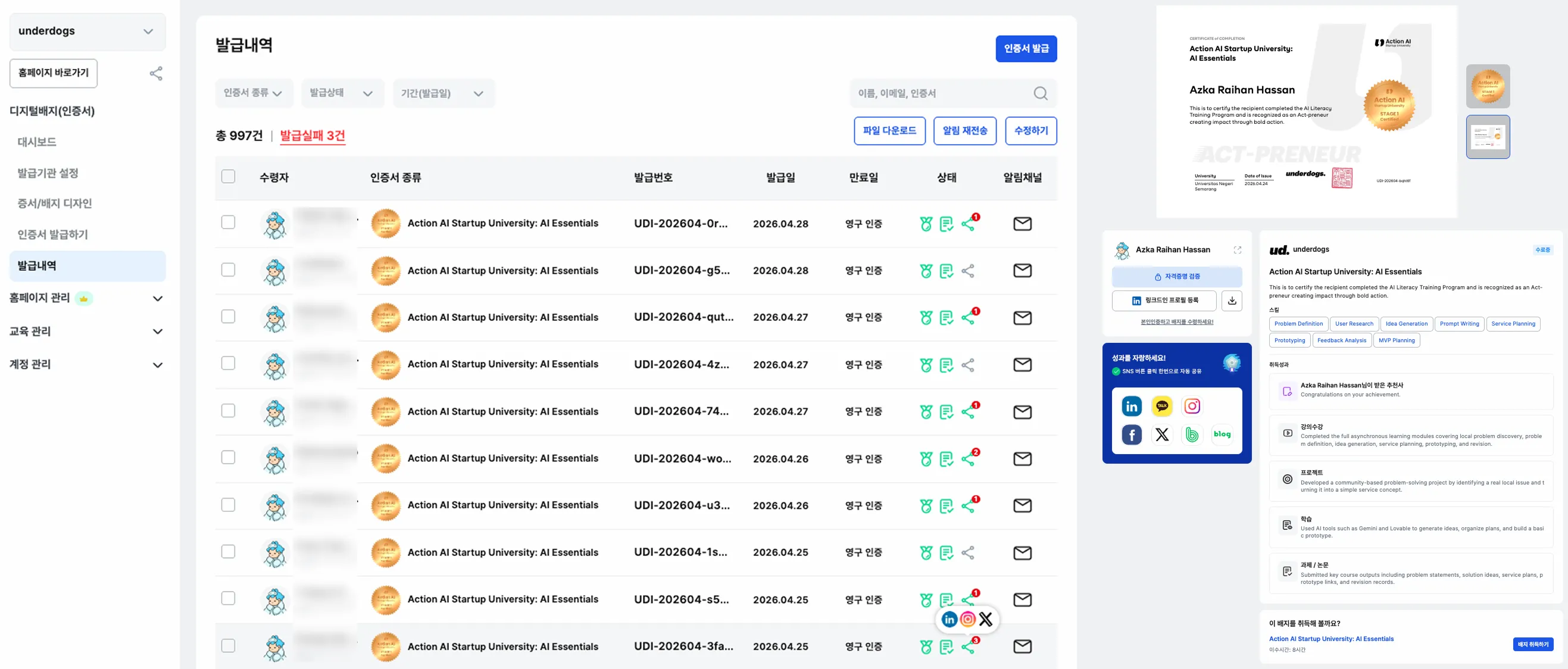
Right after Action AI’s first certificates were issued, the social share rate was 68% - a figure that came from nothing more than the LMS’s initial notice, with no separate campaign. UD IMPACT integrated its own LMS with Kolleges via API so that meeting the completion criteria activates the issue button and an information email is sent automatically.
Right after the first certificates were issued, the share rate captured on the Kolleges dashboard was 68%. That means two of every three students who completed it posted their certificate on their profile or social media. It was a figure striking enough that Kolleges reached out first, surprised.
Q. Was there a reason the share rate was so high? Did you run a separate campaign?
“No. We didn’t separately reach out or send guidance. From the start, the moment you entered the LMS, it was posted that if you take the course well and submit all assignments, a certificate is issued and you can put it on your profile - so maybe that had an effect. I hear that completing or finishing training carries weight over there, so I suspect they shared a lot in order to prove it.”
- Choi Ri, Manager
Given that the program is promoted mainly through universities, a shared certificate itself becomes the entrance to the next recruitment. Classmates and seniors and juniors see the badge on a profile, think “what’s this?,” and come in. The texture of operational inquiries changed, too.
“We get quite a lot of certificate-related questions - on what criteria it’s issued, whether what was issued is correct, and how to make use of it. More than questions about the learning environment, we get questions about how to use the certificate, so it does seem that giving a certificate at all - and being able to share it - is itself a draw. It has value as a reward to give learners.”
- Choi Ri, Manager
What about the operational burden? In global education at the scale of 2,400 people, issuing certificates by hand would have been a job in itself. UD IMPACT integrated its own LMS with Kolleges via API.
Q. It’s high-volume issuance - how was it on the operations side?
“With the API integration, we can issue from within our own LMS, and we can easily track at least whether something was issued or not, which I think was really good. The moment you open the screen, the number of successful issuances matters most to us - after the completion criteria are all met, we need to see how many were actually issued. There was nothing that was a big problem or inconvenience in operating it; if anything, having it integrated made things easier.”
- Choi Ri, Manager
When the completion criteria are met in the LMS, the issue button activates and the information email goes out automatically. What the operator sees is the number of completers, the number issued, and the number of actual recipients. The administrative task of issuance has, in effect, turned into metrics management.
Long names and a sign-up hurdle - a candid look at operations
The details that global issuance exposed
It wasn’t all good news. Applying a solution that had been used mainly by Korean institutions to global learners surfaced details no one had anticipated.
Q. Please feel free to share anything you found lacking or inconvenient in using it.
“Students in India and Indonesia have long names, you know. There was a character limit on how the name is written, things like that. And having to log in - having to sign up - just to receive the certificate seems to have been a hurdle for students. We had a few inquiries asking whether they really had to sign up. And early on, the English translation didn’t happen automatically depending on the country you accessed from, as far as I know.”
- Choi Ri, Manager
The download flow also came up.
“Right now, most of our operational inquiries come in about certificates. They’re all similar - logging in, or how to download, that sort of thing.”
- Choi Ri, Manager
This feedback was passed directly to Kolleges CEO Yoon Chang-jin at the interview, and some of it has already been reflected. The name character limit was improved in the course of the conversation, and English display by access region was reflected as well. The download button’s UX improvement is in progress. An API-integration approach that lets learners view and download certificates within their own LMS without signing up was also presented on the spot. The balance between a security design that means only the person receives the original credential containing their personal data, and learner convenience, is a problem Kolleges has to keep solving.
Even so, the point Manager Choi said she’d cite if recommending Kolleges to another institution wasn’t a feature.
Q. If you were recommending it to another education institution with similar concerns, how would you put it?
“Rather than recommending the functional side, I think I’d recommend how well they manage things. Responding right away when there’s an inquiry, and letting us know ‘there’s this feature, give it a try’ when we need one - that was what we needed most. We had a few things we requested very urgently, and they changed them right away, so I’d probably emphasize that part in a recommendation.”
- Choi Ri, Manager
”Like clearing a quest, like pinning on a medal” - stacking stages into a bigger badge
From a single certificate to a record of a growth path
UD IMPACT is envisioning a pathway structure where stage-by-stage completion - from AI Essentials to the startup track - is certified with badges, and collecting the lower-stage badges consolidates into a higher certification. For learners it becomes motivation to take the next stage; for the institution, a mechanism that creates re-engagement.
Action AI is a staged course. On a funnel that starts with AI Essentials and continues into startup education, Manager Choi was sketching the next stage for badges to go.
Q. What kind of structure do you want to take badges into going forward?
“Completing stages 1, 2, 3, and 4 drops off in a funnel shape. Someone who completes it in the end has proven they participated in the whole course really well. So when you’ve done all four stages, rather than having four badges, I thought it’d be nice to just give one bigger thing - and when you click it, the stages you went through show up in a little row underneath. So you can show that this person took it all the way to the highest stage and is therefore truly certified - like pinning on a medal. Like clearing a quest, with a main and subs.”
- Choi Ri, Manager
A structure where collecting the lower-stage badges automatically grants a higher badge, and the stages you went through are shown together inside the higher badge. For learners it becomes motivation to keep taking the next stage; for the institution, a mechanism that creates re-engagement. This idea led straight into a discussion of the Kolleges product roadmap at the interview.
The scope of use is widening, too. Another in-house education business team saw Action AI’s certificate form, inquired, and a new certificate has already been created. “It can probably be used in any education that issues a certificate,” is how Manager Choi put it. At the UD IMPACT level, it’s preparing expansion in three directions: country expansion into Southeast Asia and Japan, open innovation connecting global VCs with domestic AI startups, and platformization based on its own AI LMS. Amid the question of how to sustain the results of short-term education, Manager Choi described digital-badge certification as “the first button.”
Q. What role do you hope digital badges will play in your global expansion?
“It matters for students to show what they’ve completed and what abilities they hold, but really, by their registering it, we get our name out there too. So I hope it helps as much as possible in getting us known.”
- Choi Ri, Manager
Picture a student holding their first AI product - with their name on it - built with no code and no cost. Now, beside that deliverable sits a badge that verifies what they accomplished and at which institution. Not forgeable paper, but proof where the issuer and the criteria remain as data. For the student it’s a record of a first action; for UD IMPACT, a signal that calls in the next 2,400. The goal of becoming ‘the best startup-education company in Asia’ is being built on the place where those small proofs stack up across borders.
Frequently asked questions
Want to turn learning outcomes into verifiable assets?
From issuing to verifying and amplifying, see it for yourself with Kolleges.
Request a Kolleges demo Related posts

How to Grow Job Training Enrollment: Building a Structure Where Students Share Their Own Outcomes
Digital badges turn course completions into a self-sustaining referral loop - learners share achievements across 8 platforms with one click, cutting paid-ad dependency while driving 40% of new enrollments through word-of-mouth.

Automated Certificate Issuance in Just a Few Clicks
Kolleges automates certificate issuance end-to-end - upload an Excel participant list, set optional completion conditions, and the system generates and delivers every certificate in bulk with no manual editing.

Researching education for all: how SeeD connects a network of education experts
From fleeting association activities to verifiable records of growth - how SeeD adopted Kolleges digital badges.