
"Region, Industry, and University Thrive Together": President In-Seong Jang's Dongwon Institute of Science and Technology Opens the Next Stage of Regional Co-Prosperity with Digital Badges
 Robin Yoon · Customer Success Team Published
Dongwon Institute of Science and Technology simultaneously rolled out Kolleges digital badges across three units, cutting national-program evidence work by 40% compared with paper certificates, and is now planning S/A/B grade differentiation to signal student competency to local employers.
77.7% employment rate and 100% of incoming-student quota filled - the formula behind the numbers.
Interviewees: President In-Seong Jang, Team Lead Bo-Gyun Choi, Researcher Hee-Jin Park, Manager A-Reum Kim
Dongwon Institute of Science and Technology / Industry-Academic Cooperation Foundation (AID 30+ Intensive Camp Project Team, AI Education Innovation Center, SME Support Center)
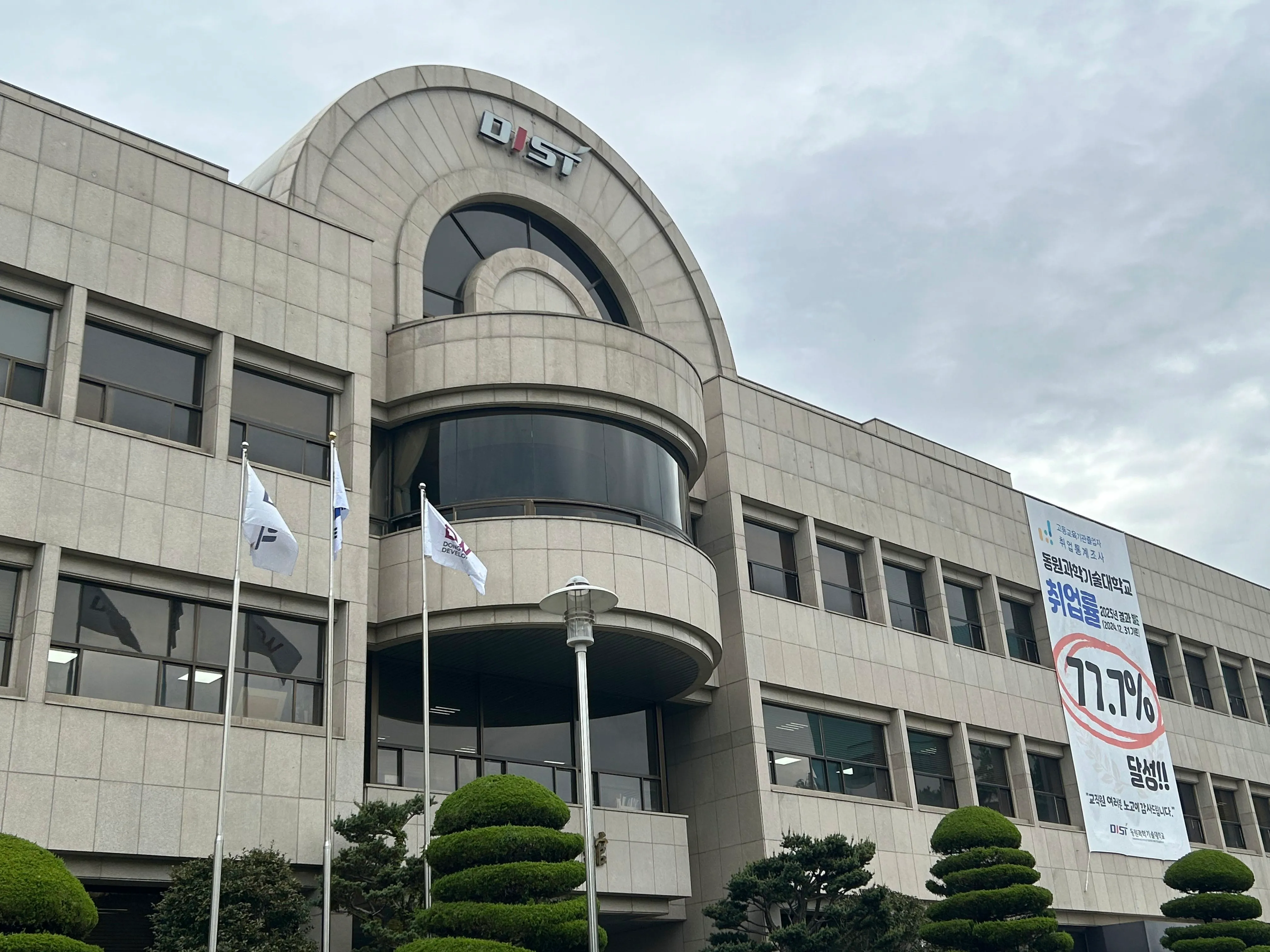
In his inaugural speech, President In-Seong Jang of Dongwon Institute of Science and Technology said the university would “ensure that the region, industry, and the school flourish together in mutual prosperity.” That sentence compresses how the university is run. In 2020, President Jang personally visited Yangsan City Hall to propose a program in which the university would directly support local SMEs; the program is now in its sixth iteration and remains rare nationwide. Built on that same orientation, the 2025 employment rate reached 77.7% (fifth-highest among junior colleges in South Gyeongsang Province), and the 2026 entering class fully filled its quota at 100%. As the next step in this regional co-prosperity structure, Dongwon Institute of Science and Technology adopted a digital badge system starting in 2025. Three units inside the Industry-Academic Cooperation Foundation - the AID 30+ Intensive Camp Project Team, an affiliated unit of Dongwon Institute of Science and Technology, and the SME Support Center - adopted Kolleges at the same time, and Kolleges was selected in the first-year project plan of the AID 30+ program after review by President Jang. President Jang participated in the interview directly, laying out concrete directions for advancing the program: strategies for securing credibility of digital badge credentials, the introduction of a grading system, the challenge of building corporate awareness, and a QR code-based linkage between badges and student personal statements. This article summarizes the interview with President Jang together with Team Lead Bo-Gyun Choi, Researcher Hee-Jin Park, and Manager A-Reum Kim.
1. Six years from a single sentence in an inaugural speech - the regional co-prosperity structure President In-Seong Jang has been building

The Industry-Academic Cooperation Foundation at Dongwon Institute of Science and Technology is structured differently from its peers at other junior colleges. Rather than supporting regional businesses only indirectly, the SME Support Center directly operates local-government subsidies from Yangsan City and consults on national-grant project proposals for local companies. That structure began with President Jang’s decision. SME Support Center Manager A-Reum Kim explains:
“Our president personally attracted what is now the sixth iteration of this program six years ago. He visited Yangsan City Hall in person, proposed that the school run such a program, secured it, and we’ve been operating it ever since. We’re told this is almost without precedent among universities.”
In other words, a program of direct support for regional businesses - driven by President Jang himself going as far as to secure the budget - has run continuously for six years. Through it, the SME Support Center consults on R&BD national-grant applications for Yangsan-region companies, and connects experts to help promising firms moving on from a startup package into a “stepping-stone” program, as well as companies that have been in business for 20 to 30 years, write their project proposals.
“When promising companies in Yangsan that have been selected for early-stage startup packages move on to the next step - applying for stepping-stone programs or R&BD national grants - we provide consultants so they can access more benefits. For firms that have been around for 20 to 30 years but struggle to write proposals, we connect them with experts. In this way we are the most active in helping Yangsan companies get selected for national programs.”
President Jang’s resolve also shows up in the university’s operating indicators. AID 30+ Intensive Camp Project Team Lead Bo-Gyun Choi explains:
“Being a local university, there are inherent limits on enrollment. Even so, a 77.7% employment rate means that roughly 8 out of every 10 graduates are placed - a figure that ranks third in the Busan-Ulsan-Gyeongnam region. We aim to advance, not regress, each year and to cultivate talent that contributes to the local community.”
The two figures - 77.7% employment in academic year 2025 and a 100% intake rate in academic year 2026 - show that the president’s direction is translating into results.
These employment results are tightly coupled with the structure of demand from local industry. The three core departments are Nursing, Aviation, and HVAC. Aviation feeds graduates into Korean Air and other major airlines; about 20 graduates joined large corporations last year. The HVAC department is President Jang’s home department and is run by only about ten institutions nationwide. With steady demand from deep-sea fishing vessels in the Busan-Gyeongnam region and from large refrigeration and HVAC facilities, graduation and employment are effectively linked. Direct support for local businesses, departments aligned with regional industry demand, and a 77.7% employment rate - these three axes all converge on the single sentence of the inaugural speech: “Region, industry, and the school flourish together in mutual prosperity.”
2. Three branches inside the Industry-Academic Cooperation Foundation - AI education, curriculum quality management, and regional SME support

The Industry-Academic Cooperation Foundation at Dongwon Institute of Science and Technology centers on “innovation” and the “RISE (Regional Innovation System & Education) initiative,” under which the AID 30+ Intensive Camp Project, new-industry units, and the SME Support Center are organized.
Could you describe each unit’s role?
“At our university, the innovation initiative and the RISE initiative are the central axes of the Industry-Academic Cooperation Foundation. Under them are the AI 30+ Intensive Camp Project I run, and units related to new industries.”
The AID 30+ Intensive Camp Project that Team Lead Bo-Gyun Choi leads is an AI-education program supported by the National Institute for Lifelong Education. The concept of “digital” was first introduced about two years ago, during the period of the “HIVE program,” and a ChatGPT-based education program run jointly with the Korea GPT Association was the starting point. A smart-factory operations certification program run jointly with Dong-A University sits in the same stream. As of April 2026, a joint proposal with Dongwon Institute of Science and Technology and Geoje College has been submitted as the 2026 AID Transition-Centered Junior College Support Program. Collaboration among regional universities is routine.
AI Education Innovation Center researcher Hee-Jin Park’s role has a different character. Her unit specializes in curriculum development and revision and in operational quality management.
What does the AI Education Innovation Center do?
“We focus on curriculum development and revision. In short, we develop and revise curricula and manage their quality. We also run quality-management work that checks whether weekly subject delivery is happening as designed.”
Her main work spans curriculum development and revision across both major and general-education tracks. The metrics emphasize curriculum delivery results and student participation rates more than employment rates. As a matter of principle, the unit conducts a student-needs survey first and then designs the curriculum around the results. Lately, preferences for AI-related extracurricular programs are particularly strong.
The scope of work led by SME Support Center Manager A-Reum Kim extends beyond the direct support for regional businesses introduced earlier. The unit also runs the work-and-study parallel program supported by the Human Resources Development Service of Korea. This year, it is launching a new ISO Occupational Safety and Health Internal Auditor certification (a private certification) program, after operating an ESG Internal Auditor certification program last year. Education, credentialing, and regional SME support all sit inside the same unit.
Inside a single university, AI education, curriculum quality management, and direct support for regional SMEs run along a single line. This is the backdrop for why the adoption of digital badges was not a pilot by one unit but a simultaneous move by three.
3. “Paper certificates take 40% more effort” - the landscape before adoption
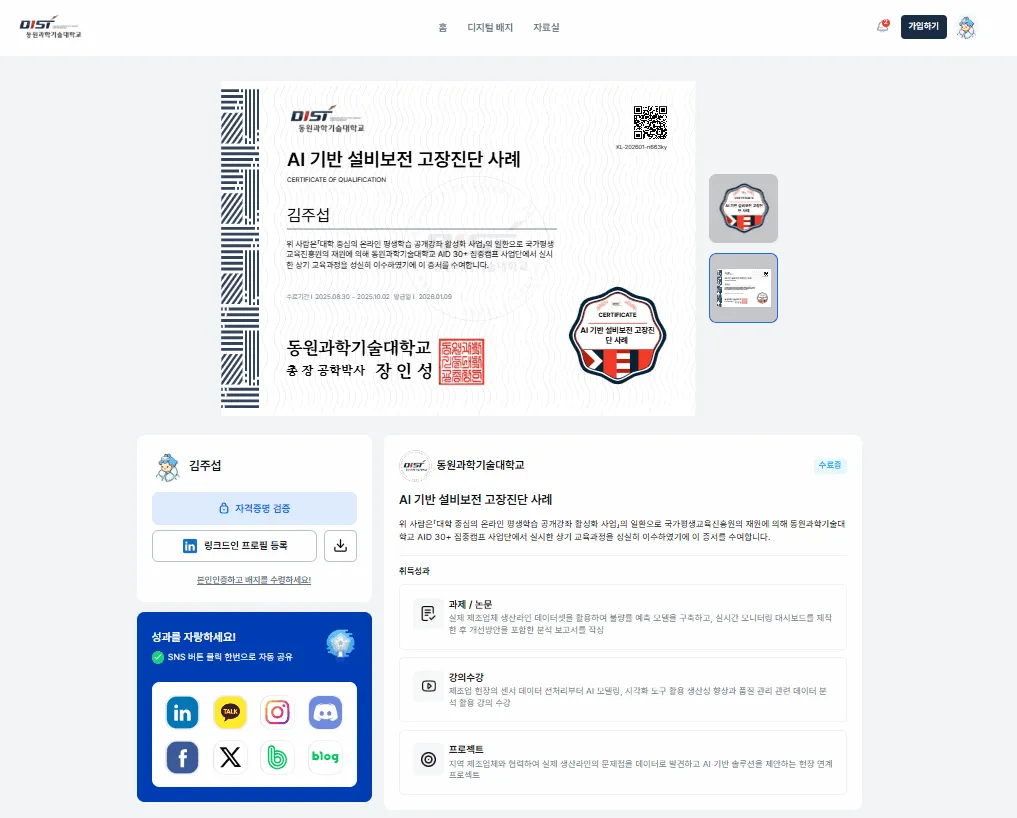
How did you handle completion credentials before adopting digital badges?
“For traditional certificates, the work begins by collecting graduates’ data directly. We organize the collected data in an Excel sheet, enter information such as the completion period, and then print them using a recruiting file.”
Organizing graduates’ information and program periods in an Excel sheet and then printing the certificate with an official seal is the typical structure at a junior college. Team Lead Choi gave a concrete account of the difference in effort when this approach is used for documenting a nationally funded program:
“Based on how we recently used these as evidence for the Institute, the paper-certificate approach requires about 40% more effort than the digital badge approach.”
This is an empirical assessment that paper certificates require roughly 40% more operating effort than digital badges in the work of submitting evidence to the National Institute for Lifelong Education. That effort is spread across staff time, printing-and-seal management, and file storage. As in the case of the Human Resources Development Service of Korea requesting four years of supporting material when selecting outstanding skilled workers, paper certificates remain a major form of evidence in national credentialing and evaluation processes. Digital badges are settling in as the replacement here.
There are also accounts that frame the utility of digital badges around personal record-keeping rather than institutional operations. Manager Kim points to her experience losing a Samsung Volunteer Leader award plaque she had received in the past:
“I once received a Samsung Chairman’s Award. The 600 hours of volunteer work are recorded on the volunteer portal 1365, but the physical plaque itself was lost. If something like digital badges had existed at the time, that record would not have disappeared. Given that 1365 still has the volunteer record, that system effectively performs the function of a digital badge.”
This remark interprets the structure of the national volunteer history system 1365 as an early form of digital badging - a perspective that replaces the loss-of-history risk inherent in a physical medium with permanent, data-based history. Manager Kim’s view is later reflected in how the SME Support Center designs its private certifications.
4. The question of “credibility” - why President In-Seong Jang chose Kolleges
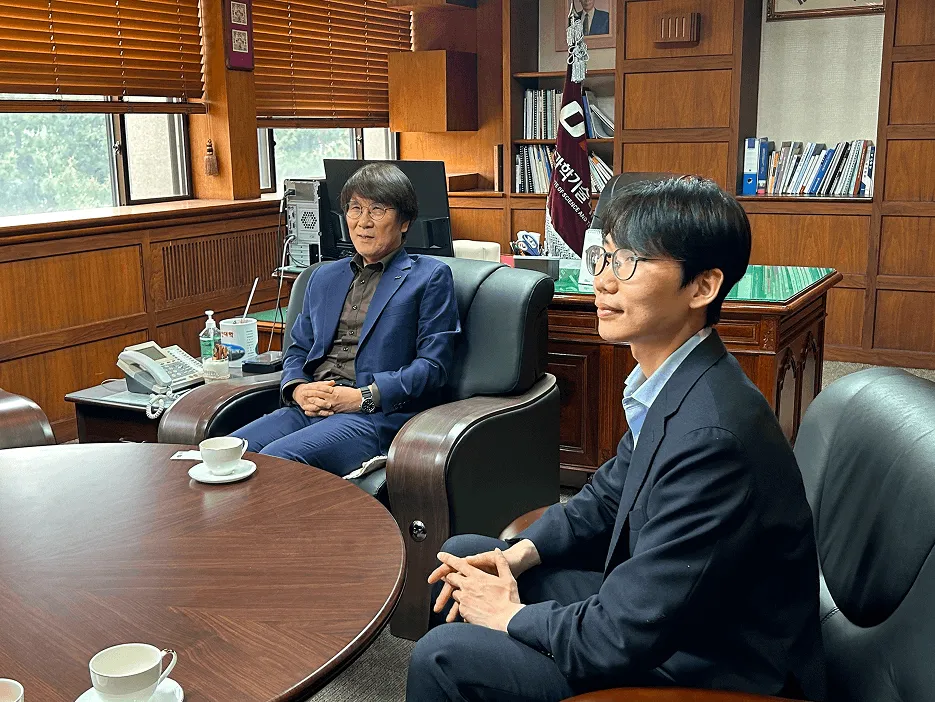
At the digital badge solution selection stage, the first criterion President Jang reviewed was “credibility.” In the interview, he summarized the recent movements within universities as follows:
“Discussions about the credibility of digital badge issuers are happening actively at the Ministry of Education and other upper-level bodies. Some universities are leaning toward using digital badges issued by accredited bodies such as the Korea Accreditation Board for Engineering Education, while Kolleges is a private operator. To be candid, we asked ourselves, ‘Should we join this trend this year, or can we make do with another approach?’”
In an environment where universities are debating which body will hold the authority for digital badge credentialing, the president’s central question was how to secure the credibility of a private solution. Badges issued by established accredited bodies like the Korea Accreditation Board for Engineering Education are already familiar names at four-year universities, while Kolleges, as a private solution, carries relatively lower recognition in corporate settings - and that was a concern.
That concern was resolved through two practical responses. The first is credibility grounded in international standards. The fact that Kolleges has already obtained Open Badge certification from an international body ensures compatibility with Ministry of Education policy. Team Lead Choi explained: “Because the certification from the international body is already in place, even if the Ministry of Education later builds a new system and recommends adoption at universities, it remains freely interoperable under the same specification.”
This is a documentation-level approach to ensuring that adopting a new solution does not collide with the authority of existing credentialing systems. That judgment led directly to Kolleges being explicitly designated in the first-year project plan of the AID 30+ program.
“My first awareness came when the president handed me a document. Our project plan named ‘Kolleges’ as the vendor. In the first-year project plan, Kolleges and digital badges are clearly described.”
There are roughly 40 companies in Korea offering similar solutions, of which only three are known to have international-standard-based credibility. “If credibility had not been confirmed, he would not have written the vendor name ‘Kolleges’ into the project plan,” Team Lead Choi added. “Seeing that the name is explicit, we read it as the president recognizing the credibility early on.” In the interview, President Jang said, “He made the initial contact well,” noting the care taken in the early vendor selection.
5. Simultaneous adoption across three units - an operational system that started with institution-wide agreement

We hear that multiple units within the Industry-Academic Cooperation Foundation adopted digital badges at the same time this year. How did that agreement come together?
“The AID 30+ program mandates digital badge issuance in its project plan and even requires the digital badge version to be specified. At the university level too, the AID 30+ Intensive Camp Project Team has to adopt digital badges this year, and the SME Support Center has formally agreed internally to use digital badges starting this year as well.”
For the AID 30+ Intensive Camp Project, digital badge issuance is a mandatory requirement under the National Institute for Lifelong Education program. As that flow extended into organization-wide agreement, three units ended up operating Kolleges simultaneously at the same time. This is not a pilot first, then sequential rollout - it is a deliberate choice to run the same platform in parallel to unify national-evidence reporting, operational data, and credentialing.
This agreement is also reflected in the certification system the SME Support Center is designing. Manager Kim is preparing to issue digital badges in parallel for the ISO Occupational Safety and Health Internal Auditor certification this year, and is considering retroactively including data from last year’s ESG Internal Auditor certification.
“This year we’re also focusing on the corporate safety and health area, and we’ll be issuing the ISO Occupational Safety and Health Internal Auditor certification and a private certification related to serious-accidents legislation. Because most of these certifications are paper-based, issuing them as digital badges in parallel preserves the record reliably even if a graduate loses the paper - that’s a real benefit.”
The fact that they are redesigning the certification system around permanent record-keeping for graduates shows that digital badge adoption is moving beyond the evidence requirements of any single project and is influencing the credentialing system across the whole organization.
The interview also expanded the conversation around the scope of digital badge usage. In the dialogue, President Jang newly recognized that digital badges are not limited to course-completion histories and can contain a wide range of activity records.
“My understanding had been that a digital badge issued for AI/DX training only contained that program’s content. But based on Kolleges’s explanation, beyond just program completion, students’ various achievements can be included as well.”
That said, there is a principle for what a single badge contains: “It has to be an activity within the category of that badge.” For example, if a student completes an AI program and then gives a budget presentation at an outcomes showcase tied to that program, the two activities can be combined into a single badge. The interpretation is that extracurricular activities can be folded into the badge’s data as long as the category connects with the program. President Jang asked the team to “systematize this use case and share it with the organization.”
6. A one-year assessment - design templates, evidence work, and improvement requests
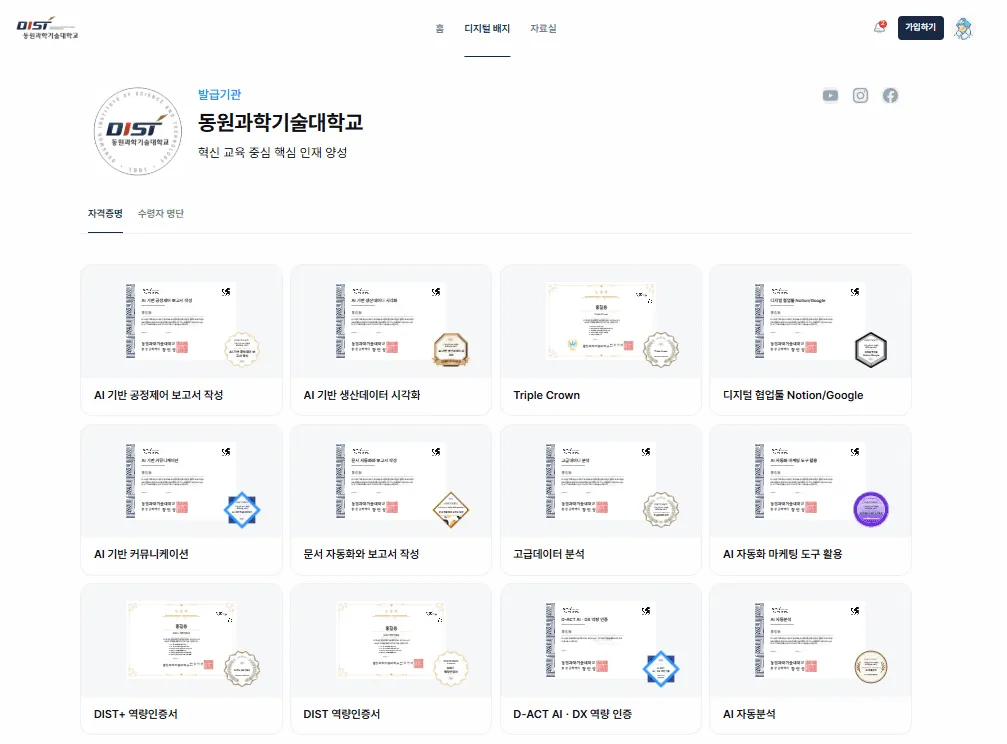
Over a year of use, which features were the most useful?
“The completeness of the default design templates is high. The templates themselves are well designed, so we could get the result we wanted with only minor modifications. The foundation is solid, so we didn’t have to design from scratch.”
The first thing Team Lead Choi mentioned was how easy badge design proved. The provided templates are of high quality, so it takes only minor variations on top of the default design to produce what they want. Manager Kim’s observation backs this up: “They’ve created truly varied designs. Other schools or institutions usually have one or two base designs and just change colors, but here they’ve tried many variations.” The result of a person with a CAD / mechanical-engineering background trying many variations on top of the templates is the variety of badge designs the university has today.
The second useful feature is the generation of supporting evidence. “Since we receive national funding for our program budget, evidence is required, and generating those documents was convenient. One reason is that they’re categorized by program,” he explained. Automatic per-program categorization and one-shot bulk PDF export significantly reduced workload during evidence submission to the National Institute for Lifelong Education.
On the other side, what improvements or pain points would you raise?
The improvement requests that came up during operations fall into four areas.
1. Technical limits of the design tool
“PowerPoint lets you adjust the front-to-back order of two shapes, and it also has a feature that lets the colors of the front and back shapes naturally blend together. In the Kolleges editor, you can adjust the front-to-back order, but there’s no feature for naturally blending the colors.”
When the school mark has a white background, the editor cannot blend it naturally with another image, so the workflow becomes: adjust colors separately in PowerPoint, capture as an image, and re-upload. Another constraint is the lack of support for circular designs. Team Lead Choi explained, “The school mark is circular. When we bring in a circular image, the background color comes through, so it ends up looking rectangular.” Given that circular shapes are favored in Korean school emblems and certification designs, this is a point where improvement is requested.
2. Email ↔ KakaoTalk compatibility
“We were told that after issuing a badge, we could choose KakaoTalk or email to notify the learner - but once we send by email, we can’t switch to KakaoTalk.”
The inability to switch the post-issuance notification method mid-flight is directly tied to the learner-age composition at Dongwon Institute of Science and Technology. Team Lead Choi added, “A significant share of our trainees are in their 50s and 60s, and many do not use email often. There are cases where if learners forget their password, they have to come in person to get help.” It is a case that shows how learner demographics affect operations in B2B SaaS UX design.
3. The burden of school-record-style data entry
“Under a certificate system, the work ends with printing. With a digital badge system, you have to keep entering detailed information into the badge - activity history, skills, and so on.”
Because a digital badge captures detailed learner activities rather than a simple completion record, staff need to enter content for each graduate in a format that resembles a school record. Two solutions were proposed. First, pre-organize curriculum and activity categories so that input becomes selection-based. Second, allow hashtag and skill tags to be pulled in from an Excel list. There was also discussion of having AI recognize course names and auto-suggest related skill tags.
7. The next agenda President In-Seong Jang laid out - a grading system, corporate marketing, and personal-statement integration

In the interview, President Jang laid out three specific items for advancing the digital badge program:
- 1 Introduction of a grading system (S/A/B) for qualitative differentiation of badges
- 2 A strategy for expanding digital badge awareness among corporations
- 3 A QR code-based mechanism for linking badges into student personal statements
“S/A/B grades” - a grading system to escape uniformity
“That’s exactly what we wanted. At other universities, digital badges are issued in bulk once certain criteria are met. Based on our operating experience, that approach felt too uniform, so we want to set our own standards and grade them S, A, and B. Is that actually feasible?”
President Jang diagnosed the current digital badge issuance practice as “uniform.” The problem is that the structure does not capture differences in capability between students who complete the same program, and that ultimately dilutes the discriminating power of the badge. The solution proposed is a relative-grading system. By assigning S/A/B distinctions to badges, corporate recruiters can grasp the competency level of graduates at a glance.
This is uncommon in Korea. Team Lead Choi added a concrete implementation idea: “Similar to relative grading at general universities - a certain percentage above 90 is one grade, A is another percentage - we want to make the differences in competency visible to companies at a glance. That’s the direction of this year’s program.” Mapping a subset of the 10 levels in the competency-diagnostic framework onto the S- and A-grade badge designs is being reviewed together.
At the same time, President Jang raised the challenge from the consumer side. “The key question is whether consumers can actually feel a meaningful difference between S, A, and B grades.” Beneath that point is the recognition that for grading to translate into individual student motivation and corporate-recruiter value, the meaning of each grade has to be communicated clearly in the field.
”Value emerges when companies recognize them” - securing the practical effectiveness of credentials
“At the university, we aggregate students’ competencies into digital badges, but we have to actively promote them to corporations. Are there good ways to do that? Companies need to recognize the value of digital badges for them to function as a plus factor in hiring.”
The second agenda President Jang identified is the expansion of digital badge awareness among corporations. Even if universities systematize student competencies into digital badges, the effectiveness of the credential is limited if corporate recruiters do not recognize their value. President Jang frames this as one of his “two current concerns”:
“We have two concerns. The first is how we propagate digital badges to corporations and deliver the message, ‘Our students have these competencies, please take notice.’ That requires a separate marketing strategy. The reality is that, outside of large corporations, many companies still aren’t very familiar with digital badges.”
President Jang also referenced the historical experience with university credentials. “There has long been broad skepticism about the usefulness of credentials. There is concern that as that flow moves into the digital arena, a similar uselessness debate could attach to digital badges.” This reflects a worry that when credentialing is confined to institutional bodies, the structure that fails to take hold on the corporate front line can repeat itself. The view is that the credential cannot be merely a self-issued credential by universities and institutions - it has to be one that is meaningfully consumed at corporate recruiting sites. Sharing examples of Kolleges credentials being used as positive factors during hiring at major companies was floated as a starting point for addressing this concern.
A QR code linkage between personal statements and badges
“Digital badges contain a QR code. Could students use that QR code in their personal statements or application materials?”
The third item President Jang raised is a structure that links digital badges with student personal statements. Because each issued badge contains a QR code, if students embed that QR code into their personal statements, corporate recruiters can immediately access the badge contents through the QR code. The president also noted a real-world constraint: “Personal-statement formats differ across universities and companies, so it’s difficult to insert QR codes uniformly into a standard format.” How to encourage QR code insertion in an environment without a standard personal-statement format is the issue.
The president’s solution is to leverage on-campus support systems. “If you can provide us with personal-statement samples that include digital badges and QR codes, we’ll send them on to the campus career and employment center and guide students to use that as the standard format during student education.” The plan is to receive sample personal statements that include digital badges and QR codes from Kolleges, distribute them through the campus career and employment center, and treat them as the standard format in student education. By embedding badge-linking conventions in the university-level personal-statement guidance, the university aims to create an institutional path for adoption that does not rely on individual students voluntarily picking up the practice.
8. From an inaugural speech to data - the next stage of the regional co-prosperity structure
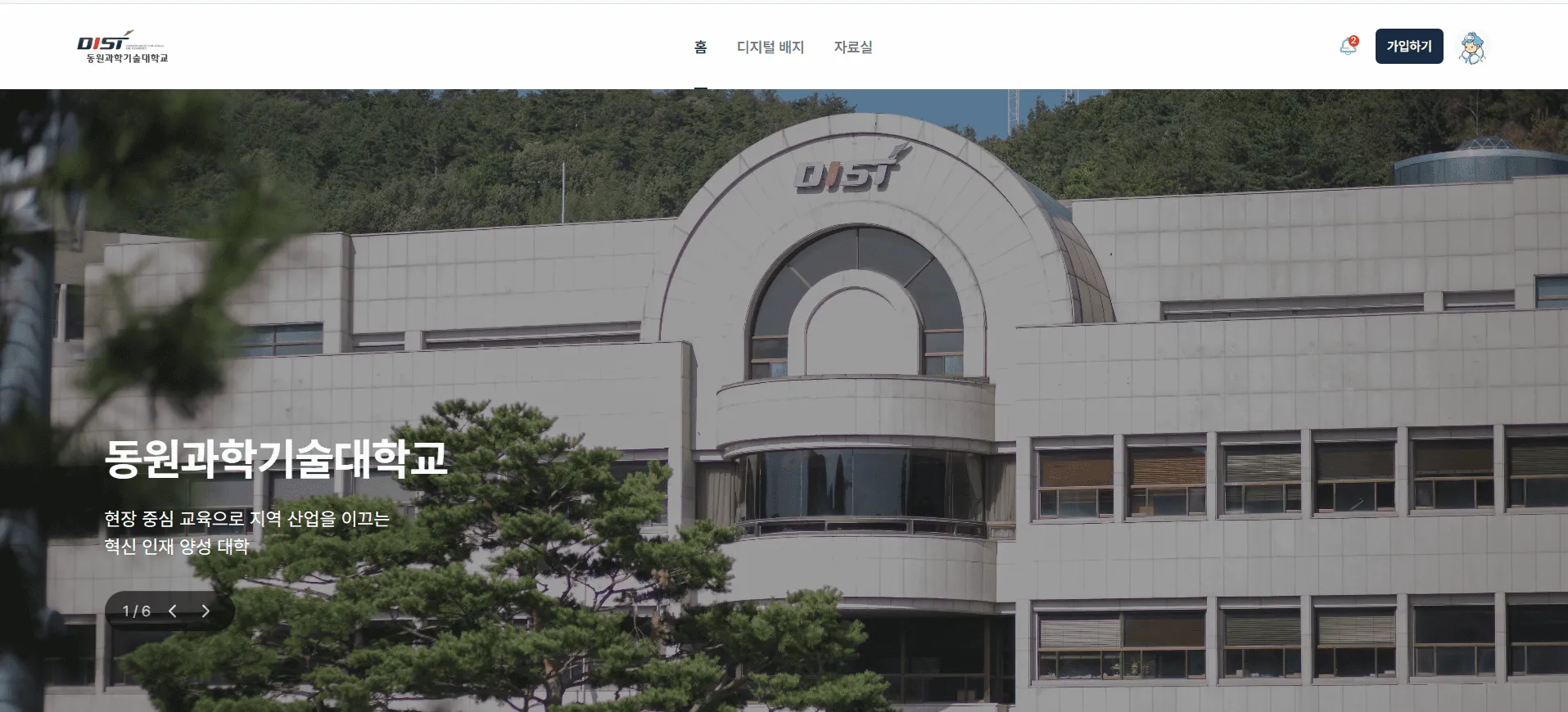
The direction of Dongwon Institute of Science and Technology starts from a single sentence in President Jang’s inaugural speech - “Region, industry, and the school flourish together in mutual prosperity.” It is a virtuous cycle in which talent is cultivated around the HVAC, aviation, smart-factory, and AI-education needs of the Yangsan region in South Gyeongsang Province; those graduates are placed in local companies; and the growth of those companies is supported directly by the SME Support Center. That a university receives Yangsan City local-government subsidies for six consecutive years to directly support regional businesses - which is rare nationwide - shows that this cycle is not merely a program but a structure that originates from the president’s decisions.
Digital badges integrate into this structure along two axes. The first is the “visibility axis.” This is where the grading system, skill tags, and national-certification linkage that let local companies see student competencies at a glance belong. The S/A/B grading system, the corporate-awareness strategy, and the personal-statement QR linkage President Jang laid out in the interview are all tasks on this axis. The second is the “permanence axis” - data-based history management that lets learners preserve their activity record across a lifetime. The conversion of private certifications into digital badges, the badging of municipal awards and honors, and API integration with national certifications all belong on this axis.
Starting this year, Dongwon Institute of Science and Technology runs the Kolleges-based digital badge system simultaneously across three units: the AID 30+ Intensive Camp Project Team, the AI Education Innovation Center, and the SME Support Center. Per-unit billing and metering, administrator-count expansion, email-KakaoTalk compatibility, support for circular designs, and API integration with national certifications all remain open issues. How quickly those items are resolved will decide how the 77.7% employment number being accumulated in Yangsan, South Gyeongsang Province, is reconstructed on top of the data structure that is the digital badge. Evidence work that is 40% lighter than paper certificates, learner histories that cannot be lost, and the three advancement tasks President Jang laid out - the grading system, corporate marketing, and personal-statement integration - Dongwon Institute of Science and Technology is showing first how a single sentence from an inaugural speech translates into a data structure.
[ Reader FAQ ]
Q1. Are digital badges recognized as supporting documentation for national-funded programs?
Dongwon Institute of Science and Technology submitted digital badges as evidence for the AID 30+ Intensive Camp Project supported by the National Institute for Lifelong Education by bulk-exporting them as per-program PDFs. Team Lead Bo-Gyun Choi assessed that this reduced operating effort by about 40% compared with paper certificates.
Q2. How can existing accredited bodies and private digital badge solutions coexist?
In the interview, President Jang laid out a strategy of stating, at the top of supporting documents, the fact that international-standard certification has been obtained - securing “complementarity” with existing accredited credentialing systems such as the Korea Accreditation Board for Engineering Education. International-standard-based digital badges are also compatible with subsequent Ministry of Education policy.
Q3. What does it take for digital badges to carry real value in corporate hiring?
President Jang argued that “companies need to recognize the value of digital badges for them to add a plus factor in hiring,” and laid out three tasks: (1) a strategy for expanding awareness among corporations, (2) securing competency discrimination through a relative-grading system, and (3) a structure that links personal statements and badges via QR codes so recruiters can verify immediately.
Frequently asked questions
Want to turn learning outcomes into verifiable assets?
From issuing to verifying and amplifying, see it for yourself with Kolleges.
Request a Kolleges demo Related posts

Cheongju University Adopts Kolleges Digital Badge Learning Recognition System
Cheongju University piloted digital badge-based learning recognition in four intensive programs, enabling students to share verified project portfolios directly with employers.

'Technology' and 'care' on a single certificate - Korea Polytechnic University Daejeon Campus's 'AI × Human Care' co-issuance
Two universities in Daejeon co-issued a single digital badge bearing both institutions' logos, solving the NCS stage-recognition gap inside a RISE regional innovation consortium.

From Hobby to Certification to Instructor: How Hongik University Sejong's Lifelong Learning Center Is Building a Virtuous Cycle of Education
Hongik Sejong's RISE-funded Lifelong Learning Center replaced paper certificates with tiered Level 1-3 digital badges to record and sustain a hobby-to-certification-to-instructor growth path.