
World IT Show 2026 Recap: Why Certificates Need to Become Verifiable Data
WIS 2026 confirmed that institutions across Korea need more than certificate issuance - they need education outcomes structured as verifiable, reusable data, which is exactly what Open Badges 3.0 enables.
The central keyword at World IT Show 2026 was AI, but the question education-institution staff asked most often at our booth was “how do we leave a completion certificate as data?” A digital badge isn’t just an online completion certificate - it’s education-outcome data bundling issuer, completion criteria, competencies, and a verification link. Only when there’s a structure that goes beyond issuance to connect verification, sharing, and re-engagement do an institution’s operations and promotion become lighter at the same time. World IT Show 2026, in its 18th edition, is Korea’s largest ICT exhibition, and it served as a venue showing how technology - beyond AI, into robotics, spatial computing, digital twins, and security/blockchain - attaches to actual work.
1. The atmosphere at World IT Show 2026
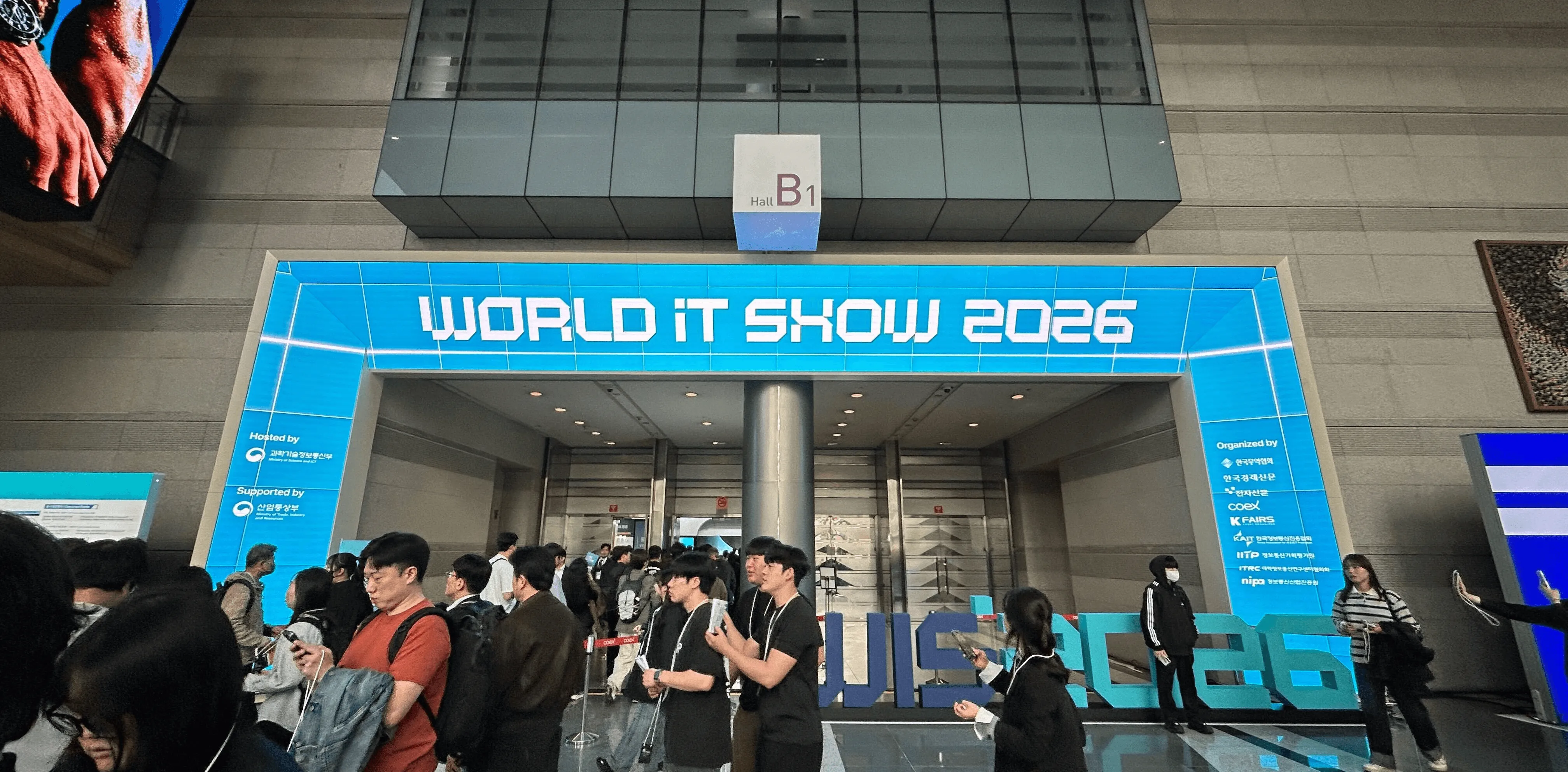
World IT Show 2026 (WIS 2026) was held from April 22 to 24, 2026, at COEX Halls A, B1, and C in Seoul. This 18th edition welcomed 460 companies from 17 countries with around 1,400 booths, and attendance reached 68,493 - reported as the largest scale since COVID-19. The event was hosted by the Ministry of Science and ICT.
This year’s slogan was “Beyond Thought into Action: AI Moves Reality.” It might look like a marketing line, but walking around the booths, you could feel the slogan was hitting its intention precisely. Until last year, the focus was on showing “what AI can do,” but this year the main story was “what is this AI doing right now in the field?”
The exhibition was divided into four areas: AI & Digital Intelligence, Robotics & Intelligent Mobility, Immersive Spatial Technology, and Smart Life & Data Technology. Here are the prominent trends in each.
AI & Digital Intelligence

Rather than the AI models themselves, the center of attention was “where and how AI has been applied.” Booths showcasing real adoption cases - call-center automation, manufacturing line inspection, medical image analysis, automated education-content generation, internal work agents - visibly increased. That’s why the slogan’s “into action” didn’t feel hollow.
Robotics & Intelligent Mobility
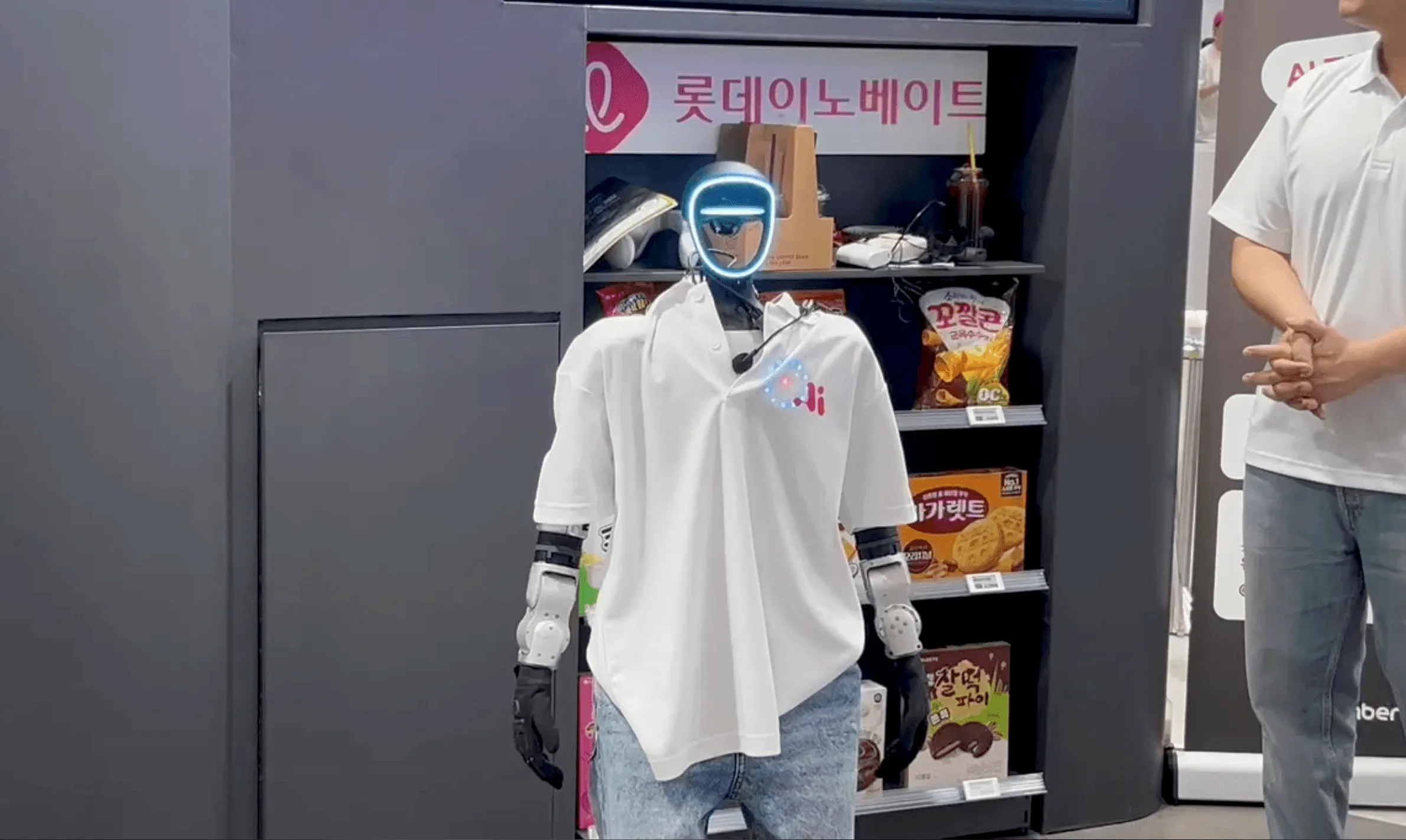
Humanoids and autonomous mobility drew the largest crowds. Many booths showed, alongside video, what roles these robots are playing in actual worksites, factories, and public facilities - not just demos. The impression was that robots are moving out of “showmanship” territory and settling in as “colleagues responsible for a single line of work.”
Immersive Spatial Technology

Unexpectedly popular were the “spatial computing” booths. Many demos showed meetings, education, and practice conducted in virtual spaces using XR headsets and digital twins, and there was a memorable scene of education staff stopping for a long time to watch the videos. It felt like virtual classrooms and virtual practice labs could soon become standard options in extracurricular and corporate education.
Smart Life & Data Technology
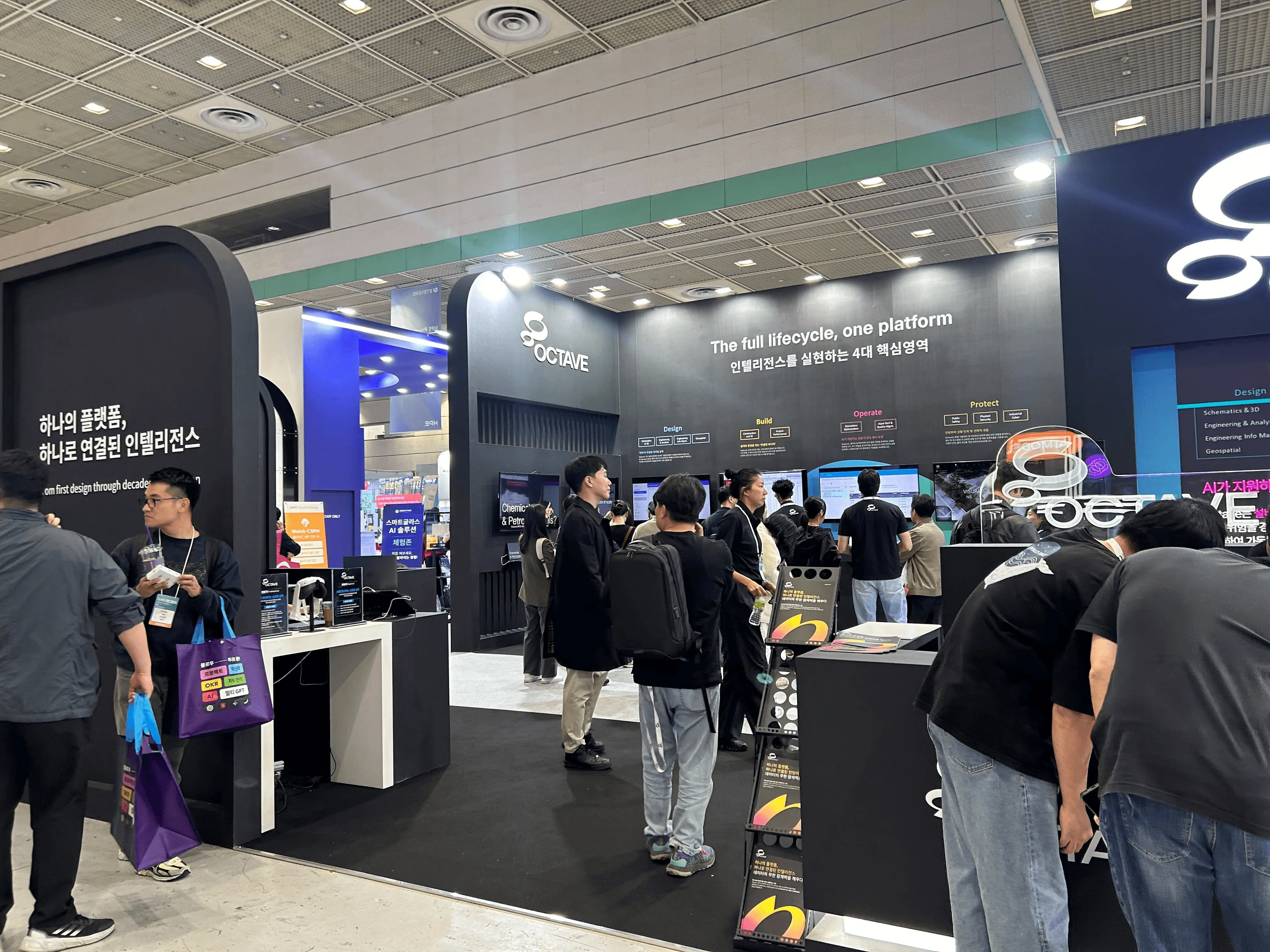
The security and blockchain zones were calmer but had steady traffic. That reflects how interest in infrastructure for handling data in “trustworthy form” has taken root. As outputs generated by AI grow, technology that confirms whether “this output was really created there” must move alongside it - that trend was clearly readable.
Overall, the center of gravity at this exhibition was less about “technology’s flash” and more about “how technology moves reality.” It wasn’t a coincidence that the words most often heard while walking the booths were “application,” “real,” and “field.”
2. What Kolleges introduced at WIS 2026
The message we wanted to deliver was simple.
A digital badge isn’t a paper certificate moved online - it’s a way of turning education outcomes into verifiable, shareable data.
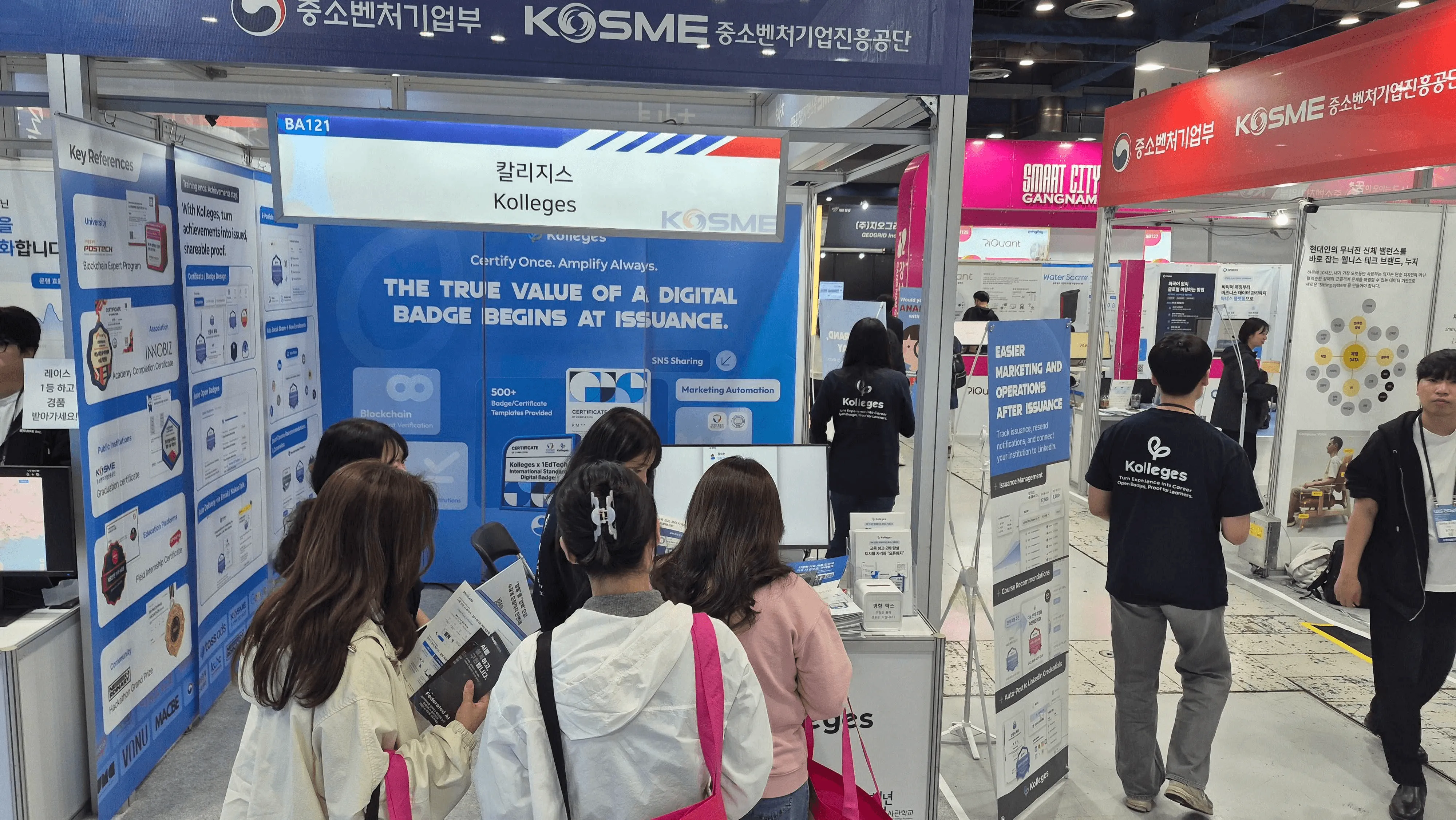
The flow we emphasized in our live demos was as follows.
-
Digital badge and open badge issuance based on the international standard (Open Badges 3.0)
-
Instant authenticity verification via QR/verification URL, with blockchain records
-
Bulk issuance from a single completion-list upload
-
A sharing path that flows to SNS, LinkedIn, and resumes
-
Institution-dedicated digital badge pages and e-portfolios
-
Issuance-history data driving follow-up training and re-enrollment outreach
For first-time visitors to digital badges, we opened the conversation with familiar operational problems instead of technical jargon. Questions like “Have you ever received a reissuance request after issuing certificates?” or “Are your graduates actually using the certificates they received?” When we followed those questions with an explanation of the digital badge structure, the conversation became concrete much faster.
3. Education ended, but where did the outcomes go? The essence after issuance is “outcome data-fication”
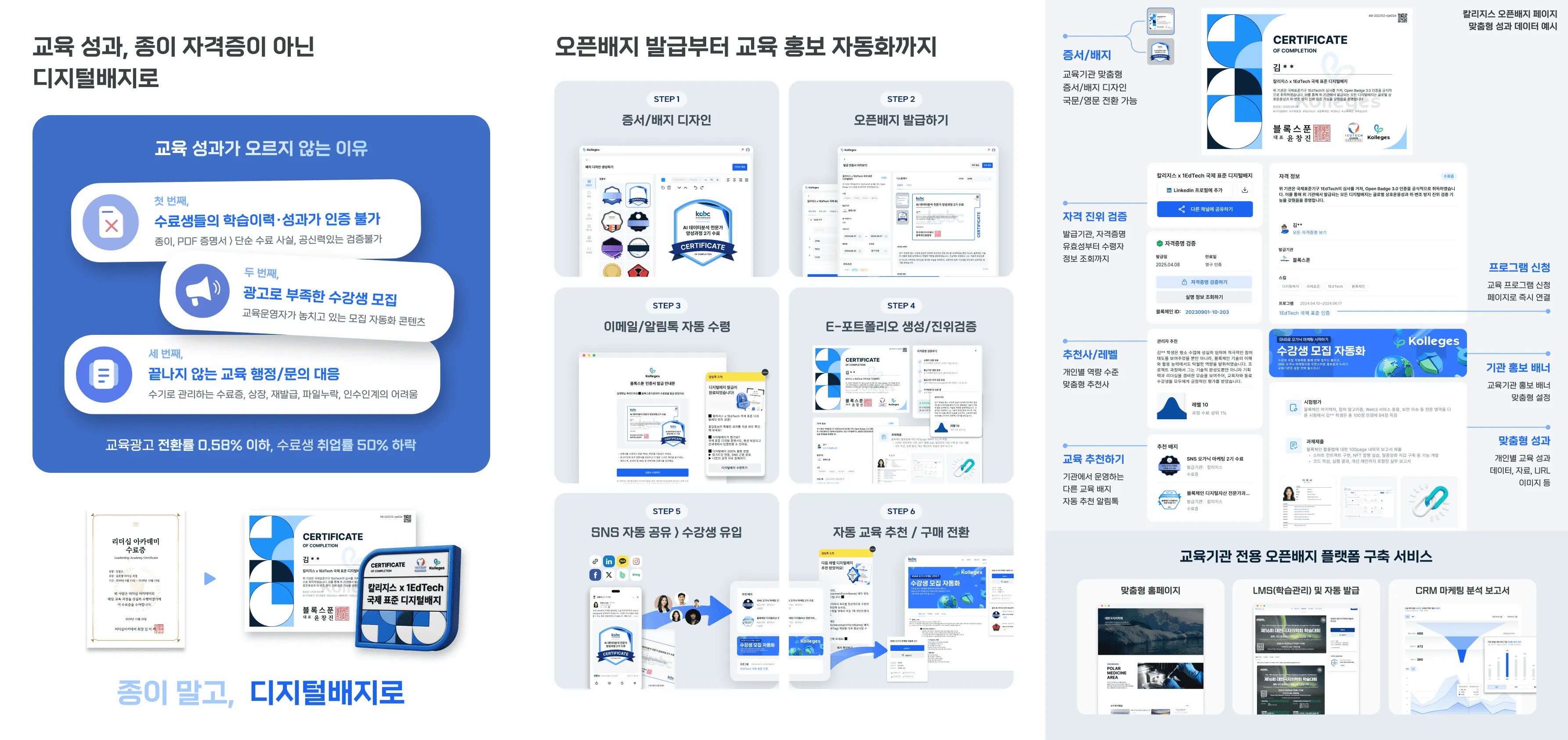
When a semester or a cohort’s program ends, countless completion certificates, participation certificates, and awards are issued. But if you think about what comes next, something feels off. PDF files end up sleeping somewhere in a download folder, and paper certificates go into a desk drawer. The hard-won outcomes of education don’t actually stay as “data that can be shown and used.”
This problem looks small but has a big impact. Graduates struggle to prove their education outcomes externally, and operating institutions don’t have data to use for the next project’s reporting or recruitment. On top of that, since the format isn’t something students would proudly share, the natural promotional effect disappears too.
The most common thing we heard from university, public-institution, and education-company staff at World IT Show 2026 came down to this point. “We’re issuing everything, but what comes after is empty.”
The event’s slogan, “Beyond Thought into Action: AI Moves Reality,” was in the same vein. It also meant that the “data” AI will analyze was the common asset of every booth. Education is the same. If education outcomes aren’t left as data, analysis and use are both difficult.
Digital badges and open badges are international-standard certification methods designed precisely to create that “education-outcome data.” They aren’t a single image - issuer info, completion criteria, competency items, issue date, and verification link are embedded as structured metadata. That’s why graduates can use them as-is on SNS, resumes, and portfolios, and institutions can accumulate issuance history as an asset that can be reused for operations and promotion.
4. Common questions and insights from the floor
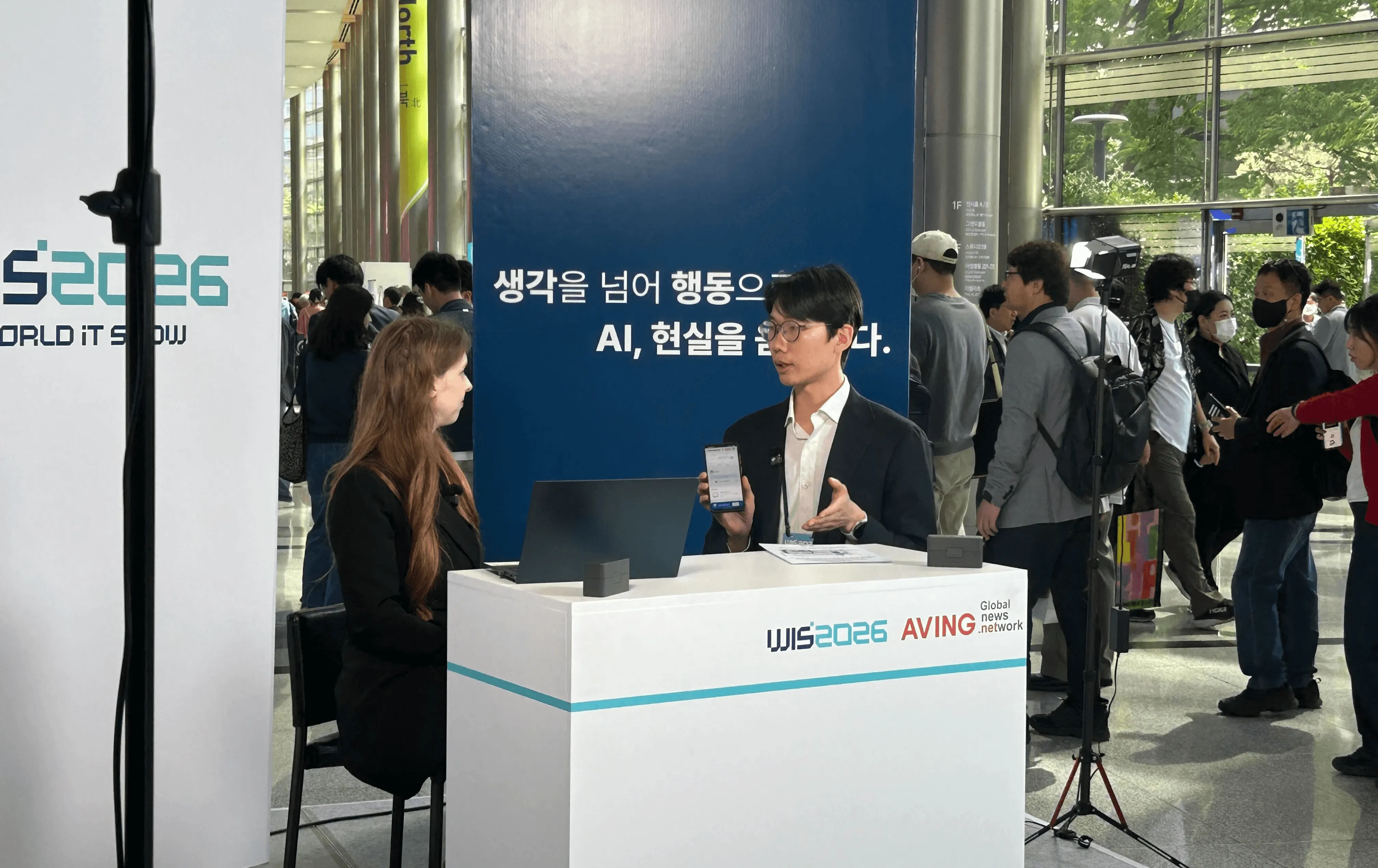
The questions from visitors at the World IT Show 2026 booth varied slightly by institution type. We’ve kept the texture of those conversations intact below.
University extracurricular and lifelong-learning offices, LINC/RISE project teams
The most common comment was, “Even when students receive PDFs over KakaoTalk, they end up not knowing what to do with them.” Staff running extracurricular and microdegree programs clearly wanted to gather scattered enrollment records across campus into student-level portfolios, while also leaving them as data usable for LINC and RISE project reporting. The question “When submitting to external evaluations, can I send a verification link instead of a screenshot?” came up repeatedly.
Public-institution training and startup support
The core question was how to credibly issue participating-company commendations and outstanding-graduate certifications. After a project ends, external parties need to be able to instantly confirm that “this person actually participated in this program,” and there was a common desire to automatically organize issuance-history data for project reports.
Education companies, bootcamps, and academies
Many wanted to naturally grow course reviews. With paper certificates, graduates don’t really show them off, but with digital badges the rate at which they post on LinkedIn or Instagram is noticeably different - a fact they paid attention to. From the operator’s perspective, the complaint that manual issuance hits a ceiling as cohorts grow was also a constant.
Associations, certification bodies, and corporate HRD
The most frequent question was, “Can you redo an external certificate or another institution’s completion certificate as a digital badge for us?” The short answer: rather than replacing the original issuer’s certification, the realistic approach is to design a separate certification system based on the operating institution’s own review criteria.
The wording varied by institution, but in the end, everyone was asking about “the flow after issuance.”
5. The 8 most-asked FAQs at the exhibition
Q1. What’s different between a digital badge and a paper certificate?
→ Paper is a document to display; a digital badge is verifiable data.
A digital badge isn’t a simple image or PDF - it’s a data-form certificate with issuer, completion criteria, competencies, and a verification link embedded as metadata. Authenticity can be verified externally with a single link, and it can be used in the same format on resumes, portfolios, and SNS. If the essence of a paper certificate is “showing a document,” the essence of a digital badge is “having data verified.”
Q2. Can certificates issued by external institutions or overseas also be managed as digital badges?
→ It can’t replace the original issuer’s certification, but it can be designed as a separate certification system.
GTQ, private qualifications, external training certificates, and certificates from overseas universities or certifying bodies cannot simply be “reissued as if authentic” - that authority belongs to the original issuer. However, it’s possible for an operating institution to run its own review process - verifying original evidence, issuer info, issue date, certification number, verification link, and so on - and design a separate certification system such as an “External Qualification Confirmation Badge,” “Overseas Education History Confirmation Badge,” or “Portfolio Certification Badge.” The key is “how to preserve source and verifiability.”
Q3. How is a digital badge’s credibility proven, and how can it be verified externally?
→ Rather than sending a file, you share a QR / verification URL.
Graduates can prove their education outcomes through a badge link, a QR code, a portfolio URL, the LinkedIn credentials section, SNS sharing, or by embedding a link in a resume. External stakeholders such as recruiters, university and institutional staff, evaluators, partner organizations, and investors can instantly confirm the issuer, completion criteria, and issue date through that single link. That said, credibility depends on the issuer’s authority and the clarity of the metadata.
Q4. Can issued certificates be gathered in one place?
→ They’re designed to be gathered and used in the form of personal badge wallets and portfolio pages.
Digital badges are typically designed to be viewed together in digital wallets, personal badge wallets, and portfolio pages. If a single person has received completion certificates, qualifications, participation certificates, hackathon awards, mentoring activities, and project-participation certifications, it’s much more efficient to view and externally share them in one place than store them separately. Kolleges is structured to provide a user experience that lets recipients view and use their badges in one place.
Q5. What are Open Badges?
→ An international-standard certification method designed to digitally issue, verify, and share learning outcomes and competency information.
Open Badges are a digital certification method standardized by 1EdTech, bundling issuer, completion criteria, competencies, and verification link into the badge as metadata. Because they follow the same standard, they have strong compatibility with other systems and platforms, and they can be used as-is in global hiring and education environments.
Q6. How does Kolleges differ from other digital badge solutions?
→ It doesn’t stop at issuance - it bundles verification, sharing, outcome management, and promotion into one flow, and is designed for Korea’s operating environment.
Solutions that only provide an issuance tool focus on filling in name, course name, and issue date to produce a certificate. Kolleges looks at what comes next. It handles digital badge issuance, QR/verification URL-based verification, graduate SNS sharing, education-outcome data-fication, bulk-issuance automation, and design of institution-tailored badge systems as one flow - and ties the issued badges into “a structure where they accumulate as assets and get reused in the next project.” Overseas solutions have strengths in global standards and networks, while Kolleges, built on an understanding of Korean education-project operations such as extracurriculars, microdegrees, LINC/RISE projects, government-supported projects, and association certification programs, has strengths in consulting, Korean-language operating experience, and bulk-issuance operational support.
Q7. Are bulk issuance and automated operations possible?
→ Bulk issuance from completion lists, issuance-history management, and reissuance handling can all be processed through an automated structure.
As cohorts grow, manual issuance hits its limits. With Kolleges, you can bulk-issue from a single list upload, and you can set up an issuance environment separated by cohort, course, and institution. Issuance history accumulates as data in the admin page, and recurring work like reissuance and verification requests is reduced.
Q8. Is it suitable for universities, public institutions, or corporate education?
→ The use cases differ by institution type, but it’s broadly suitable across all of them.
Universities can use it for extracurriculars, microdegrees, industry-academia education, startup education, global programs, and field internships. Public institutions can use it for training completion, project participation, outstanding-company selection, competency certification, and history management for outcome reporting. Corporate HRD can use it for internal training, role-competency certification, partner-training certification, and motivating participation in retraining and upskilling programs. Associations and certification bodies can use it for member-qualification management and strengthening certification credibility, while bootcamps and education companies can use it effectively to expand reviews via voluntary sharing by students.
6. After issuing certificates, design how outcomes are used as data
The major trend World IT Show 2026 showed was “leave it as data, then connect that data to action.” Education works the same way. Beyond issuing certificates themselves, the real difference comes from whether the issued outcomes are verified, shared, and connected to the next action.
Digital badges and open badges are tools that make that flow possible, and Kolleges is closer to infrastructure that “designs and embeds that tool to match an institution’s operating environment.” Rather than the cost of a single issuance, the more important standard, in our view, is whether issued education-outcome data can be reused in the next project, the next recruitment, and the next cohort.
Frequently asked questions
Want to turn learning outcomes into verifiable assets?
From issuing to verifying and amplifying, see it for yourself with Kolleges.
Related posts

2025 EduPlus Week Future Education Expo - Key Keyword: "Personalized Learning"
At the 2025 EduPlus Week expo, 170+ organizations from 15 countries converged on "personalized learning," and Kolleges served as the event's official digital badge partner, issuing blockchain-based credentials via Open Badges 3.0.
From Certificate Issuance to Connection: The Next Step in Outcome Management
Standards like Open Badges, CLR, and LER transform one-off certificate issuance into a connected, reportable flow of learning and employment outcomes.

Digital Badge Market Size 2025: 320M Issued, 1.7M Badge Types Live | A 1EdTech Report Analysis
The 2025 Badge Count report (1EdTech + Credential Engine) shows 320M digital badges issued globally - a 13x rise since 2018 - with 1.7M live badge types and 74% of badges shared via social media.