
How to Connect RISE Performance with a Three-Tier Digital Badge Structure: A University of Seoul Case
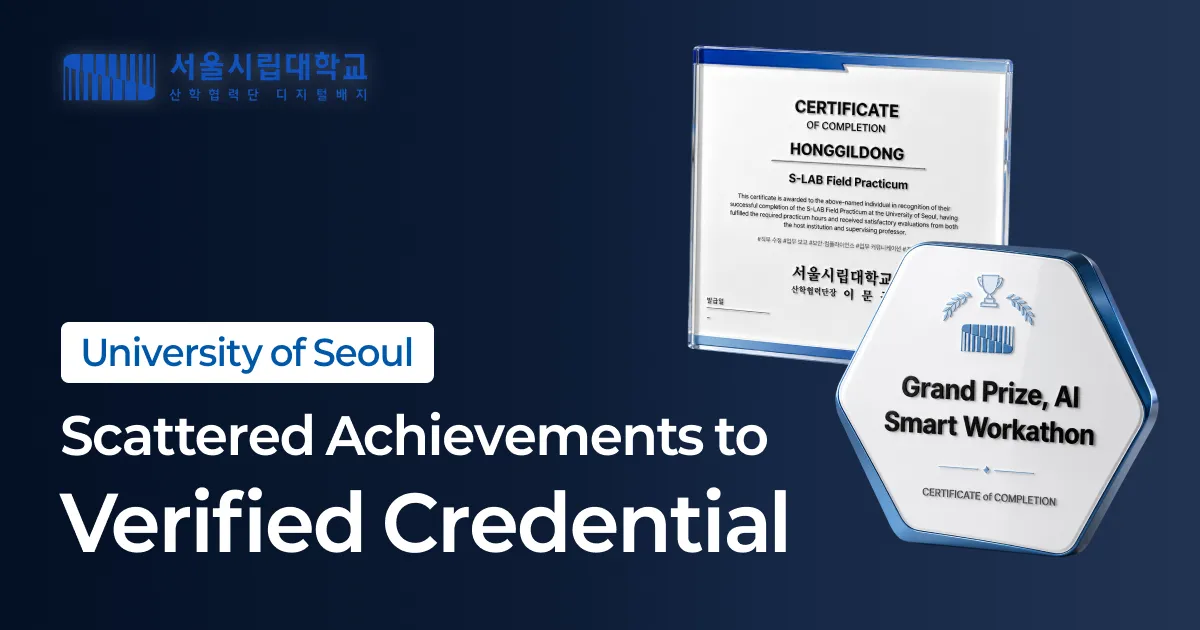
The University of Seoul's RISE project team bundled the outcomes of 7 programs across 3 areas (industry-academia cooperation, AI, and convergence regional innovation) into 15 digital badges. This is the design behind a three-tier structure connecting unit badges through pathways to a comprehensive certification, turning scattered university achievements into verifiable one-line credentials.
The achievements a university produces over a year come in many forms: capstone design, corporate field training, AI certifications, startup demo days. The problem is that these records end up scattered across paper certificates and department-by-department Excel files. As the Regional Innovation System for Education (RISE) rolled out nationwide in 2025, universities entered an environment where they must prove these achievements as verifiable, quantitative indicators.
The University of Seoul Industry-Academic Cooperation Foundation’s RISE project team designed a system that bundles the outcomes of 7 programs across 3 competency areas (industry-academia cooperation, AI, and convergence regional innovation) into 15 digital badges. At its core is a three-tier structure: 12 unit badges gather into 3 pathways, which in turn lead to a single comprehensive certification. We’ve laid out the backbone of the design so that Industry-Academic Cooperation Foundations and RISE/LINC project teams facing the same challenge can use it as a reference.
In the RISE era, why scattered university achievements get stuck at ‘proof’
The Regional Innovation System for Education (RISE) is a framework that shifts the authority to execute university funding budgets from the central government to local governments, and it rolled out nationwide in 2025. Seoul is investing 422.5 billion won over five years across five projects, including strengthening global university competitiveness. The common demand is clear: universities must prove the outcomes they create as quantitative indicators.
In the Seoul-type RISE framework, where the region holds the key to university support, the five flagship projects are strengthening global university competitiveness, reinforcing the base of Seoul’s strategic industries, shared regional growth, strengthening lifelong and vocational education, and fostering university startups. The five directions differ, but one thing is the same: universities must prove the outcomes they create in numbers.
This is where the Foundation’s challenge begins. Every year, countless achievements pile up - capstone design, field training, student clubs, AI certifications, public-event supporters, corporate employee work-a-thons, startup education - but the records were left separately in paper certificates and department Excel files. They were hard to protect against forgery, and gathering the scattered material into indicators for project reporting was cumbersome.
The digital badge system was the choice for bundling these scattered achievements into a single verifiable structure. Together with Kolleges, the Foundation started from a design that records the type and level of each achievement as data, then elevates that into project performance indicators.
From unit badge to comprehensive certification: a three-tier structure connecting the growth path
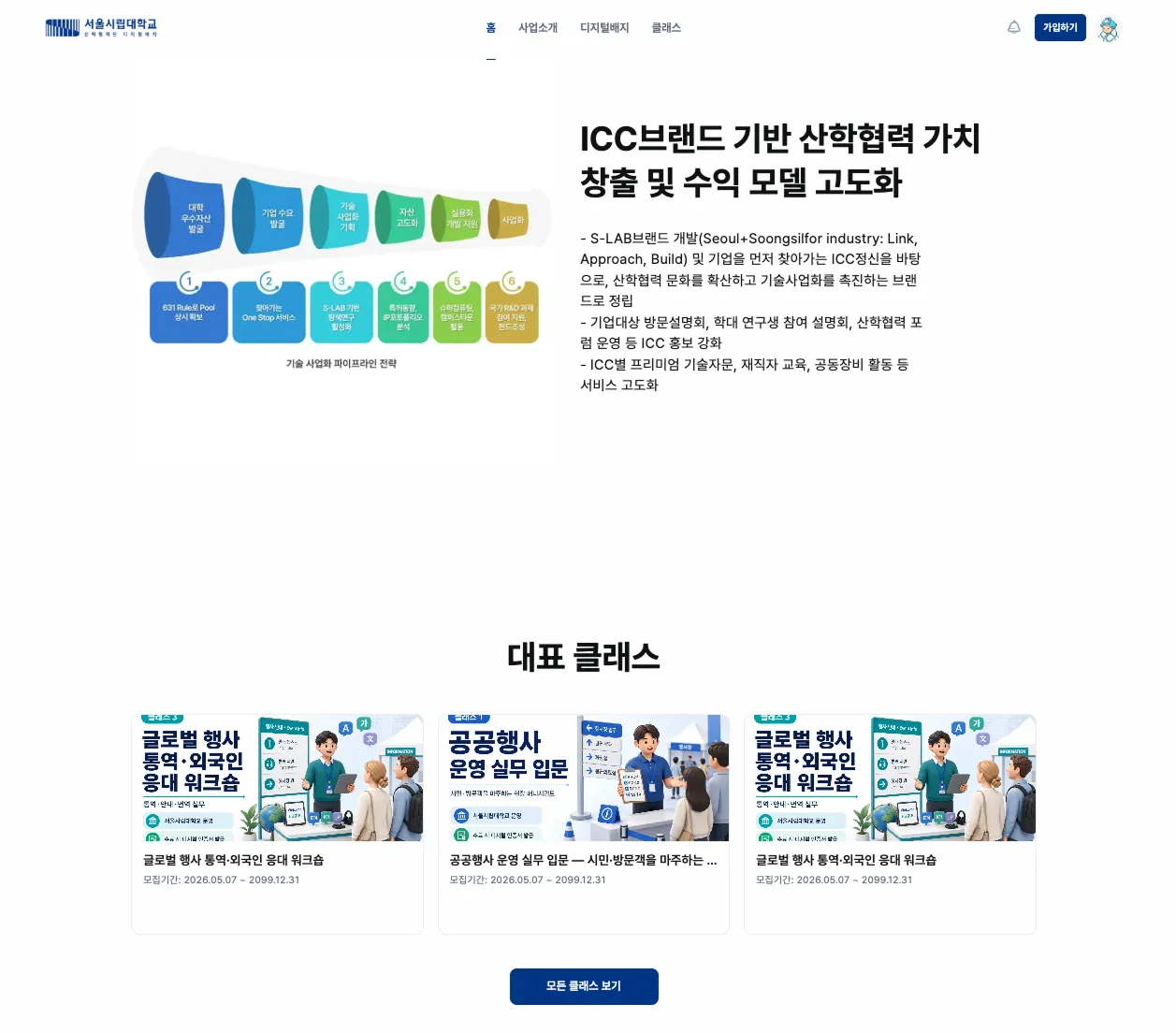
The UOS RISE team’s badge system stacks in three layers. 12 unit badges (L1) form the base, and collecting unit badges by area automatically issues 3 pathways (L2). Above that, anyone who holds two or more pathways plus one or more awards or commendations receives the top-level ‘UOS Practical Talent Comprehensive Certification’ (L3). The issued badges total 15, made of 12 unit badges and 3 pathways, with the comprehensive certification sitting above them.
The core of this three-tier structure is that the more achievements you accumulate, the more the higher certification follows automatically. Each time a learner receives a badge, the next step comes into view.
This structure is designed to drive re-engagement automatically. For a student on the verge of completing a pathway, it automatically points out the missing badge, connecting the next step - from sitting an AI certification exam to passing it, from completing a capstone to making the top team. Not ending at issuance but leading to the next participation is what the three-tier structure aims for.
A differentiation design splitting ‘completion’ and ‘excellence’, and three competency areas
The key to differentiation is placing both a ‘completion’ badge and an ‘excellence’ badge in every competency area. Anyone who meets the criteria receives the completion badge, while the excellence badge is issued only to those who pass external validation such as a joint internal-external review (industry, alumni, VC) or a top rating from a training institution. Depending on the nature of the achievement, it splits into seven certificate types: certificate of completion, project certification, qualification, certificate of participation, letter of appointment, award certificate, and commendation.
The more varied the programs, the harder it is to differentiate by the mere fact of ‘having completed.’ If completion badges widen the breadth of participation, externally validated excellence badges remain as scarce achievements that create differentiation. Aligning each badge’s skill tags with NCS core vocational competencies and job-posting keywords is in the same vein: a design that matches the recipient’s resume with the language of the hiring market from the start.
This differentiation structure was built on the asset that the Foundation operates curricular and extracurricular, public and corporate, all within one institution. That asset is organized into three competency areas.
| Competency area | Key programs | Representative excellence outcomes |
|---|---|---|
| Industry-academia practice | S-LAB capstone design, S-LAB field training, ICC student clubs | Top capstone team, outstanding field-training performer |
| AI practice | AI certification (exam and pass), SLW supporters | AI certification pass, public on-site operation |
| Convergence and regional innovation | AI Smart Work-a-thon, Startup Academy | Top startup team, team deliverable presentation |
On-campus projects and corporate field experience connect into one area; learning flows into qualification and then into public on-site application; and the university’s resources extend into companies and the region. With completion and excellence placed together in each of the three areas, it becomes a system different in texture from the flat certification of ‘a single completion certificate.‘
From undergraduates to corporate employees: four learner groups on one infrastructure
The learners the UOS RISE team faces fall into four groups: undergraduates, graduate students, citizens, and corporate employees. Managing them on different paper forms means institution-level outcomes never come together. So the starting point of the design was ‘issue all four groups from one infrastructure.’ By embedding the issuer, criteria, skills, and evidence into the badge as data, whoever receives it is verified and aggregated the same way.
Undergraduate and graduate students take part in S-LAB capstone design and ICC student clubs; citizens join the Seoul supporters and the Startup Academy; corporate employees take part in the AI Smart Work-a-thon. So that everyone is verified by the same standard and aggregated the same way, the branches were divided: corporate employee badges come with a separate verification URL and sharing guide for use in in-house HR development (HRD), while citizens’ outcomes connect to follow-up lifelong-education courses.
Why a design that bundles onto one infrastructure matters lies in the reality of Korea’s badge ecosystem. The same diagnosis came up at the Korea Education and Research Information Service (KERIS) digital-education forum.
Korea’s digital badge ecosystem today is fragmented like the Galapagos. Various platforms each issue badges in their own way, so linkage and interoperability between platforms need to be secured.
If fragmented platforms are the problem, the starting point for securing interoperability is standards-based design. Kolleges supports the international Open Badges standard too, but the heart of the University of Seoul design is not the standard itself: it is bundling four learner groups’ outcomes into one system and automating issuance and aggregation.
Beyond paper certificates: verification and bulk-issuance operations
Paper certificates and department Excel files are hard to protect against forgery, get lost, and make it hard to gather scattered records for verification and aggregation. A digital badge lets anyone verify authenticity with a single link and a QR code. Operations run from the admin portal: upload a roster by Excel to issue in bulk at once, add attribute values like cohort and score, and handle issuance-complete notifications and resending of failed cases. To validate the build, six were issued as a pilot and all were confirmed received normally.
| Aspect | Paper certificate and Excel | Digital badge |
|---|---|---|
| Authenticity check | Requires a separate inquiry | Instant check via link and QR |
| Forgery and tampering | Hard to detect | Blocked by digital signature |
| Outcome aggregation | Manual gathering by department | Auto-aggregated on the dashboard |
| Use and sharing | Only stored away | Shared on resume, LinkedIn, social media |
| Re-engagement | No connecting link | Guides the next step by flagging missing badges |
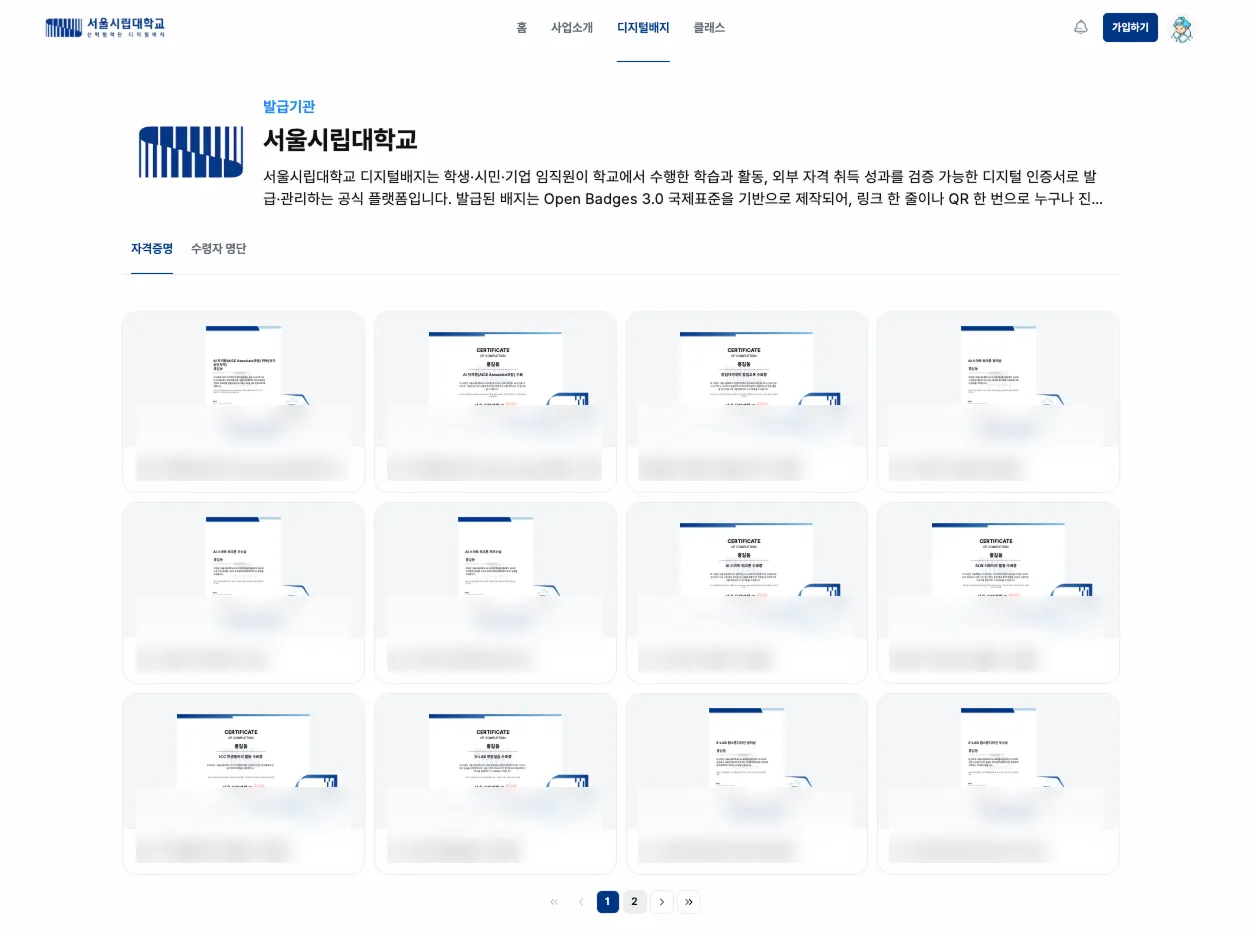
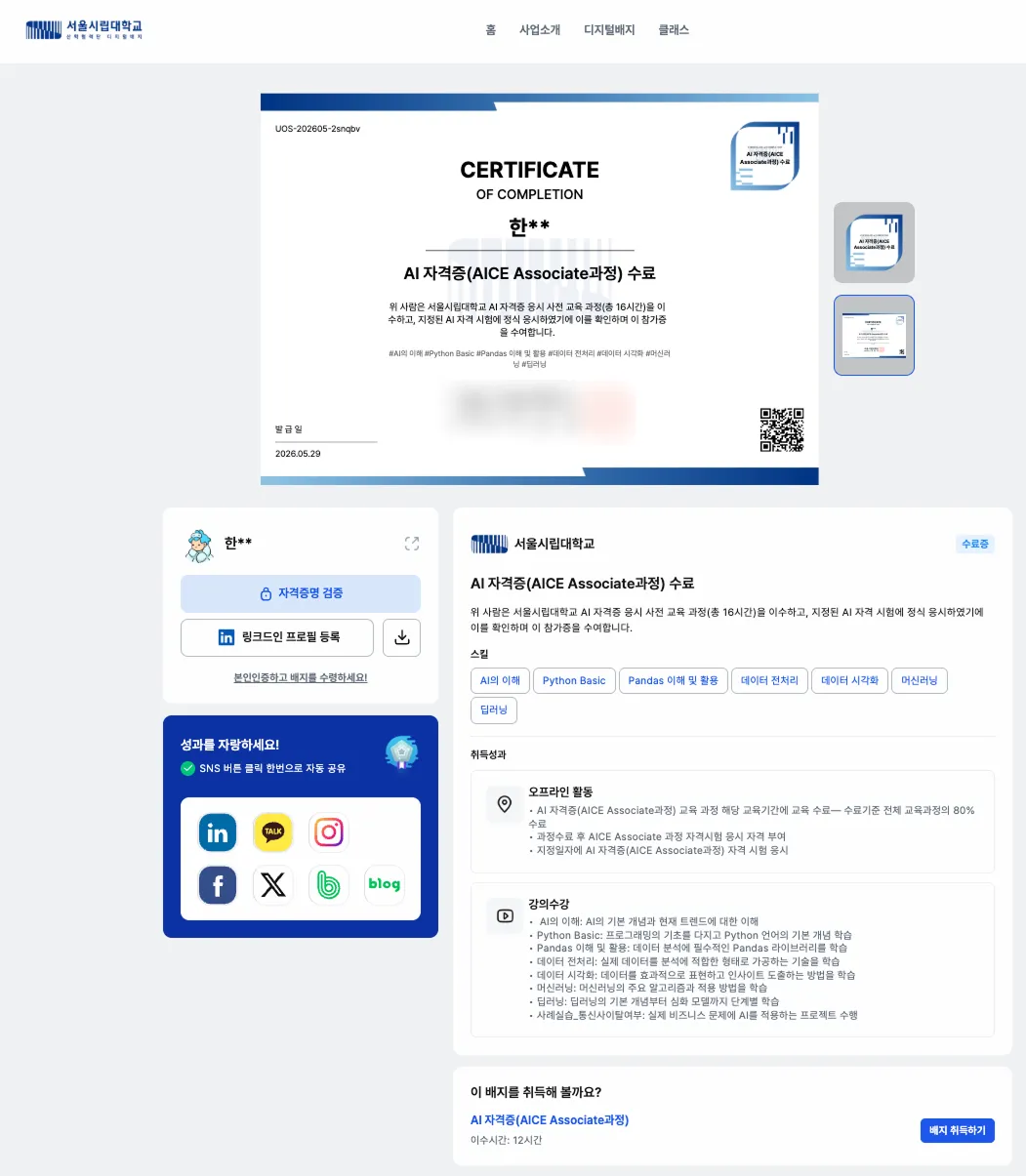
In the admin portal, you create and duplicate certificate and badge templates with the design editor, and you can add issuers for co-issuance. The recipient checks the badge’s skills and achievements on the receipt page, verifies authenticity via QR and URL, then downloads the certificate or shares it on a resume or social media. Screen compatibility was confirmed on Chrome, Edge, and Safari.

Not ending at issuance is the decisive difference from paper. The University of Seoul’s digital badge guide page explains it this way.
It works as an official credential that stays unchanged wherever you attach it - a resume, LinkedIn, a portfolio, or a corporate recommendation letter.
Pre-issuance checks and a 12-month roadmap
On June 11, 2026, the Foundation held a platform build completion report meeting and is preparing the first issuance. The pilot issuance confirmed it works, but applying badges across all 7 programs and actually issuing them to learners starts now. Automatic academic and LMS integration, portfolio customization, and large-scale issuance expansion are classified as second-phase enhancement tasks.
What the working team reviewed at the completion meeting was not features but operational detail: which channel to send issuance notifications through and how to resend them, how to explain a badge’s earning criteria to learners, how to design attribute values like cohort and score at issuance, and how to help departments and learners understand the concept of a ‘pathway.’ Handover was completed with the transfer of operating authority and a maintenance agreement (99.5% server uptime, response within 2 hours for incidents, critical-bug patches within 24 hours, and daily automatic backups).
The roadmap is phased. The first month runs a pilot on the S-LAB capstone design and AI certification lines, and within 3 months it widens to all 7 programs. At the 6-month mark it activates the comprehensive certification, dashboard, and promotion system; at the 1-year mark it stabilizes the integrated performance-management system while connecting alumni and re-enrollees as well as corporate and public partners.
If your institution stands at the same starting line, it’s worth examining your own organization’s outcome structure first.
What the University of Seoul Industry-Academic Cooperation Foundation designed on top of digital badges comes down to one line. Scattered capstones, field-training, and startup demo days remain as verifiable unit badges, are bundled into pathways by area, and are finally proven as the comprehensive certification ‘UOS Practical Talent.’ Three things sit together in that one line: leaving outcomes as verifiable data, automating bulk issuance, and connecting through sharing and re-engagement.
Frequently asked questions
Want to turn learning outcomes into verifiable assets?
From issuing to verifying and amplifying, see it for yourself with Kolleges.
Request a Kolleges demo
Related posts
Kwangwoon University De-Butler × XRPL hackathon wraps up - interviews with the organizers and the top-prize winner
How the De-Butler × XRPL blockchain hackathon DE-BUTHON came together and wrapped up - told through interviews with the organizers and the top-prize winner, plus a behind-the-scenes look at issuing digital certificates and badges with one CSV upload.
Managing employee security-training completion: what changes with automatic certificates and digital badges
How BizMarket ran its employee security training on Kolleges' automatic certificates and digital badges - 166 credentials auto-issued, verifiable completion records, and client-proof requests handled in one screen.
Uhyeonmoon Gallery | Exhibition Records Once Lost When a Space Closed Now Live On as Digital Badges
Fifty-one young artists selected on a professor's recommendation. The exhibition ends, but the credential remains. An interview with Kim Sun-hak, CEO of Uhyeonmoon Professional Arts Organization.