
What Is K-MOOC's Lifelong Free Lecture Service? A Guide to Starting Online Learning Today
K-MOOC is Korea's state-run open course platform offering free university lectures to lifelong learners, with select courses eligible for official academic credit.
“What if you could take quality university lectures for free, for life?”
It’s a question many of us have asked at least once.
The service closest to answering that question is K-MOOC.
As the era of online learning expands rapidly, an environment in which anyone can learn without limits on time or place has become essential infrastructure. At the center of that shift is K-MOOC (Korean Massive Open Online Course), operated by the National Institute for Lifelong Education (NILE).
But few people accurately know what K-MOOC is, or what “lifelong free” really means.
So today, we’ve prepared a guide that lays out K-MOOC’s concepts, how it operates, the conditions for free courses, and how beginners can get started - all in one place.
1️⃣ What Is K-MOOC?
K-MOOC is a Korean-style online open course platform, where major Korean universities and research institutions participate to provide high-quality lectures for free.
The main features can be summarized as follows.
✔ Run directly by Korean university faculty
It offers free lectures across nearly all academic fields - humanities, social sciences, natural sciences, engineering, arts and athletics, and medicine and pharmacy -
and lecture quality is mostly equivalent to regular university coursework.
✔ Learning is structured like “a university class”

It’s not just video viewing. The structure is:
lecture → PDF teaching materials → quiz → discussion → assignment → assessment → certificate
So it’s appropriate to view K-MOOC as an online-based higher education system.
✔ Some courses are even eligible for credit recognition
For courses linked to the Academic Credit Bank System, you can earn official credit if you meet the assessment criteria. A growing number of universities are also recognizing K-MOOC completion as special credit, which helps with substantive academic development.
So K-MOOC isn’t just a “free online lecture platform” - it’s a core platform of Korea’s lifelong education system.
2️⃣ Is It Really Free for Life? Operating Conditions and How to Read Them
When K-MOOC is promoted, the phrase “lifelong free lectures” appears often.
It’s not inaccurate, but you need to understand a few conditions to interpret it correctly.
✔ Most lectures are completely free
You can apply for courses immediately after signing up, with no tuition fees.
There are no payment prompts in the middle - it’s a truly free service.
✔ Completion certificates are free or conditionally issued
If you meet a course’s criteria (attendance rate, quizzes, assignments), you can get one for free.
In some courses there may be separate fees - but these are exceptional cases.

✔ Not all courses are offered “permanently”
This is often misunderstood.
The phrase “K-MOOC = lifelong free”
means a service structure designed so that learners can use it for free for life.
It doesn’t mean every course is maintained indefinitely.
-
Some courses are discontinued
-
Some are time-limited
-
Some are reopened after renewals or updates
That said, the platform is building a long-term, stable always-on learning framework, so many courses do continue to be offered.
✔ Linkage with the Academic Credit Bank System and university credit recognition
Some K-MOOC courses are linked to
-
Academic Credit Bank-evaluated learning programs
-
Individual universities’ credit recognition systems - which provide tangible benefits for learners who need academic development.
K-MOOC is therefore valued as a platform that goes beyond free courses to support career development, expansion of specializations, and academic recognition.
3️⃣ How to Use K-MOOC and Learning Tips
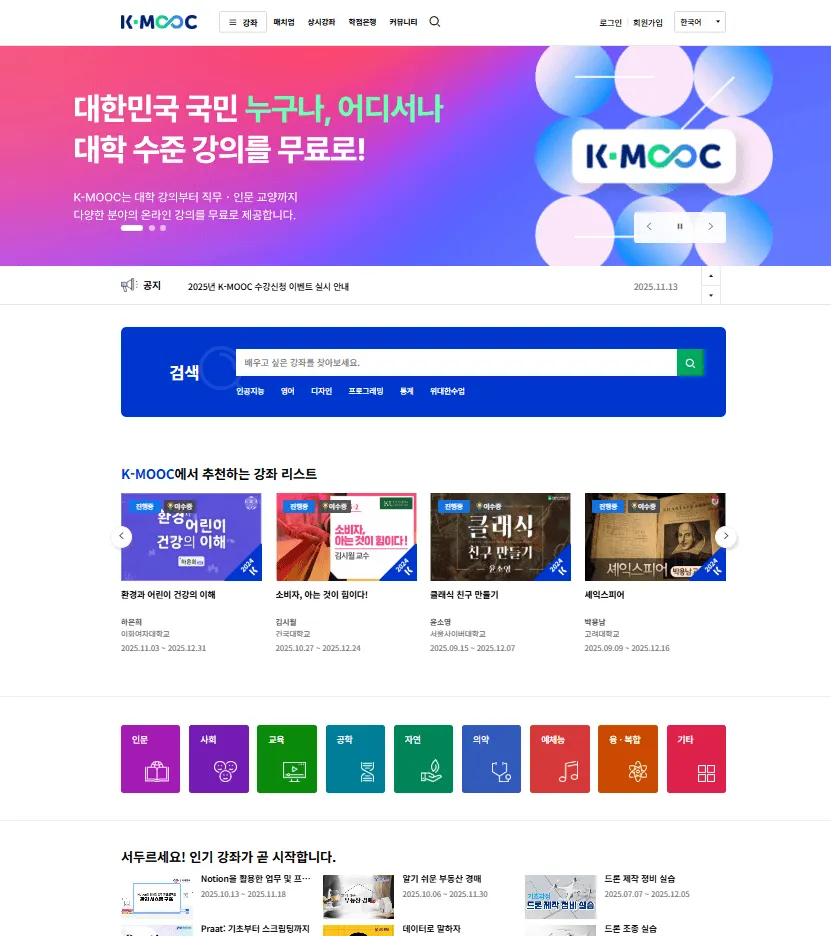
It may look complex at first, but understanding a few basic flows makes it easy for anyone to start.
✔ ① Sign up and search by area of interest
On the K-MOOC website,
-
Field of study
-
Operating institution
-
Difficulty level
-
Course duration
-
Course type - and many other filters help you quickly find the lectures you want.
✔ ② Enroll and progress through the course
Most courses consist of the following components.
-
Lecture videos
-
Teaching materials (PDF)
-
Quizzes
-
Discussion boards
-
Assignments
-
Exam assessments
It’s a university class moved online, with enough structure to keep you engaged.
✔ ③ Always check certificate and credit requirements
Course criteria differ, so check before enrolling.
In particular, if you’re using the Academic Credit Bank System, you must verify whether the course is eligible for credit recognition.
✔ ④ Recommended use by goal
| Goal | Recommended Strategy |
|---|---|
| Job skill development | Use practical courses such as data analytics, AI, business, and digital literacy |
| Certification prep | Use as supplementary study for Korean history, IT, digital competency, and other exams |
| Credit acquisition | Prioritize Academic Credit Bank-eligible courses |
| General education | Expand knowledge through philosophy, humanities, art, and other general courses |
Why K-MOOC Matters
K-MOOC goes beyond a simple free lecture platform to function as a public higher education system operated by the state.
Anyone can take high-quality university lectures for free and, depending on their goals, secure completion certificates and credits - making it highly valuable for adult learners, university students, and working professionals alike.
Not every course is permanently offered,
but because the state designs the service structure around the goal of “lifelong free learning infrastructure,”
the term “lifelong free lectures” carries real meaning.
Going forward, learning accessibility will only become more important - and K-MOOC will continue to develop at the center of that shift.
📌 About Kolleges
Kolleges works with many educational institutions to operate
digital badges, certificates of completion, and competency-based credentials - transparently recording learner growth,
and supporting the management of completed courses and outcomes in the form of E-portfolios.
We’ll continue to provide trustworthy content on online learning, lifelong education, certifications, and more - to make your learning journey easier.
Frequently asked questions
Want to turn learning outcomes into verifiable assets?
From issuing to verifying and amplifying, see it for yourself with Kolleges.
Request a Kolleges demoRelated posts
The Pros and Cons of Online Education, and an Introduction to an Online Education Platform
Online education breaks barriers of time and place, yet success hinges on learner self-direction and a reliable technical environment - Kolleges automates the platform so operators can focus on teaching.
Education Digital OnePass: Signup Guide and Tips
Education Digital OnePass lets students, parents, and school staff access Korea's major education platforms - NEIS, EduNet, EBS Online Class, and more - with a single secure account.

The Credit Bank System: A Complete Guide for Working Professionals
The Credit Bank System lets working professionals earn a Korean bachelor's degree in as little as 1-2 years through online courses, certification credits, and transfer credits - at up to 90% less than university tuition.