
Bitcoin and Blockchain: Why All the Heat?

Blockchain stores data across all network participants rather than a single server - making it tamper-resistant - while Bitcoin is one virtual currency application built on top of it.
Hello, this is Kolleges.
Today we’ve prepared a deep dive into Bitcoin - a hot topic recently - and the blockchain technology that makes it possible.
Blockchain and Bitcoin are different concepts, but many people still confuse the two. In this post we’ll look at the difference between blockchain and Bitcoin, and how both technologies are changing the world.
What is blockchainWhat is blockchainWhat is blockchainWhat is blockchain
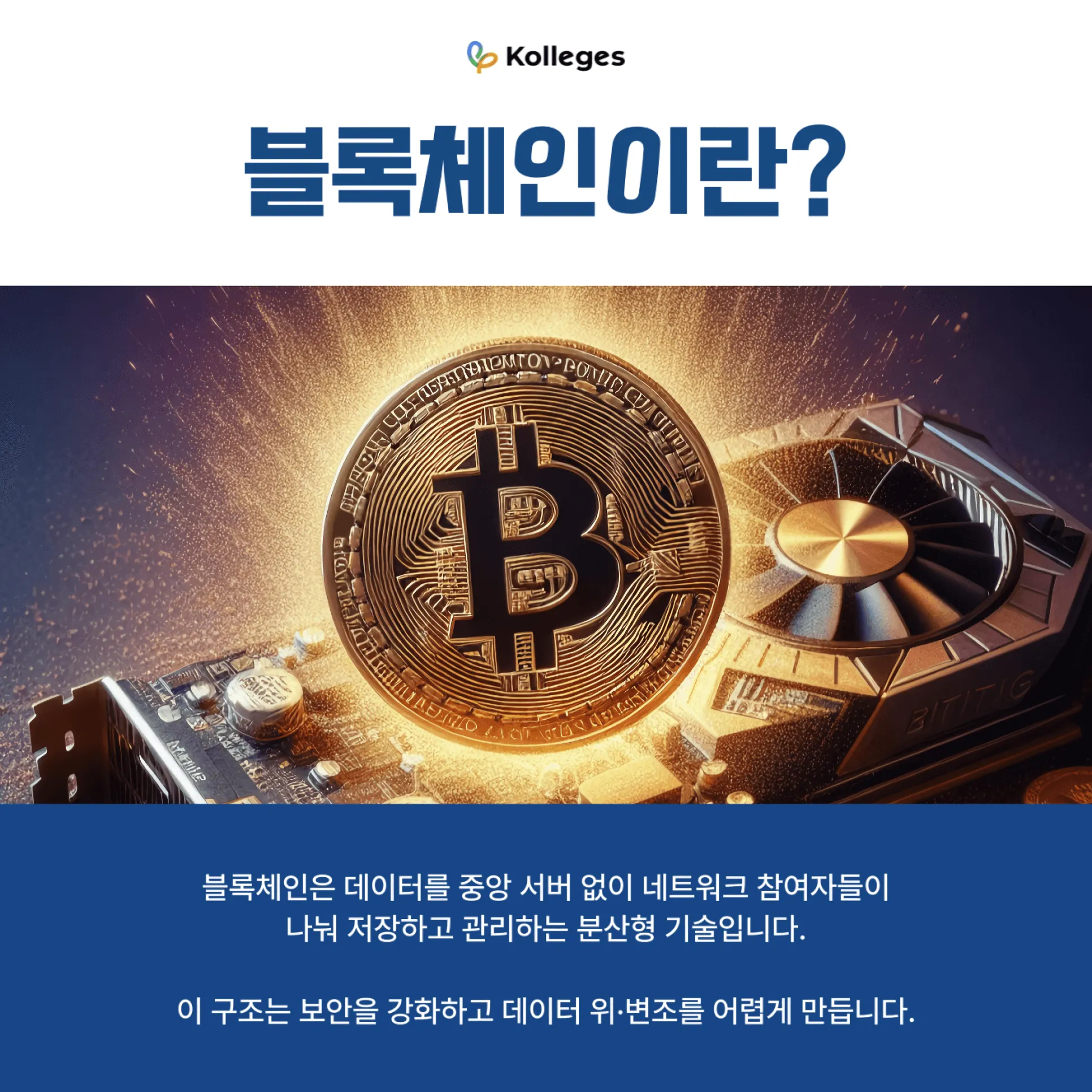
In simple terms, blockchain is a technology that stores data across all participants in the network, rather than on a single central server.
For example, banks manage all transaction records centrally - you have to go through the bank for transfers and authentication. Blockchain distributes that role across all participants. There’s no central administrator, and security becomes much stronger.
Thanks to this structure, forging or tampering with data is extremely difficult. Attacking a single central server isn’t enough - you’d have to alter the data held by every participant at the same time.
How are Bitcoin and blockchain relatedHow are Bitcoin and blockchain relatedHow are Bitcoin and blockchain relatedHow are Bitcoin and blockchain related

Bitcoin is a virtual currency built on blockchain technology.
It was first proposed by a developer named Satoshi Nakamoto in Japan, demonstrating that currency issuance and circulation are possible without a central bank.
In short, Bitcoin is a system with no controlling authority - transaction records are stored on the blockchain, and everyone can verify them transparently.
Bitcoin’s value fluctuates daily, which has drawn criticism that it’s speculative.
But as Bitcoin draws this much attention, blockchain technology is expanding beyond finance into other industries. Don’t you find yourself curious about the changes it will bring? 😊
Today we covered blockchain and Bitcoin briefly - does it feel a little more approachable?
Blockchain offers strong trust and security, and the range of fields using it is likely to keep expanding.
Kolleges will continue sharing useful information in an easy-to-follow way. See you next time. Thanks!
Frequently asked questions
Want to turn learning outcomes into verifiable assets?
From issuing to verifying and amplifying, see it for yourself with Kolleges.
Request a Kolleges demoRelated posts
How to Issue Digital Badges and Store Them Safely (feat. IPFS)
Digital badges become tamper-proof Verifiable Credentials by combining JWT cryptographic signatures with IPFS distributed storage, letting anyone verify authenticity via a content-addressed CID link.

What Is DID - Managing Digital Badges with Decentralized Identity
Kolleges builds digital badges on DID using the did:key method, so both issuers and recipients hold cryptographic key pairs that let anyone verify badge authenticity without a central server.

A New Standard for the AI Era: Digital Identity Verification
Personhood Credentials let users prove their humanity online without exposing personal data, and digital badge platforms like Kolleges are positioned as a key asset for this emerging trust layer.