
Digital Badges vs. Traditional Certificates: Which Strengthens Student Employability?

Digital badges embed verifiable skill metadata and integrate with LinkedIn, giving graduates a data-backed credential that employers can trust and discover - unlike paper certificates that require manual verification.
The Era of Paper Certificates Is Ending
No matter how high the quality of education at a vocational training institution, if the outcomes of its graduates are not “objectively proven,” their employment competitiveness has a ceiling.
Paper certificates and PDF documents used to be the standard, but “learning that can be shown” and “verifiable competency” have now become core values in education.
Leading this transition is the digital badge.
A digital badge is more than an image - it is a data-rich credential containing the learner’s skills, achievements, and evaluation criteria.
In other words, it is a “smart credential” that holds far richer information than a single piece of paper.
These digital badges, built on international standards (OBv3), have become a certification system that any institution or enterprise can trust.
(International standard (OBv3): 1EdTech’s international certification specification that guarantees the credibility and interoperability of digital badges, defining issuance, verification, and sharing to work the same way worldwide)
The Difference Between Digital Badges and Traditional Certificates Comes Down to “Credibility” and “Sharing”
Online Verification vs. Manual Confirmation
A digital badge is a credential that can be verified instantly via blockchain or an official certification server.
With no separate administrative process, anyone can click the badge to immediately see the issuing institution, issuance date, and technical details.
By contrast, paper or PDF certificates require manual verification processes such as confirming with an administrator or requesting documents.
From an employer’s perspective, a verifiable digital badge lets them quickly and reliably assess a candidate’s skill.
The core value of digital badges, in short, is “automated credibility.”
✅ Digital Badge vs. Traditional Certificate

The Metadata Inside a Digital Badge Proves “Evidence of Skill”
A digital badge contains more than the fact “this person completed the course.” It includes specific metadata such as:
-
The skills learned and the project content
-
Evaluation criteria and scores
-
The issuing entity and the assessment standard
(Metadata: in general, “data that describes data” - in education and digital badges, it refers to core data such as the learner’s achievements, issuance criteria, and assessment.)

This information objectively shows “what the learner can actually do.”
Companies can click a badge on a candidate’s résumé or portfolio to verify the actual competency with data instead of relying on a simple completion history.
In other words, a digital badge is a new form of competency credential that proves “what someone can do” rather than just “what they learned.”
This structure becomes a real competitive advantage in recruiting.
The learner no longer just holds a single certificate; their specific competencies and outcomes are revealed visually, as data - turning into a real strength.
For the employer, in just a few seconds, they can verify the candidate’s technical level, project experience, and evaluation criteria all at once, building strong trust before the interview stage even begins.
Stand Out More and More Easily as a Job Candidate with Digital Badges
A digital badge is a credential asset that displays a learner’s skills online, instantly.
Because verifiable competency information is already embedded, employers can quickly assess a candidate’s skill level just by clicking a link.
In particular, Kolleges’ digital badges integrate directly with LinkedIn, so badges earned can be immediately added to the “Skills” section.
Recruiters and headhunters can then easily discover talent with those skills through LinkedIn search.
In addition, badges can be shared with a single paste anywhere:
-
SNS (Instagram, Facebook, etc.)
-
Portfolios and personal websites
-
PDF résumés, email signatures, messenger profile links
In other words, a student’s competency spreads in a form that doesn’t require them to actively pitch themselves - recruiters can find them first.
As a result, learners with digital badges:
-
Are noticed faster during résumé screening
-
Earn trust without additional proof in skill verification
-
Gain the competitiveness to be prioritized in role-fit assessments
In short, digital badges go beyond simple completion certificates - they become “career amplifiers” automatically discovered across multiple channels.
A Real Case Study of Career Competitiveness Made Whole: Esri’s Transformation

Esri, the global map data company, used PDF certificates for many years.
But it recognized that completers were unable to easily share or verify those credentials online.
So Esri introduced a digital badge issuance system (Acclaim).
The results:
-
82% of completers said “it became easier to share my credentials”
-
44% said “my skills were discovered more often through search exposure”
In other words, digital badges are not just visually appealing credentials - they function as practical tools that meaningfully raise students’ career exposure and employment opportunities.
This case offers important lessons for vocational training institutions:
beyond simply issuing certificates, there is a need to evolve into an education operating system that manages the employment competitiveness of completers.
Brand Trust and Improved Evaluation in Public Programs: The Real Effects for Educational Institutions
Institutions that adopt digital badges are perceived as “institutions with innovative and transparent education assessment systems.”
In particular, badges issued through platforms compliant with the international Open Badges 3.0 (OBv3) standard can be verified at home and abroad, elevating the institution’s international competitiveness and education brand value.
In addition, government and university-linked program calls for proposals and industry-academia cooperation deliverables increasingly cite “digital management of completer outcomes” and “building a digital badge issuance system” as explicit requirements.
For example, some universities’ continuing education programs for working professionals explicitly include “digital badge issuance (under the university’s name)” as a formal deliverable. KERIS (Korea Education and Research Information Service), through public research, has also proposed a model for the standardization, diffusion, and quality management of digital badges.

In this way, institutions with systems that can prove outcomes with data have a growing chance of receiving positive evaluations on the dimensions of innovation and diffusion potential in government-supported and industry-academia cooperation programs.
Some universities have also been observed providing internal evaluation bonuses for operating micro-degrees or digital badges, and for opening external cooperation programs.
Ultimately, digital badges have become more than a tool for raising student employability - they are positioning as core infrastructure that expands an institution’s public-program competitiveness and partnership opportunities.
Digital Badges That Connect Completion to Employment
A digital badge is not just a “digitized” credential.
It is a technology that proves a student’s learning journey with data and connects outcomes to society.
For students, practical employment competitiveness; for institutions, trust and promotional impact; for employers, the efficiency of acquiring verified talent.
Going forward, vocational training institutions must go beyond creating good education - they must build a system that proves and amplifies that outcome.
The starting point is the Kolleges digital badge.
Kolleges supports badge issuance, completion management, and sharing/distribution all at once, with international-standard OB3.0-based blockchain certification technology.
With a single issuance, completers gain more opportunities and institutions gain broader promotional reach.
Now, the opportunity to turn the moment of completion into a stepping stone to employment,
Kolleges Digital Badge
Frequently asked questions
Want to turn learning outcomes into verifiable assets?
From issuing to verifying and amplifying, see it for yourself with Kolleges.
Request a Kolleges demoRelated posts
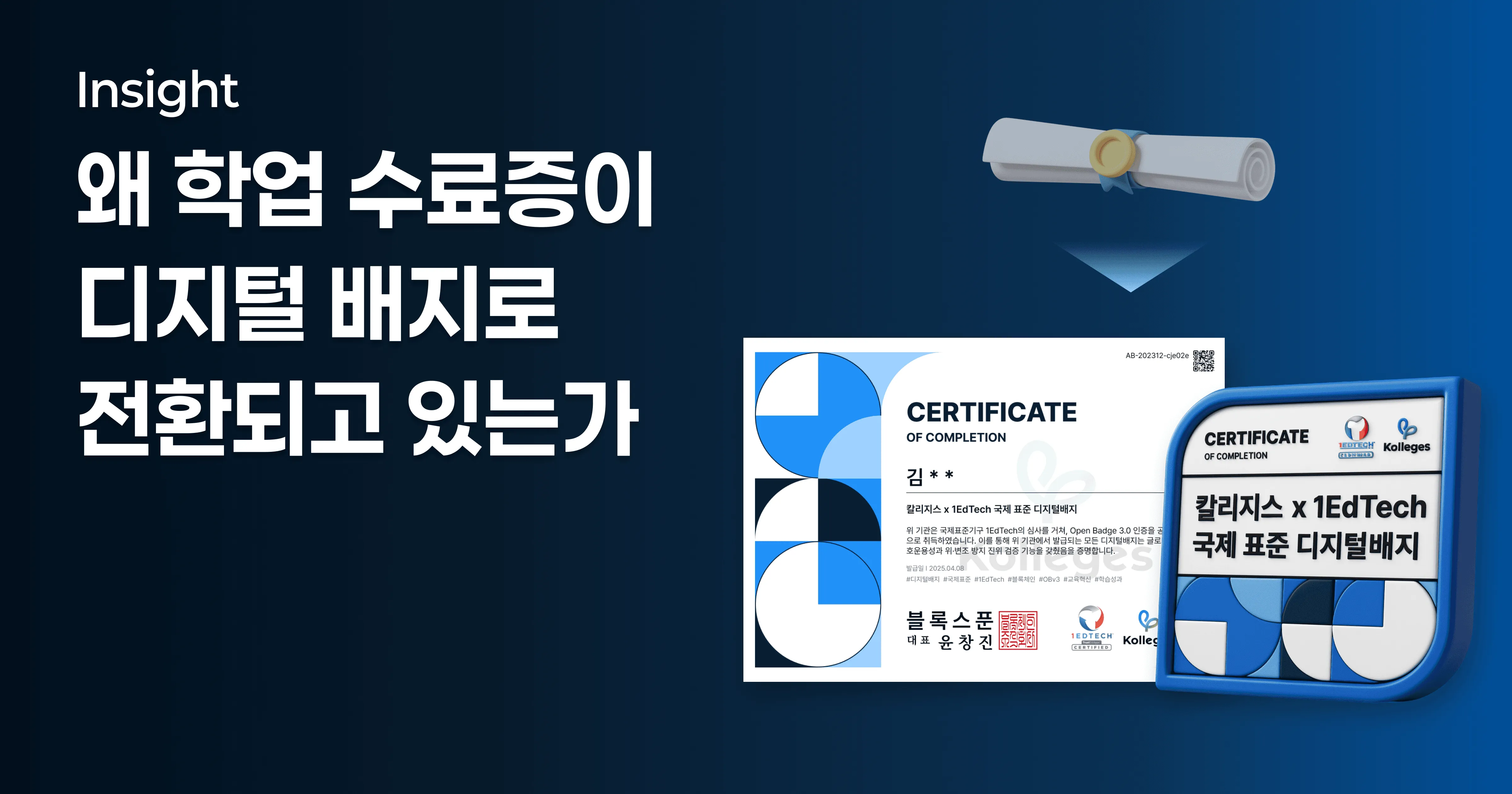
Why Academic Certificates Are Turning Into Digital Badges
Digital badges replace paper certificates by embedding verified competency data - practical outcomes, skills, and issuer credentials - that learners can share instantly and employers can trust.

How to Use Digital Badges in Resumes and Portfolios
Digital badges embedded in resumes, portfolios, and LinkedIn profiles function as verifiable, metadata-rich credentials that strengthen your case in skills-based hiring.

The fundamentals of career growth: a complete guide to building your performance portfolio
A performance portfolio built around quantified outcomes and digital badges is the most credible way to prove job-performing ability during hiring, role transitions, and internal career growth.