
Five Essential Checks Before Adopting Digital Badges

A practical five-point checklist - covering data privacy, blockchain stability, Open Badges 3.0 compliance, issuance management, and share UX - to evaluate before adopting digital badges.
Digital badges have moved beyond simple certificates of completion to become a core tool for amplifying an institution’s brand and validating learner growth.
But a growing number of institutions are adopting them without proper preparation and running into problems such as legal risk, system errors, and erosion of brand trust.
That is why we put this together. The five checks you must complete before adopting digital badges, drawn from real cases and limited to the items that actually matter.
Check 1. Are the servers located overseas?
Why it matters
Many overseas solutions store personal data on servers located outside Korea, such as in Japan or the United States. In this case, using them without the disclosure and consent required for cross-border transfer of personal data violates Korean law.
Risks if unchecked Missing cross-border transfer disclosure → violation of the Personal Information Protection Act → inability to participate in public-sector or government projects → learner complaints and grievances.
Check 2. Does it run on a stable blockchain mainnet?

Why it matters
The core value of a digital badge is tamper-proof verification. Yet some solutions run on experimental blockchains or chains whose stability has not been validated.
Risks if unchecked
- Badge links break over time
- Reissuance requests surge
- Trust in the institution declines
- Examples of validated blockchain mainnets
Check 3. Is it certified to the Open Badge international standard?
Why it matters
Open Badges 3.0 is the international standard for digital badges. Badges without certification may be rejected as invalid by global partner organizations and recruiting systems.
A real case A Korean education provider issued badges through a foreign platform → an international NGO partner treated the badges as “just images” → the entire training program was disqualified → the project collapsed.
Check 4. Can issuance history and validity be managed?
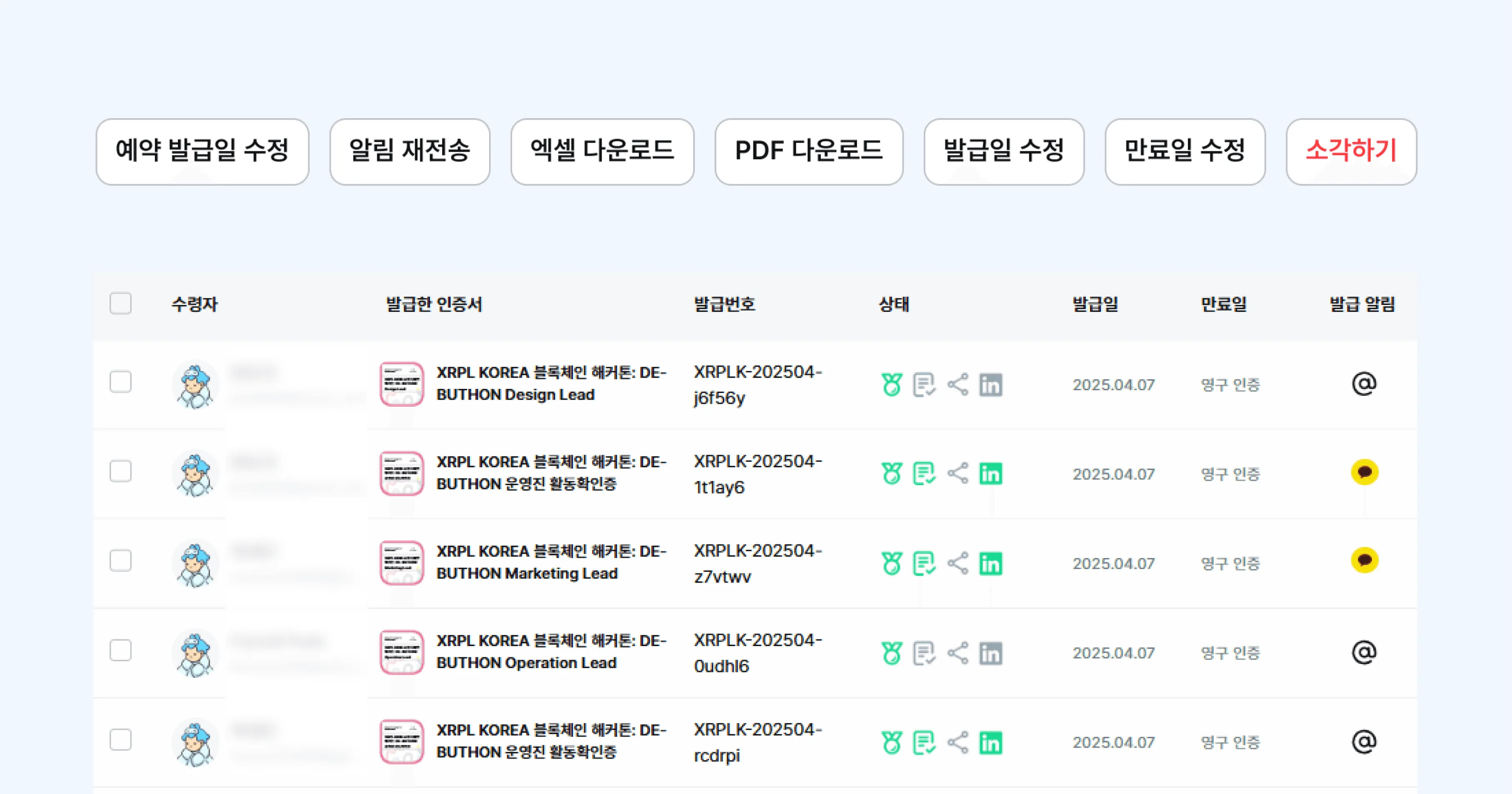
Why it matters
Managing issued badges matters even more than issuing them. Without validity periods, revocation, and SNS-sharing tracking, you lose both the trustworthiness of the credential and the marketing reach.
Examples of problems No tracking after issuance → forgery risk Manual issuance → wasted resources No analysis of SNS distribution paths → no marketing asset value
Try it for yourself now Experience Kolleges
Check 5. Is the UX something people actually want to share and verify?
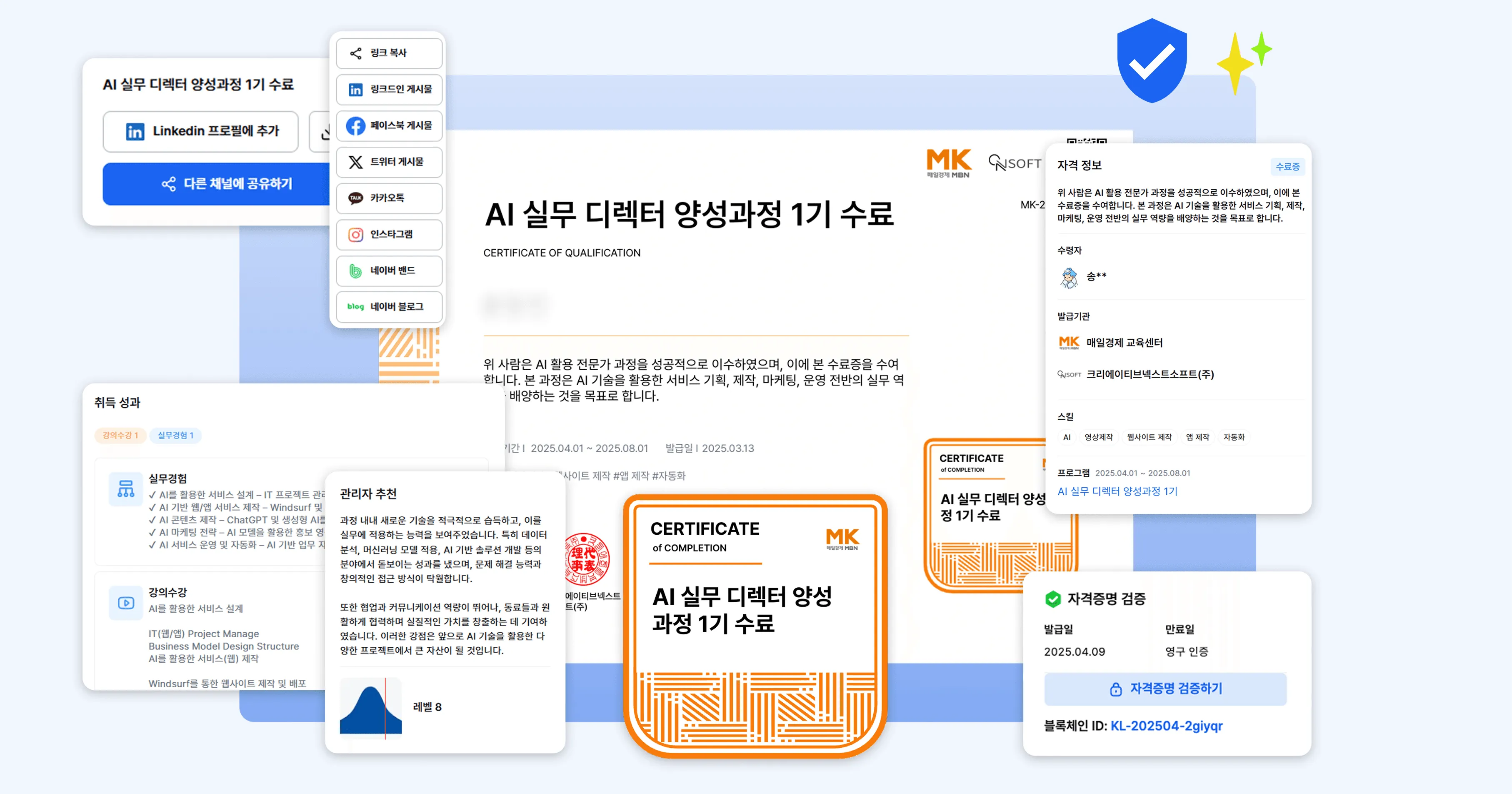
Why it matters
A digital badge generates real value the moment it is seen. When the UX is clunky, share rates collapse and the distribution effect drops to nearly zero.
Examples of problems
- Hard to share → not used in practice
- Indistinguishable from a paper certificate → no interest
- Lower learner satisfaction → lower re-enrollment
Bonus summary: the checklist at a glance
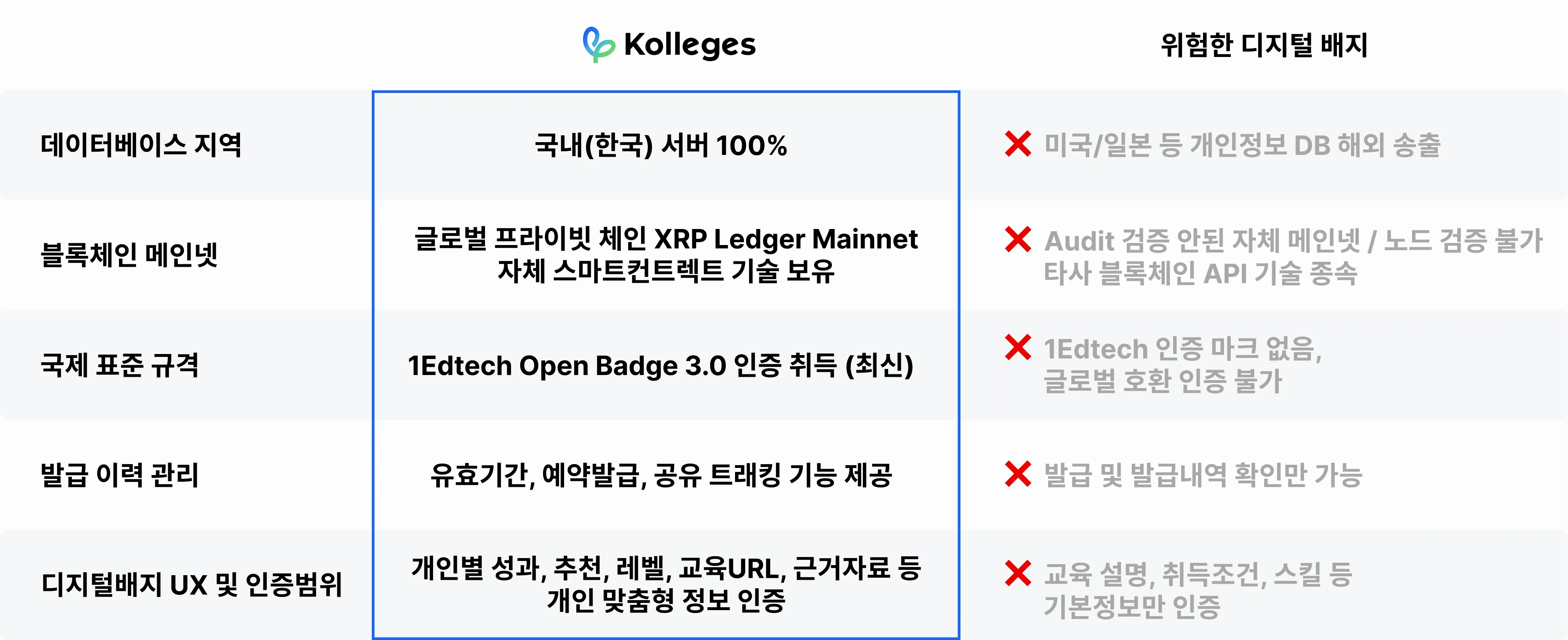
Frequently Asked Questions
Q1. How is a digital badge different from a certificate of completion? A. A digital badge is a credential that can be verified online and used for SNS sharing and portfolios.
Q2. Can smaller institutions also adopt digital badges? A. Yes. Kolleges offers a range of adoption options tailored to budget and features.
Q3. What if learners do not actively use the badges? A. Improved share UX and portfolio automation help drive higher adoption.
Q4. Can international learners use them? A. Choose a solution that supports English certificates and multilingual UI.
Q5. Could the verification ever stop working? A. Using a validated mainnet guarantees verification persistence.
Run through these five checks, and let Kolleges add real value to your educational content.
Frequently asked questions
Want to turn learning outcomes into verifiable assets?
From issuing to verifying and amplifying, see it for yourself with Kolleges.
Request a Kolleges demoRelated posts

Digital Badge Adoption Checklist | 7 Things to Verify Before Signing in 2026
From the version and roles of 1EdTech certification to the ISO 27001 edition number, personal data processing consignment, the amended privacy law effective September 2026, and public procurement requirements - seven things to verify before signing a digital badge solution contract.

A 10-Point Digital Badge Design Checklist for Your Institution
Badge programs fail not from bad technology but from skipping design-stage decisions; this 10-point checklist helps institutions build badges that recipients actually use and share.

Why ISO 27001 (Information Security) Certification Is Essential for Digital Badge Platforms
Digital badge platforms must hold ISO 27001 certification because learner credentials are lifelong career assets - any forgery, leakage, or outage directly harms individuals, not just institutions.