
How to Evidence High School Credit System Competencies Beyond the School Record, with Digital Badges

In 2026, with credit completion criteria relaxed, this article sets out how to record the learning experiences the school record cannot hold as verifiable data, using practical criteria for schools and education offices.
From 1 March 2026 the credit completion criteria for first- and second-year high school students change. The requirement to meet both a two-thirds attendance rate and a 40% academic achievement rate is relaxed so that meeting either one alone counts as completion (resolved by the National Education Commission, January 2026). It is a measure aimed at reducing the number of students who fail to complete credits. For third-year students the same criteria apply from 1 March 2027.
From a school’s point of view this change means two things at once. The risk of a student missing credits falls, and the amount of information carried by the “completed” mark on the school life record grows thinner. A student who chose subjects to match their career path and went outside the school to learn, and a student who only met the attendance requirement, receive the same mark. Where to record that difference has become a practical task for high schools in 2026.
In the 2026 High School Credit System, does the “completed” mark distinguish student competency?
The completion mark shows only whether the minimum was reached; it does not hold what the student became able to do. From 1 March 2026, first- and second-year students earn credit by meeting either a two-thirds attendance rate or a 40% academic achievement rate. The Ministry of Education recommended reflecting both criteria for common subjects while reflecting attendance alone for elective subjects. The fact that the 192 credits required for graduation have been met, and the competency built up along the way, are two different pieces of information.
The relaxation of completion criteria is designed to protect students from the risk of not completing credits. As a result, though, the range of students bundled under the single signal of “completed” grows wider. Layered on top is the shift, from the 2028 admissions cycle, of high school internal grades from a nine-band to a five-band system. As the share of distinction carried by grade indicators shrinks, the weight of records showing what a student actually did grows by the same measure.
The purpose of the High School Credit System itself points in this direction. It is a system built so that each student chooses different subjects and learns along a different path, yet the record format meant to hold that difference remains subject names and narrative text. A gap has opened between a system that respects individual choice and the way the results of that choice are recorded.
What does the school record hold, and what does it fail to hold?
The school life record holds subject names, achievement levels, and detailed ability and special notes, and mostly fails to hold learning that happened outside the school. For joint curriculum courses too, foundational and inquiry subjects are recorded with raw scores, averages, and achievement levels, while physical education, arts, and liberal arts subjects are recorded with achievement levels, and completion is judged by attendance at two-thirds or more of the 16 sessions per credit (2022 revised national curriculum). By contrast, camps run with local universities and companies, or job experience hosted by an institution, are compressed into a few lines of narrative or never become data at all.

| Learning experience | Form it takes in the school record | What is not held |
|---|---|---|
| Elective subject completion | Subject name, credits, achievement level, detailed ability and special notes | Deliverables from the tasks performed, evidence of the competency level reached |
| Joint curriculum courses | Raw score, average, achievement level (foundational and inquiry), achievement level (physical education, arts, liberal arts), special notes | Project outputs produced at the partner school |
| Creative experiential activities | Narrative special notes for autonomous and self-governance activities, club activities, and career activities | Level of proficiency in the tools and techniques acquired during the activity |
| Regionally linked camps and job experience | Mostly not recorded | The activity in its entirety and its deliverables |
The density of the record splits between the “elective subject completion” row and the “regionally linked camps and job experience” row. The top two rows have a set format, so comparison across schools is possible, but the further down the rows go, the more likely it is that two schools record the same activity entirely differently, or not at all. Students can take up to two joint curriculum subjects per semester, and the work produced in those subjects is summarised inside a sentence of special notes rather than left behind as separate evidence.
In practice this gap comes back as three burdens. Teachers spend recording time translating the quality of an activity into sentences, universities have no ready way to verify competency from narrative alone, and students lose the evidence of what they accomplished the moment they graduate.
What data does a digital badge use to record student competency?
A digital badge is a credential issued with the issuer, recipient, earning criteria, issue date, and verification information held inside the badge as metadata. The international standard 1EdTech Open Badges 3.0 places an issuer digital signature in each badge, in a form compatible with the W3C Verifiable Credentials Data Model 2.0. Unlike a screenshot of an award or a downloaded PDF, the issuer signature makes tampering detectable on the spot, and a badge can be linked to a competency framework to show which criteria were met.
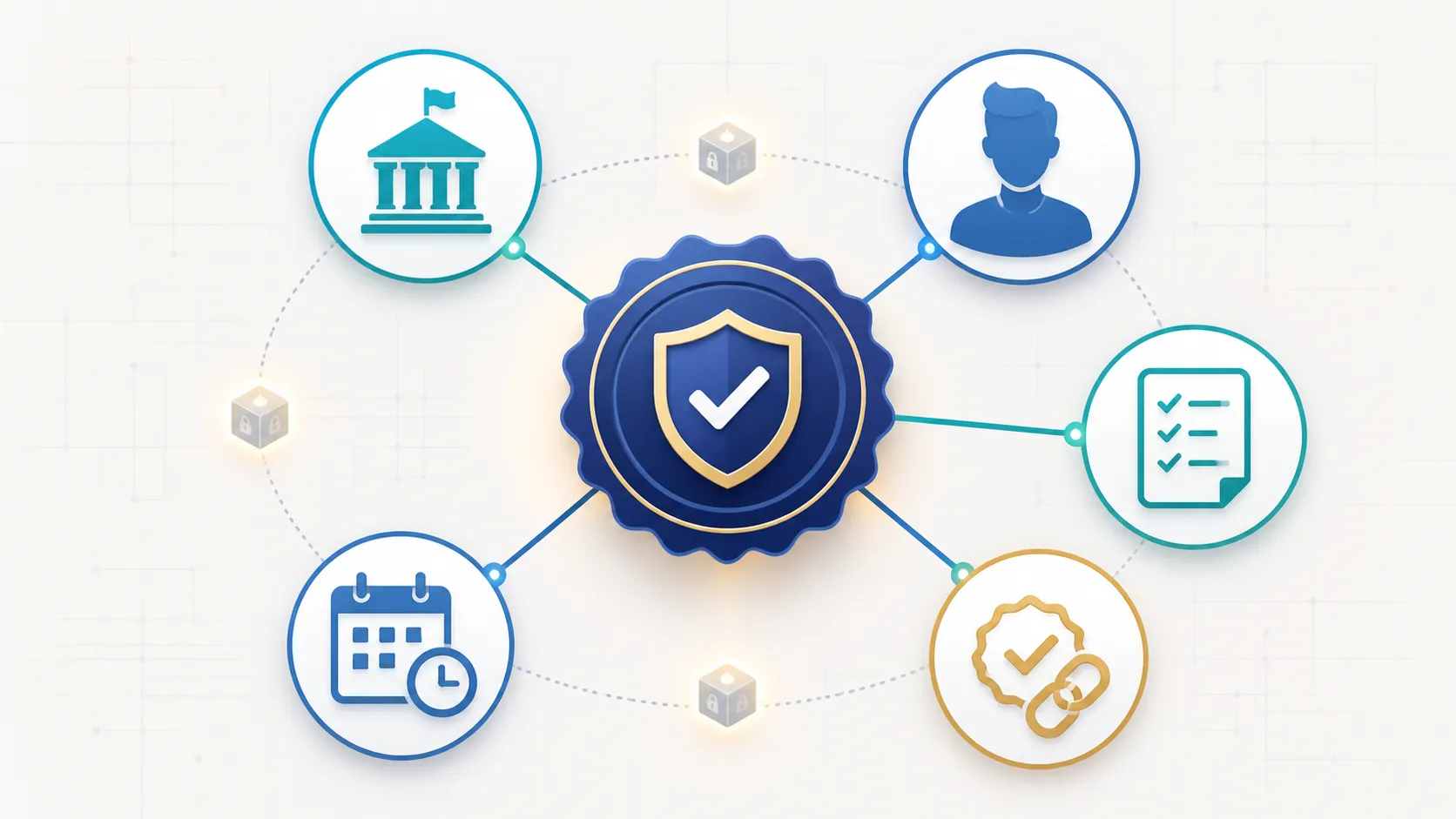
The information inside a single badge is structured like this.
- Issuer - which school, which education office, which partner institution issued it.
- Recipient student - who it was issued to. The identifier can be carried as a hash.
- Earning criteria - what must be done and how to receive it. The badge’s distinguishing power is decided here.
- Issue date and validity period - when the achievement happened. Because the year remains, comparison across time becomes possible.
- Verification information - the route by which anyone confirms authenticity. It is checked instantly on the issuer’s server.
If achievement-based assessment judges whether something was completed, a badge layers on top of it what was accomplished and against which criteria. The two records are not substitutes for each other; they sit at different levels. The school record remains the official record managed by the school, and the badge becomes evidence the student carries and presents when needed.
Design in the same direction is not unique to Korea. The European Union’s European Digital Credentials for Learning issues degree certificates, completion certificates, and micro-credentials as digital credentials carrying an electronic signature, and lets viewers confirm issuer authenticity and whether the credential has been tampered with. When the grammar of the standard is the same, it reads across borders. If the differences between standards are of interest, the structure is set out in Open Badges 3.0 compared with W3C Verifiable Credentials.
Where are high schools and education offices applying this first?
Adoption in Korea started in universities and is now moving down to education offices and high schools. As of end-July 2024, 192 Korean universities had adopted Open Badges, with 20,000 users and roughly 100,000 badges issued over three years (Korea University Times, 2024). By October 2025 the figures were 2 million cumulative issuances, 1,000 participating institutions, 238 adopting universities, and 5,653 badge types (Electronic Times, 2025 - external aggregate figures, not Kolleges figures). The issuance breakdown was 52% education, 34% public sector and associations, and 14% enterprise.
The application points in K-12 are already clear.
- High schools - Changnyeong Supertech High School was reported as the first high school to certify job-related learning history with Open Badges (Korea University Times, 2023).
- Seoul Metropolitan Office of Education - runs a reading badge policy certifying reading activities and growth with digital badges, and applies badges to AI and digital competency training as well (Electronic Times, 2025 and 2026).
- Gyeongbuk Office of Education - applies badges to regionally specialised curricula (Electronic Times, 2025).
- Incheon Metropolitan Office of Education - has begun managing the training teachers have completed, and their competencies, as international-standard digital certificates. It is an attempt to shift records centred on training hours toward competency (Electronic Times, 2026).
There is a reason education office cases emerged first in teacher training and reading activities rather than with students. These areas are not directly tied to university admissions, so the institutional burden is smaller, and they suit an attempt to convert records that only held training hours into competency units. Expansion to students is being discussed as the next stage.
“If the past five years were the time for settling international-standard digital badges into universities and education settings, the next five years should be the time when the competency data inside badges connects to admissions, employment, and job placement.” - Noh Won-seok, CEO of Rekos (Electronic Times, July 2026)
The fact that universities adopted badges first carries real meaning for high schools. Records cross the school fence only when they are issued in a form the receiving side knows how to read. The way universities organised extracurricular outcomes into badges is set out step by step in how to record extracurricular outcomes as verifiable evidence, and it transfers directly to the design of creative experiential activities in high schools.
What does a school decide first when designing badges?
Before choosing an issuing tool, decide what to record as a badge. Badge design proceeds in four steps: choose the activities where demand for evidence is high, write the earning criteria as measurable conditions, issue on an international standard, and set out the routes for use after issuance. Skip this order and start from issuance, and the more badges accumulate, the more their distinguishing power falls.
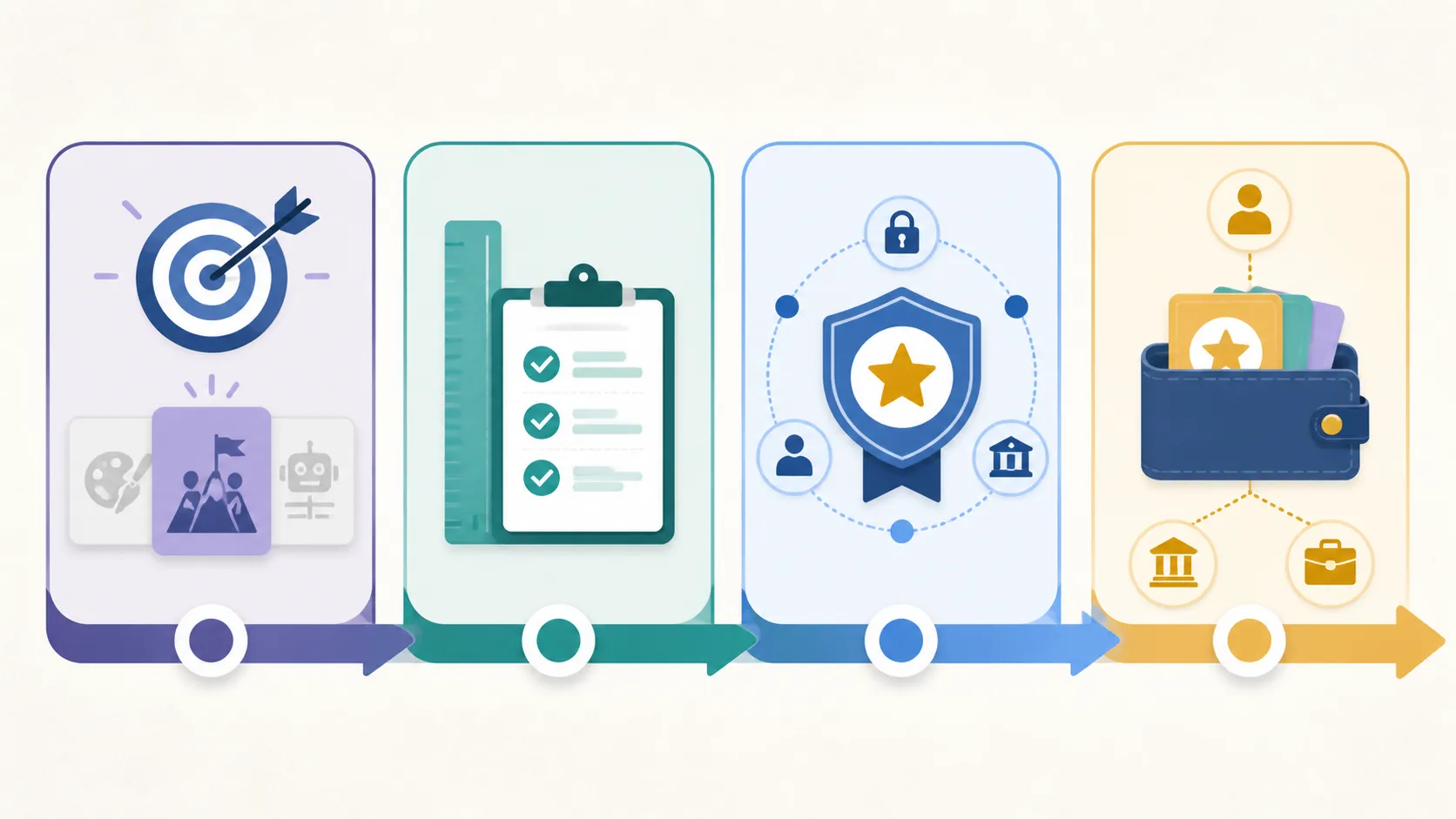
- Choose the activities where demand for evidence is high - do not attach a badge to every activity. First priority goes to activities that are hard to confirm from the school record’s narrative alone and where demand for verification actually arises from outside. Project subjects in the joint curriculum, career activity programmes that leave a deliverable, and job experience linked with local universities and companies fall into this group.
- Write the earning criteria as measurable conditions - not “participated diligently” but “attended at least 6 of 8 sessions and submitted a team deliverable.” That sentence goes into the badge metadata as written and becomes the criterion whoever reads it later sees. If the criteria are vague, the badge ends up in the same position as a narrative record.
- Issue on an international standard - for a badge to circulate outside the school, it has to be issued on an interoperable standard such as 1EdTech Open Badges 3.0. A self-made certification image outside the standard supports neither verification nor movement into another wallet.
- Set out use after issuance as well - decide before issuing where the student collects badges and what they use them for. A badge does its job when the badges gathered in a wallet carry through to an admissions portfolio and later career records.
As more activities are issued, badge numbers rise quickly. At that point a three-tier structure is useful for keeping order: individual activities as unit badges, sets of unit badges as pathways, and semester- or year-level outcomes as comprehensive certifications. From the student’s side, scattered badges appear as a single growth path; from the school’s side, the data reveals which domains activities cluster in and where the gaps are. The practical method for connecting indicators to badges can be seen in a university case in four steps for mapping performance indicators to badges.
Operational workload is looked at during the design stage too. Using roster-based bulk issuance and automatic issuance means the teacher in charge never has to create badges one at a time, and participation data accumulates at the moment of issuance. In the first year it is safer to run one cycle with two or three programmes, confirm that receipt, verification, and aggregation work as intended, and then widen the scope.
References
- Relaxation of High School Credit System completion criteria - MoneyToday (January 2026)
- General guidance on joint curriculum operation - High School Credit System Support Center
- Open Badges standard - 1EdTech
- Three years into Open Badges adoption, in use at 192 Korean universities - Korea University Times (2024)
- Rekos passes 2 million digital badge issuances - Electronic Times (2025)
- Rekos: “Digital badges have become education infrastructure five years after adoption” - Electronic Times (2026)
- European Digital Credentials for Learning - Europass
The High School Credit System is built so that each student learns along a different path, yet the results of that path still scatter into a few lines of text. Kolleges supports designing activities in a three-tier structure of unit badges, pathways, and comprehensive certifications, and running roster-based automatic issuance and issuance data aggregation on one infrastructure. If you are considering application at the school or education office level, you can receive a design proposal based on a single programme through a Kolleges consultation.
Frequently asked questions
Want to turn learning outcomes into verifiable assets?
From issuing to verifying and amplifying, see it for yourself with Kolleges.
Request a Kolleges demoRelated posts
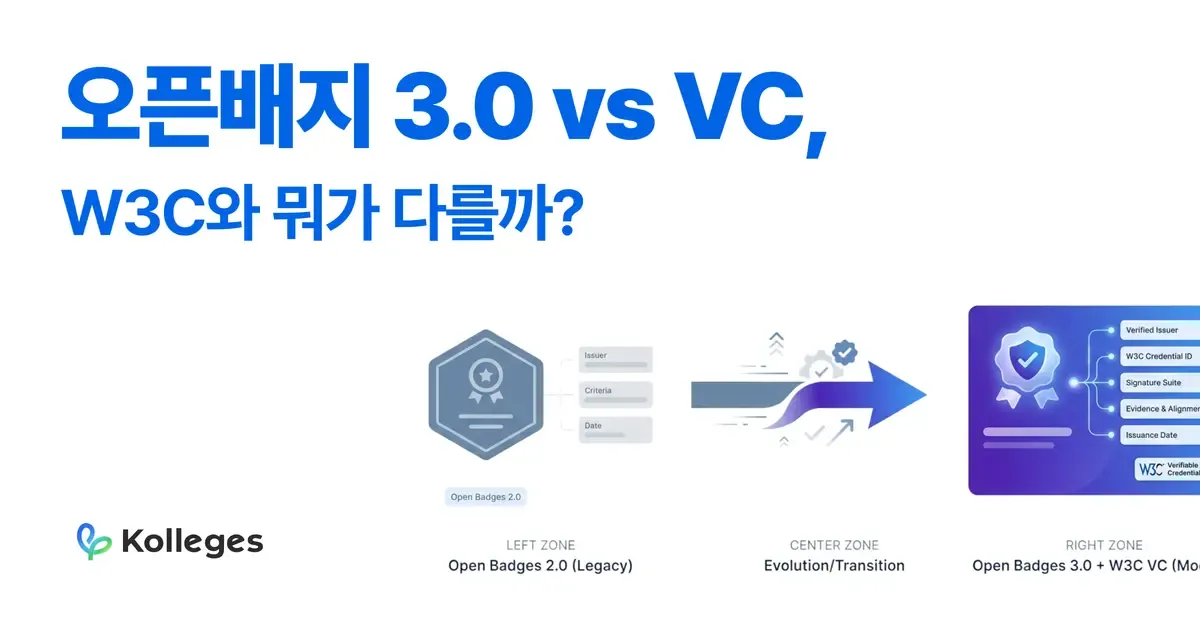
The complete Open Badges 3.0 guide: how it differs from W3C Verifiable Credentials
Open Badges 3.0 wraps W3C Verifiable Credentials with an education-specific metadata layer, replacing platform-dependent verification with cryptographic signatures that let learners own and selectively disclose their credentials.

RISE Performance Metrics: 4 Steps to Prove Them with Metric-by-Metric Badge Mapping
The 4-step practice of mapping the 6 core RISE performance metrics to metric-specific badges, organized in comparison with qualitative reports.

2026 RISE·Anchor Performance Evaluation: 3 Steps to Prove University Outcomes with Data
As RISE becomes Anchor, budgets are divided by performance evaluation. Here is how to prove scattered university outcomes with the 3-tier digital badge structure and co-issuance, with cases.