
2026 RISE·Anchor Performance Evaluation: 3 Steps to Prove University Outcomes with Data

As RISE becomes Anchor, budgets are divided by performance evaluation. Here is how to prove scattered university outcomes with the 3-tier digital badge structure and co-issuance, with cases.
From RISE to Anchor: What Changes in University Performance Management in 2026?
RISE (Regional Innovation System & Education) was fully implemented nationwide in 2025 and is being reorganized into “Anchor” (regional-growth talent development system) in 2026. Under a structure that evaluates 2025 program outcomes to allocate 2026 budgets differentially, about KRW 400 billion has been assigned as a performance-evaluation incentive. Universities that leave their outcomes as verifiable data get ahead on budget.
RISE was organized at a scale of about KRW 2 trillion alongside its 2025 nationwide implementation, becoming a pillar of higher-education financial support (Ministry of Education, 2025). The key change as it becomes “Anchor” in 2026 is the way budgets are divided. It has been restructured to evaluate the previous year’s outcomes and differentially allocate the following year’s budget, and what changes and how is divided along the axes below.
| Category | RISE (2025) | Anchor (2026) |
|---|---|---|
| Name | Regional Innovation System & Education | Regional-growth talent development system |
| Budget allocation | Organized based on regional master plan | Differential support based on previous-year performance evaluation |
| Performance evaluation | Nationwide implementation; system settling in | 40% quantitative + 60% qualitative, 4-grade differentiation |
| Performance incentive | Not applied | About KRW 400 billion (differentiated across 17 cities/provinces) |
| Program focus | Region-led university financial support | Regional settlement; student-perceptible tasks |
| University's immediate task | Program design and execution | Verifiable quantitative performance proof |
These evaluation criteria were confirmed in the first evaluation the Ministry of Education launched in May 2026 targeting 17 cities and provinces. The criteria include whether budgets were executed with a performance focus and the degree of student perception (Electronic Times; Korea University News, 2026).
The core of the changed rule is one thing. How well you “prove” your outcomes becomes your budget.
Why Have Universities Suddenly Become Pressed for “Proof of Outcomes”?
Because under the 2026 Anchor system, university budgets are divided by performance evaluation. Anchor demands the outcomes of contract departments, long-term field placements, and startup programs not as qualitative reports but as student-level quantitative data. No matter how many activities there are, it is hard to prove outcomes with scattered records. Gathering everything from participation through completion to employment linkage in a verifiable form has become the university’s immediate task.
The problem is that the data is scattered across departments. The industry-academic cooperation foundation manages industry-academic results, the lifelong education center manages adult-learner completion records, and the education innovation center manages extracurricular activity records separately. The transcript holds only regular coursework and does not prove the competencies students have actually built. What universities face in front of the performance evaluation is a situation of “the activities happened, but there’s no data.”

How Do You Record RISE Performance Metrics with Digital Badges?
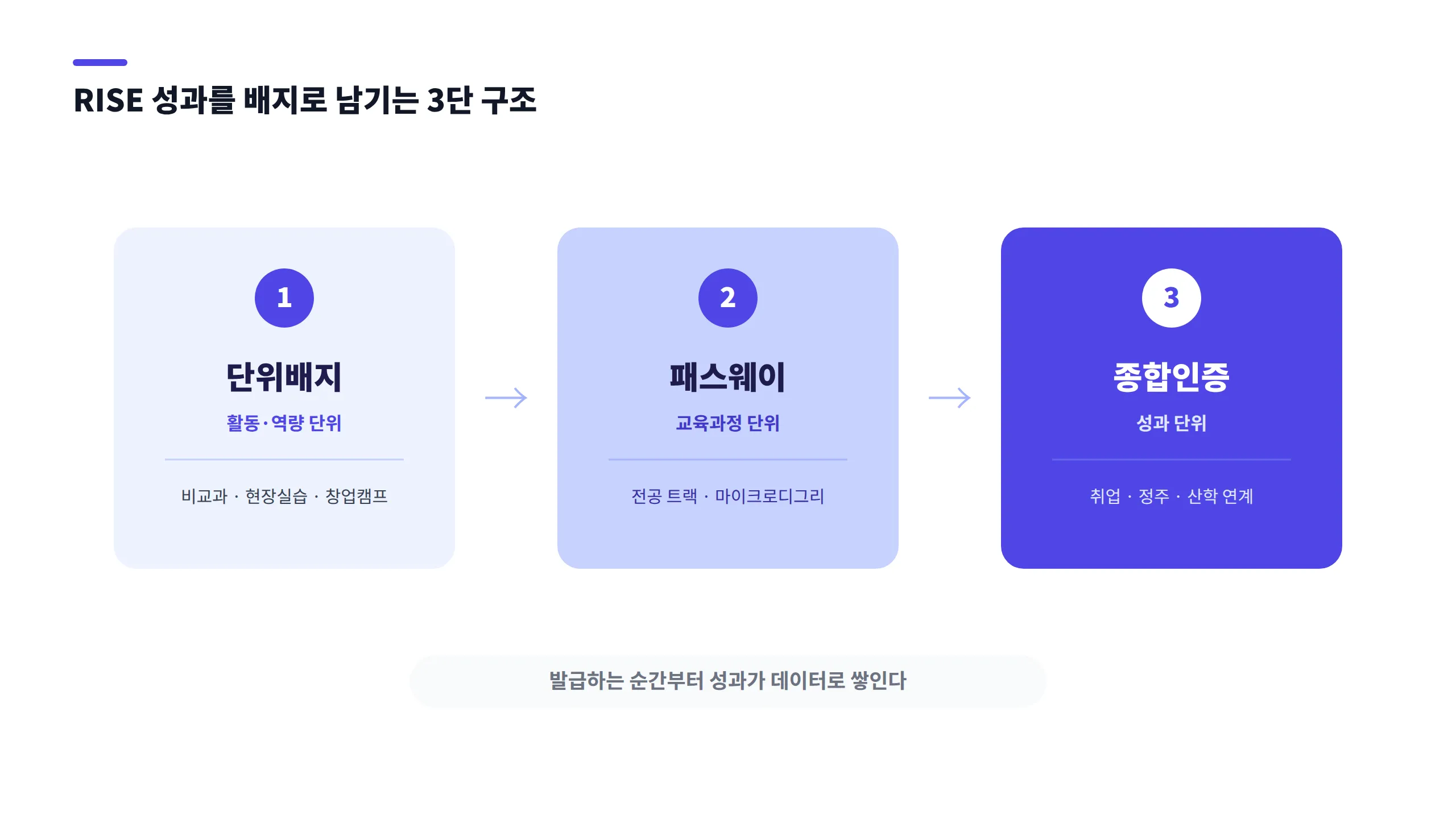
A digital badge is a verifiable credential that records activities, competencies, and outcomes together with the issuing body, criteria, and verification information. If you map RISE performance metrics to a 3-tier structure of unit badges (activities), pathways (courses), and comprehensive certification (outcomes), you can connect a single student’s journey from participation to employment and settlement as one dataset. From the moment of issuance, outcomes accumulate as data.
The advantage of this structure is that you don’t have to create new metrics.
How Do You Integrate Outcomes Scattered Across Departments Through Co-Issuance?
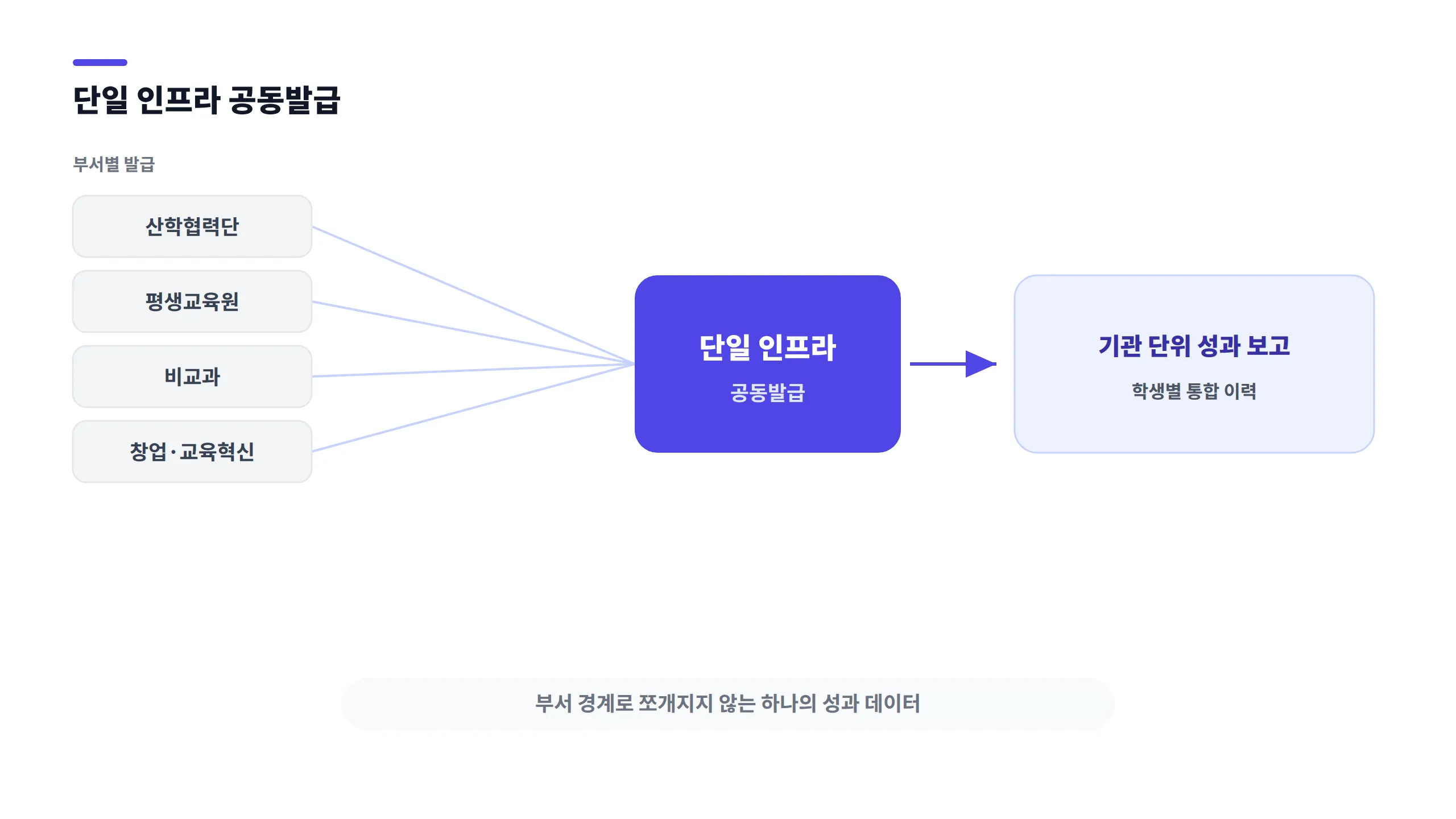
A university’s outcomes are scattered across the industry-academic cooperation foundation, the lifelong education center, and extracurricular departments. If departments co-issue on a single infrastructure, you can gather outcomes in one place without duplicate operations. Co-issuance, where multiple parties jointly issue a single credential, keeps one student’s record from being split along department boundaries and lets you pull institution-level performance reports at once.
Daegu Haany University unified credentials from multiple parties through portal-based co-issuance, and Korea Polytechnic University Daejeon Campus connected technology and care competencies into a single co-issued certificate. If each department keeps a separate system, outcomes are scattered separately too. Bringing the infrastructure together is the starting point for integrating outcomes.
How Did Actual Universities Manage RISE Outcomes?
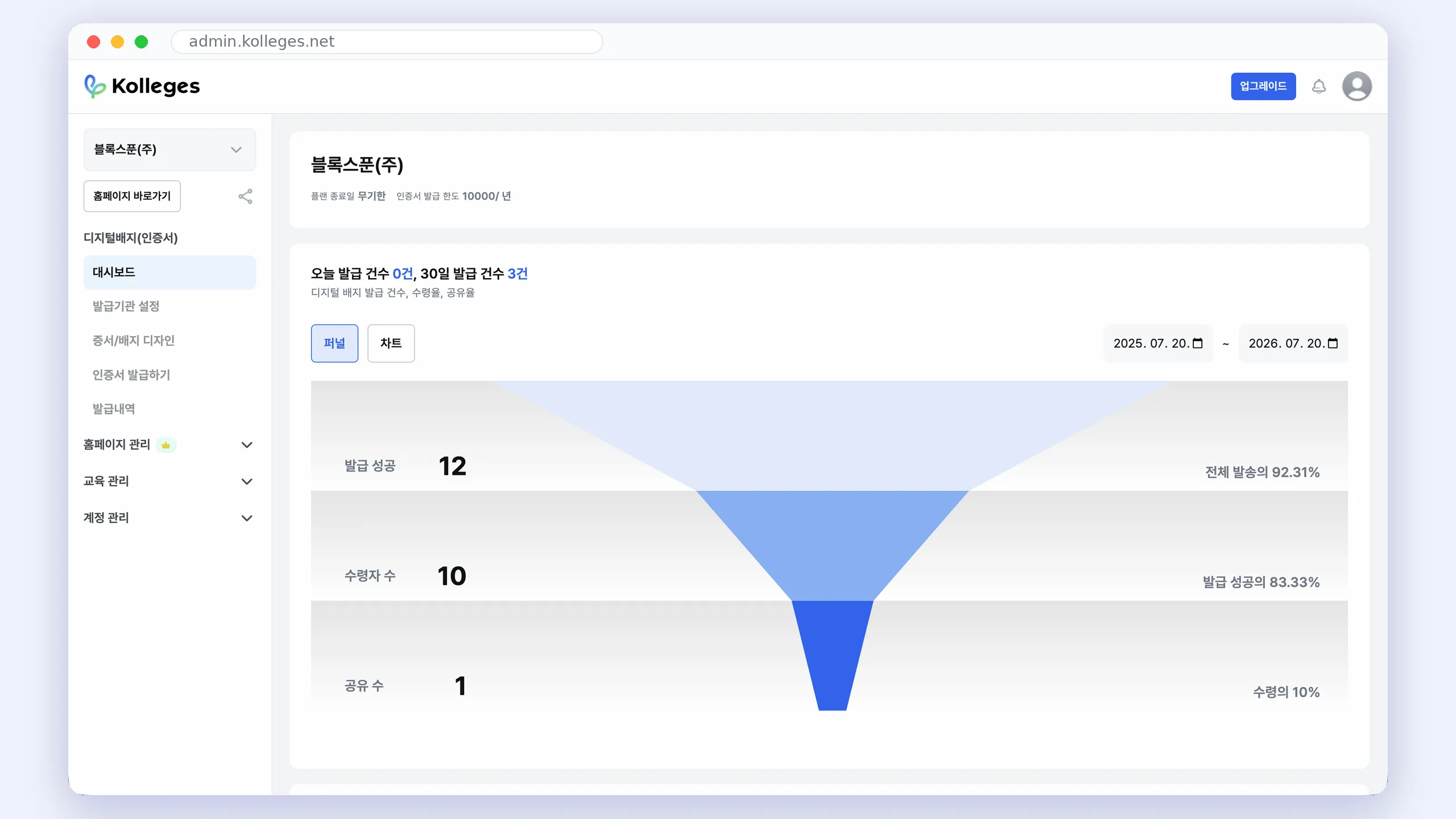
The University of Seoul industry-academic cooperation foundation connected RISE outcomes with a 3-tier structure from unit badges to comprehensive certification, and the Hongik University Sejong lifelong education center left adult learners’ records as badges, creating a virtuous cycle leading to re-enrollment. Both cases share the fact that they gathered scattered activities into verifiable data and used it as the basis for performance reporting.
The University of Seoul case designed the foundation’s activities into a 3-tier structure, showing the skeleton of RISE performance management. The Hongik University lifelong education center case captured the flow where badges received by adult learners lead to sharing and re-enrollment. Both are universities that adopted Kolleges.
Before Adopting RISE Performance Management Badges, What Should You Check?
Adoption starts with defining performance metrics. Deciding first which activities to turn into badges by which criteria is the most important step. Only when these criteria are clear do the subsequent data linkage, co-issuance, and verification/security checks stay steady. The remaining items can be decided in order on top of this definition.
The performance evaluation comes around every year. If you build a system where data accumulates from the moment of issuance, you can escape the burden of creating evidence anew each reporting season.
Frequently asked questions
Want to turn learning outcomes into verifiable assets?
From issuing to verifying and amplifying, see it for yourself with Kolleges.
Request a Kolleges demoRelated posts

What Is the RISE Project? Seoul's Selected Universities and Key Strategic Directions
Seoul selected 35 universities under RISE to align higher education with regional industry needs, investing 76.5 billion KRW across five strategic priorities including AI talent development.

How to Connect RISE Performance with a Three-Tier Digital Badge Structure: A University of Seoul Case
The University of Seoul's RISE project team bundled the outcomes of 7 programs across 3 areas (industry-academia cooperation, AI, and convergence regional innovation) into 15 digital badges. This is the design behind a three-tier structure connecting unit badges through pathways to a comprehensive certification, turning scattered university achievements into verifiable one-line credentials.

How to Evidence High School Credit System Competencies Beyond the School Record, with Digital Badges
In 2026, with credit completion criteria relaxed, this article sets out how to record the learning experiences the school record cannot hold as verifiable data, using practical criteria for schools and education offices.