
Is the Degree Era Over? What 11 Million Job Postings Reveal About Skills-Based Hiring
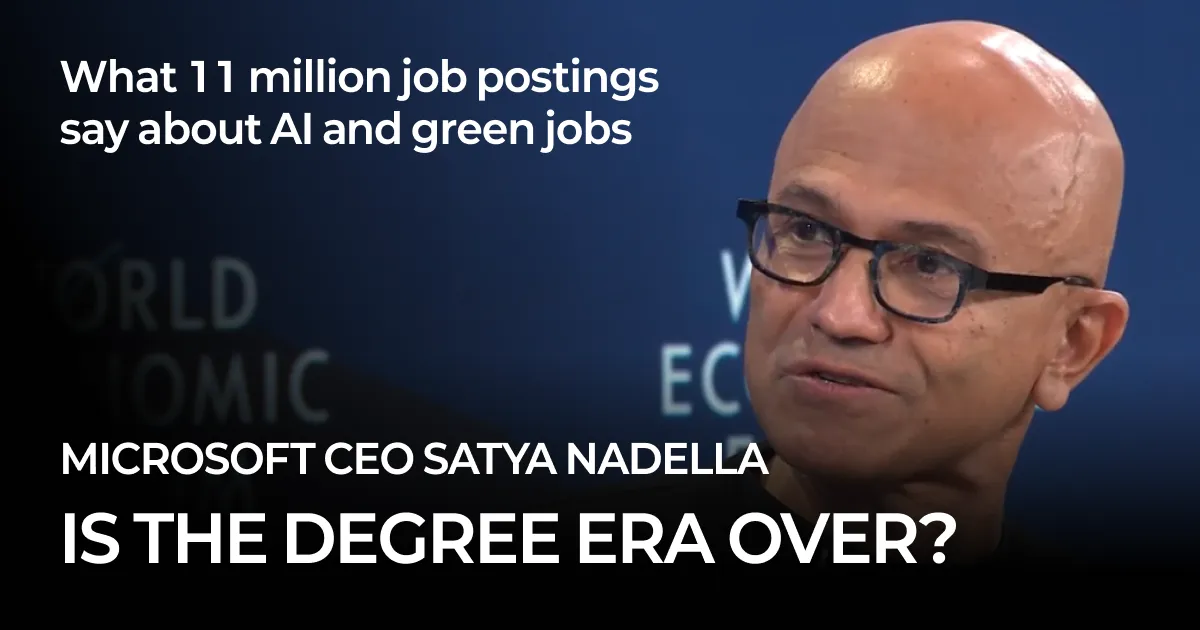
The data confirms that hiring is looking at skills over degrees. We break down the shift to skills-based hiring through the numbers from Oxford's research, remarks at Davos 2026, and signals from Korea.
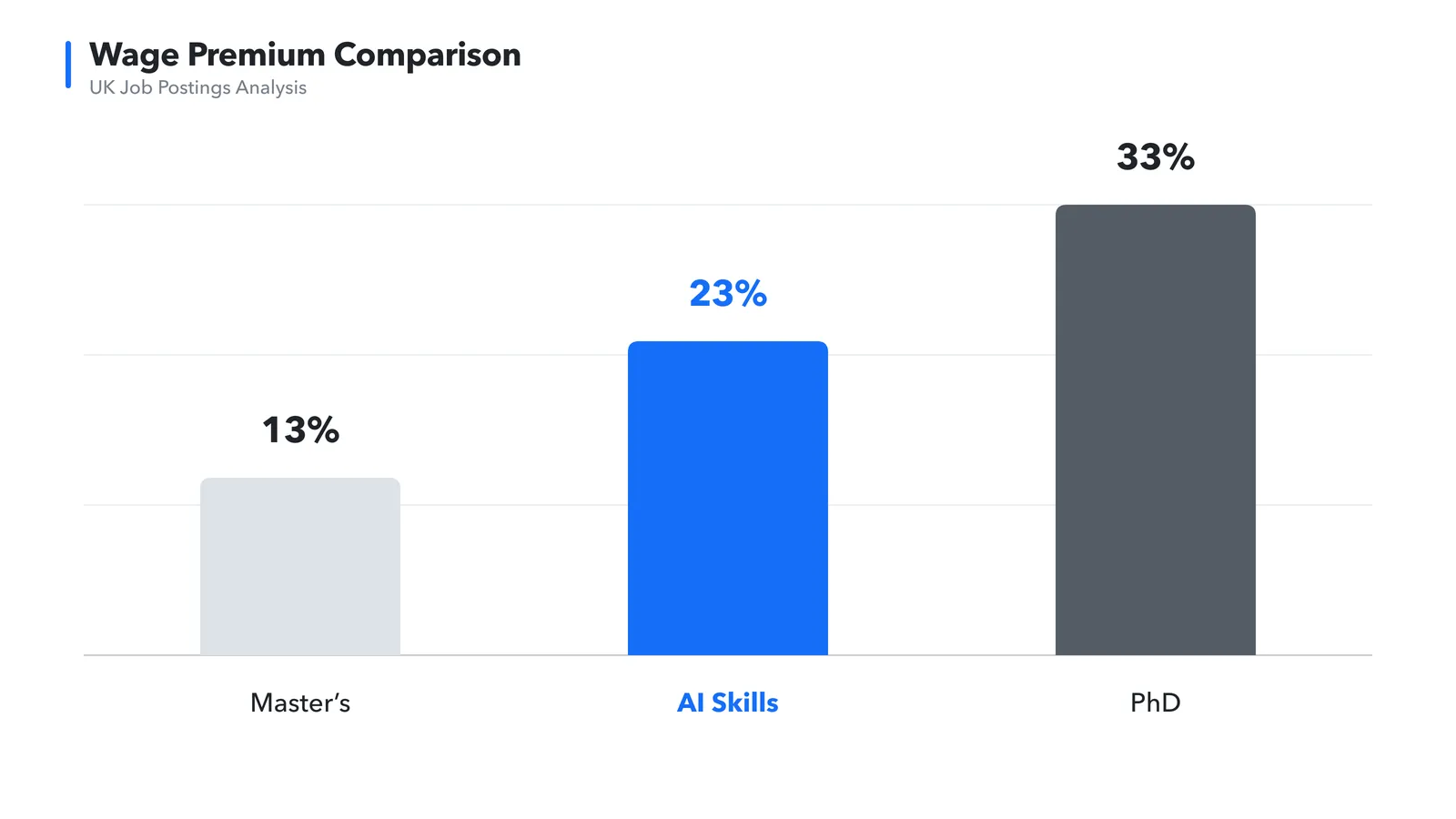
The criteria for hiring are moving from degrees to skills. In an Oxford Internet Institute study analyzing 11 million UK job postings, the wage premium for AI skills was 23%, ahead of a master’s degree (13%), and AI postings requiring a degree fell from 36% in 2018 to 31% in 2023 (Technological Forecasting and Social Change, 2025). The researchers call this trend “skill-based hiring.” When Microsoft CEO Satya Nadella pointed to AI skills at Davos 2026 as a new pathway to jobs and mobility, he was describing the same thing. This article lays out what the hiring data on the move from degrees to skills actually shows, and the credentialing systems educational institutions should prepare.
Are hiring criteria really moving from degrees to skills?
In the UK, skills-based hiring has entered a diffusion phase, centered on AI roles. Oxford Internet Institute researchers analyzed roughly 11 million UK online job postings from 2018 through mid-2024 and found that AI postings specified skills three times as often as general postings, and that AI roles as a share of all postings rose 21% between 2018 and 2023. Degree requirements, by contrast, fell markedly over the same period (Bone, González Ehlinger, and Stephany, Technological Forecasting and Social Change, 2025).
The study’s key figures are organized in the table below.
| Item | Figure | Notes |
|---|---|---|
| Wage premium for AI skills | 23% | Master's 13%, PhD 33% |
| Share of AI postings requiring a degree | 36% → 31% (a 15% decline) | 2018 → 2023 |
| How often AI postings specify skills | 3× general postings | - |
| AI skills premium in science, engineering, and technology roles | 36% | Per the Oxford Internet Institute announcement |
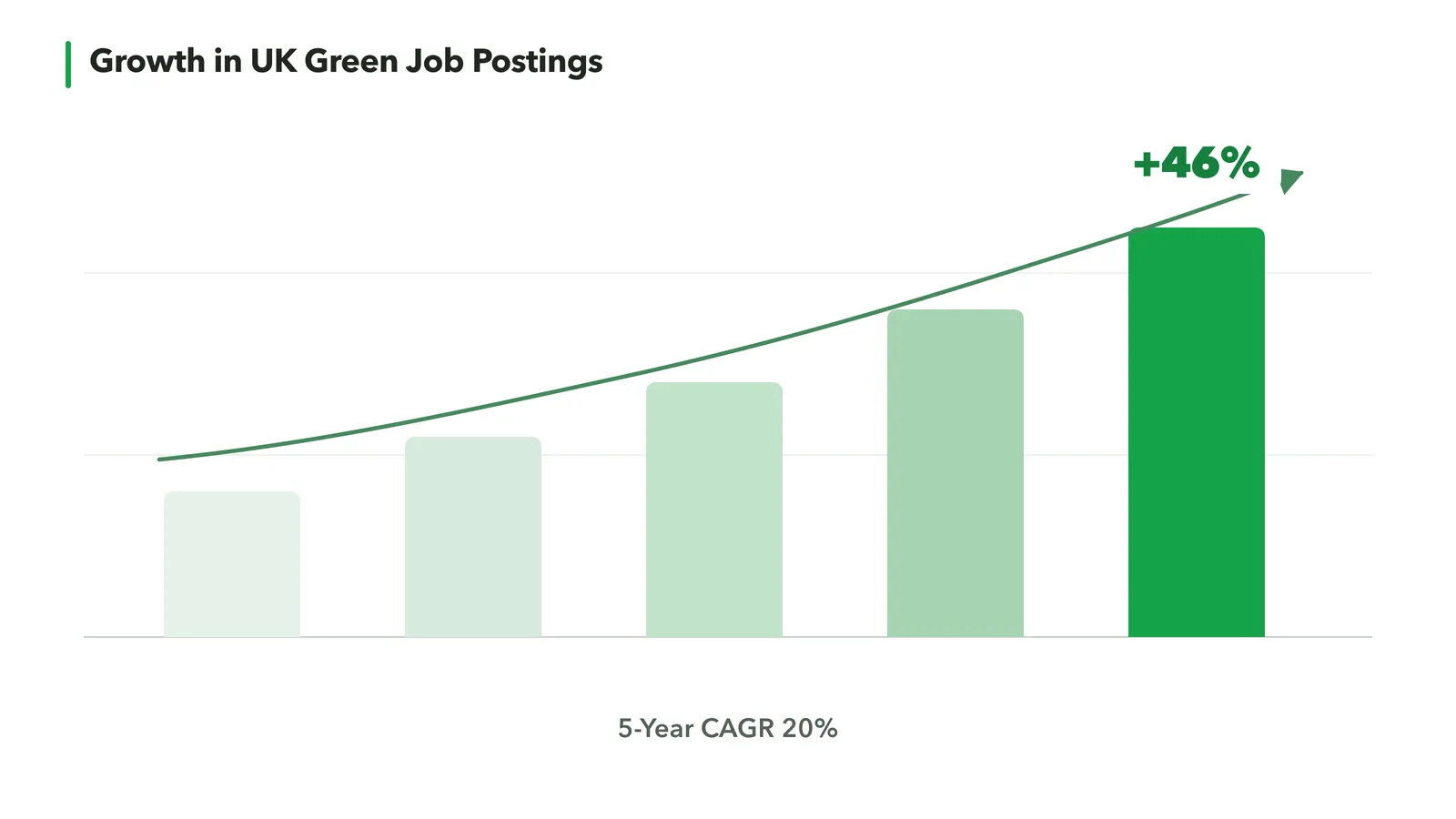
| Growth in green job postings | 46% | Between 2024 and 2025; 20% average annual growth over five years |
| How often green job postings mention skills | 2× the labor market average | - |
The sources are the University of Oxford announcement (2025) and the researchers’ LSE Business Review post (2025), and the original is the paper published in Technological Forecasting and Social Change.
Dr. Fabian Stephany of the Oxford Internet Institute, who led the study, summarized the findings this way: “The traditional path in which a university education leads to higher pay is no longer the default for AI professionals. They are being rewarded for practical skills and industry-specific know-how.”
That said, the figures are best read exactly as they are. In the same study, the premium for a PhD was 33%, higher than that for AI skills (23%). In their LSE post, the researchers described the 23% figure as “comparable to the pay increase that has historically accompanied a doctorate.” It is less that the value of a degree has disappeared than that a new path has opened to reach similar rewards without one.
Is skills-first hiring only a story about AI roles?
No. Hiring that puts skills ahead of degrees also shows up in green jobs. UK green job postings grew by an average of 20% a year over the past five years, and surged 46% between 2024 and 2025. Green job postings specified skills twice as often as the labor market average, and in public sector green roles the premium attached to skills was 50% higher than the degree premium (Oxford Internet Institute, 2025). That is evidence the shift to skills is a structural change in the labor market rather than a fashion within one job family.
What stands out is the type of qualification requested. Green role postings feature practical qualifications such as HNC and HND (UK vocational education qualifications) more often than academic degrees like a master’s or PhD. In other words, the faster on-the-ground technology changes in a field, the more the hiring side looks for signals that confirm “what can you do now” rather than “what did you major in.”
What AI and green have in common is speed. Where technology and regulation move faster than the cycle for revising degree programs, skill signals are replacing degree signals first.
How much will the hiring market change by 2030?
In the Future of Jobs Report 2025, the World Economic Forum (WEF) projected that 39% of workers’ core skills will change by 2030. The same report forecast that 170 million jobs will be created and 92 million will disappear by 2030. Since the newly created jobs are concentrated in AI, data, and green fields, hiring that looks for people by skill unit is likely to broaden as 2030 approaches. It also means a career model that runs for decades on a single degree becomes hard to sustain.
Executives see it the same way. Microsoft CEO Satya Nadella, in a Davos 2026 conversation, presented AI skills as a new pathway to jobs and social mobility: “People have to be able to say, ‘I’ve learned this AI skill, and now I’m someone who supplies goods or services better in the real economy.’” In an ETS survey in the United States, 90% of CHROs (chief human resources officers) said the need to look for talent outside the four-year degree had grown (Fortune, 2025). Detailed projections are available in the WEF Future of Jobs Report 2025.
Signals have already appeared in Korea. SK hynix removed the educational requirement from its eligibility criteria starting with its new-graduate hiring in June 2026. It deleted the “bachelor’s degree or above” requirement and said it would evaluate candidates on experience, job competency, and culture fit (Herald Business, 2026). Companies are also reaching again for the lattice career model, which includes lateral moves and role changes instead of a promotion ladder, because they have begun to read a career as an accumulation of skills rather than a sequence of titles.
So does a university degree lose its meaning?
No. The degree is not disappearing; its role is moving. Even in the UK analysis above, the PhD premium was the highest of all at 33%. What changes is the middle layer of education. Repeatable functions such as transmitting knowledge and handling administration are being taken over quickly by AI, while education that requires people sitting across from one another - critical thinking, ethical judgment, discussion, mentoring - remains an asset the university continues to hold. The value of the degree is maintained while skill-level credentials are layered on top of it.
Higher education researcher Professor Hung-Yi Chen put the university’s reason for being in the AI era this way: “The value of the university classroom has to move toward experiences AI cannot provide. Socratic questioning and debate, simulations of real cases, the collision and reconciliation of differing perspectives, and intellectual mentorship between professor and student.” (Chen, 2025) That is why universities remain even after Google, Apple, and IBM stripped degree requirements out of their hiring.
The university’s task is, if anything, concrete: making the learning outcomes a transcript cannot hold into a provable form. Skill-level credentials that can be presented alongside a degree - like competency records beyond grades or certification of extracurricular activity - become the university’s output after the degree.
What should institutions prepare first? Skill wallets and verifiable credentials
A skill wallet is a tool that gathers proof - completed training, qualifications, project experience - as verifiable digital credentials and presents them in hiring and evaluation. JFF (Jobs for the Future), a US workforce development nonprofit, identified such credential wallets in a 2025 report as a foundational tool for a skills-first labor market. The more skills become the language of hiring, the more “who certified that skill, and against what criteria” becomes the core question of trust. And the side that creates the proof to fill that wallet is, in the end, the institution running the education.
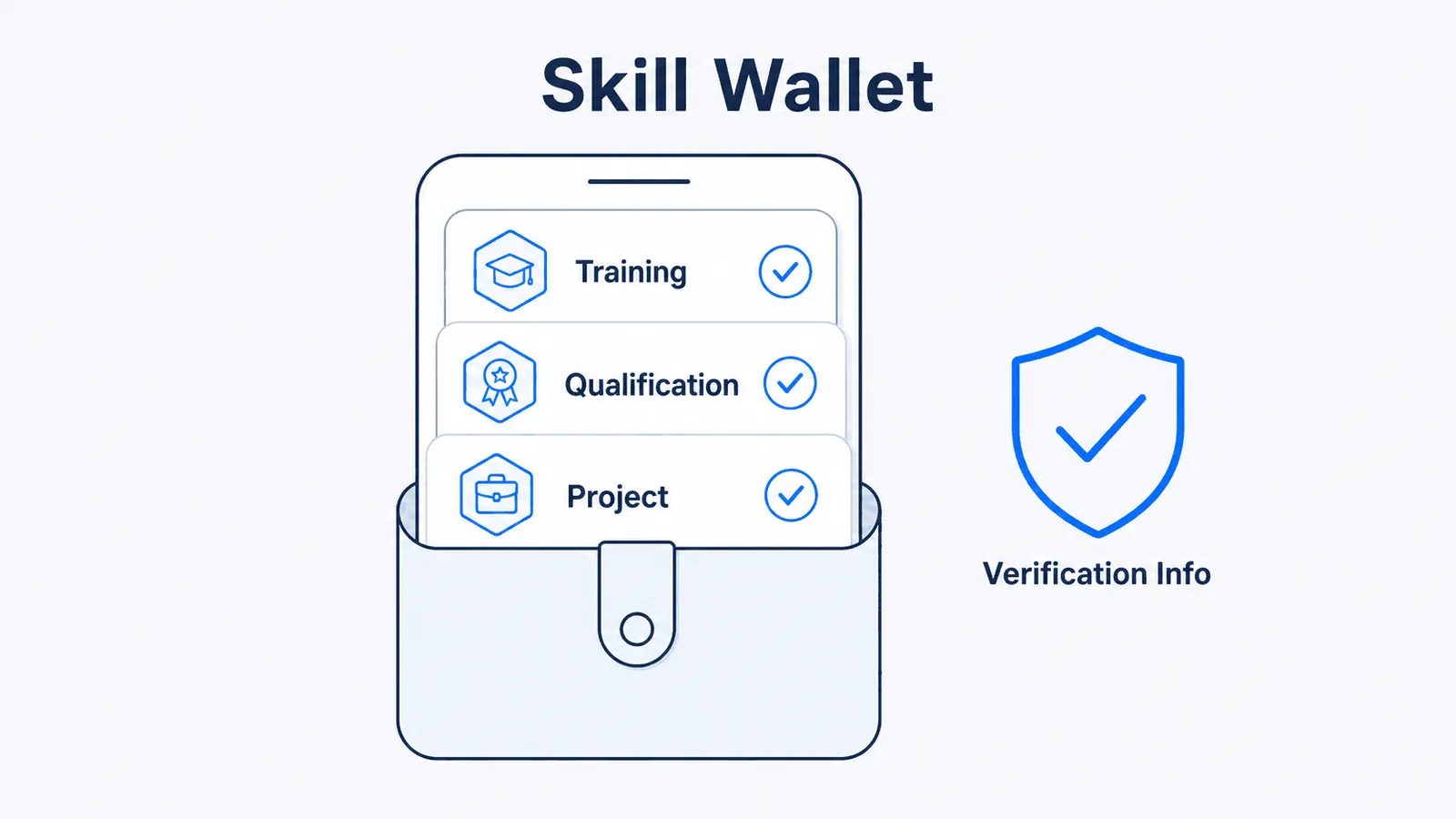
This is where the institution’s role divides. A skill a learner simply writes down as something they “can do” struggles to work as a signal. Only a credential that holds the issuing organization, the criteria for earning it, and verification information as data lets a recruiter confirm authenticity with a single link. Internationally, standards such as W3C Verifiable Credentials and 1EdTech Open Badges 3.0 underpin this verification system.
What to prepare breaks down by institution type as follows.
- Universities - Issue the outcomes of extracurricular, micro-credential, and industry-academic programs as skill-level credentials, creating proof students can present alongside their degree.
- Corporate HRD - Recording completed internal training as verifiable credentials builds up competency evidence data usable for promotion and placement.
- Education companies - The more a completion credential works as a career signal for the learner, the stronger the reason to choose the course becomes.
Kolleges supports educational institutions and companies in issuing completion, activity, and competency as verifiable digital badges, and in aggregating what happens after issuance - receipt, sharing, and views - as performance data. An actual accumulated skill wallet looks like the screen below. Certificates and employment records issued separately by many organizations gather in one person’s profile, and each credential carries its issuing organization and issue date.
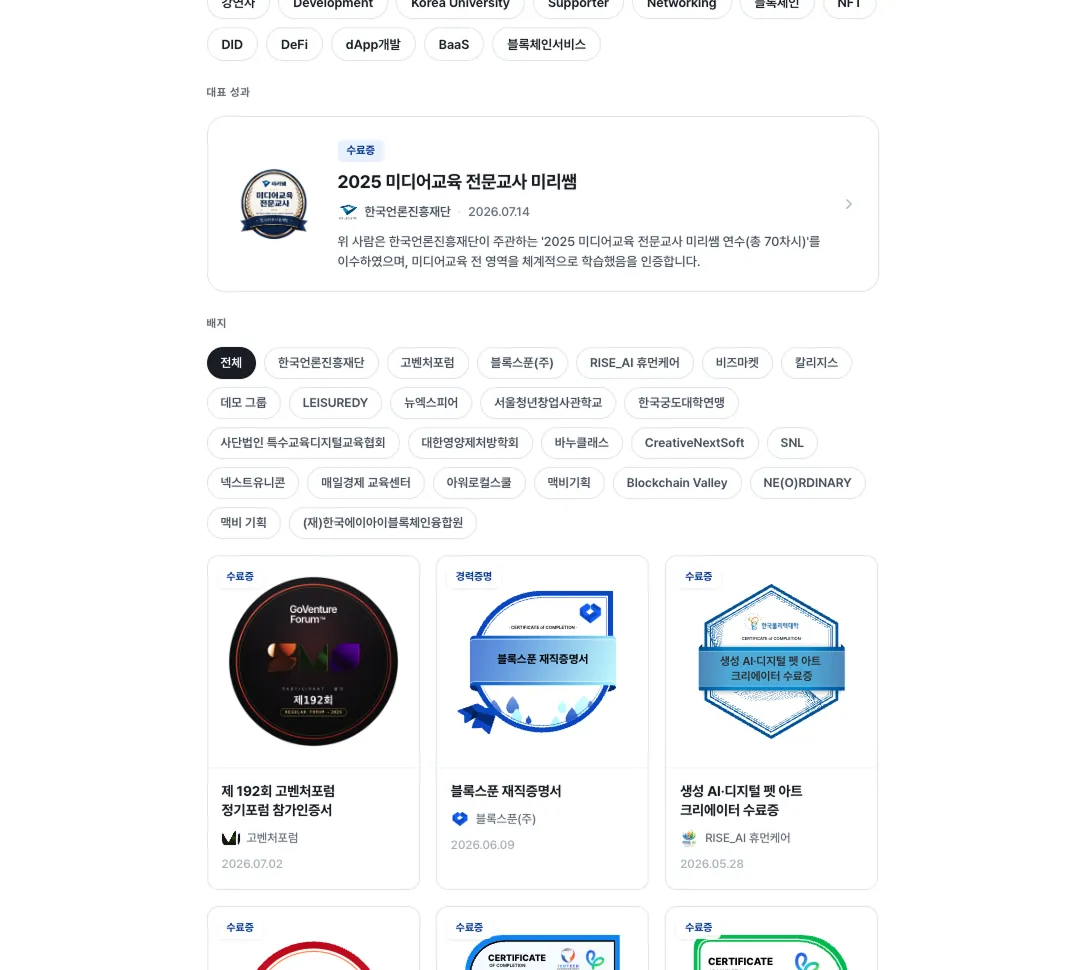
There are already cases like Hongik University Sejong’s Institute of Lifelong Education, where adult learners’ records accumulated as badges and led to re-enrollment.
When the language of hiring changes, so does the method of proof. In the era when a degree was everything, the proof was a single diploma; in the era of skills, you have to be able to show what you learned and accomplished unit by unit. The sooner an institution puts this credentialing system in place, the sooner it becomes that institution’s asset of trust.
If you are curious how a skills-credentialing system actually runs at an institution, you can see the operating structure in the issuance case at the University of Seoul’s Industry-Academic Cooperation Foundation. If you are at the stage of drawing up a design that fits your institution, you can use Kolleges consulting and demo requests.
Frequently asked questions
Want to turn learning outcomes into verifiable assets?
From issuing to verifying and amplifying, see it for yourself with Kolleges.
Request a Kolleges demoRelated posts
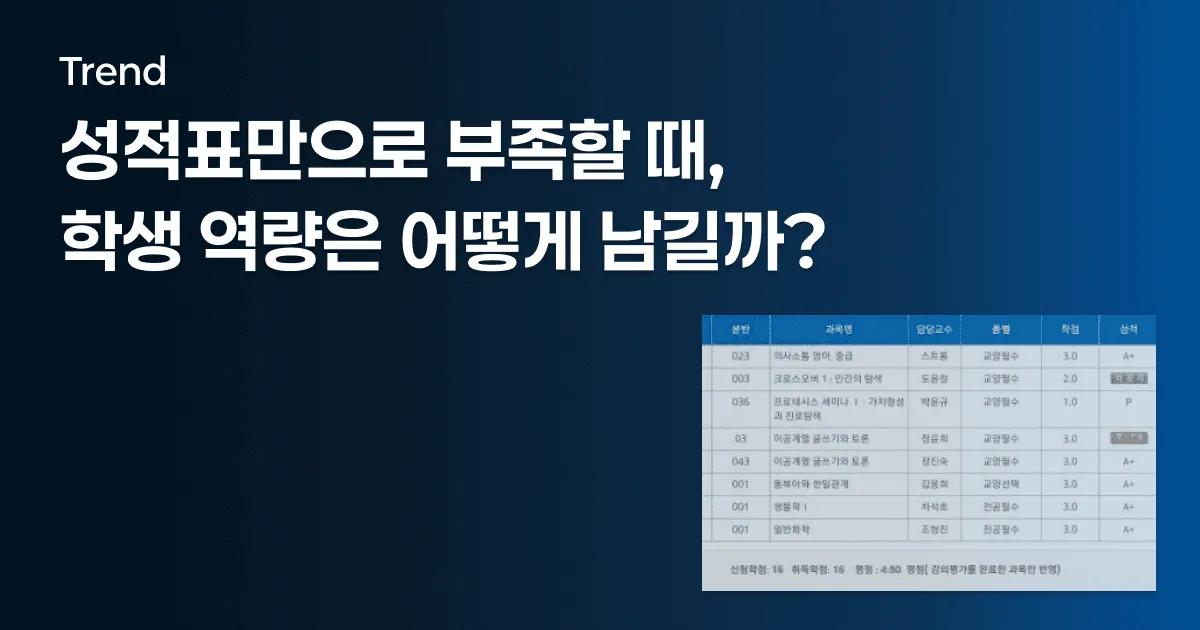
When Grades Aren't Enough: How Do You Capture Student Competencies?
Transcripts capture scores but not skills - digital badges and CLR close that gap by connecting learning objectives through CASE to portable, verifiable competency records.
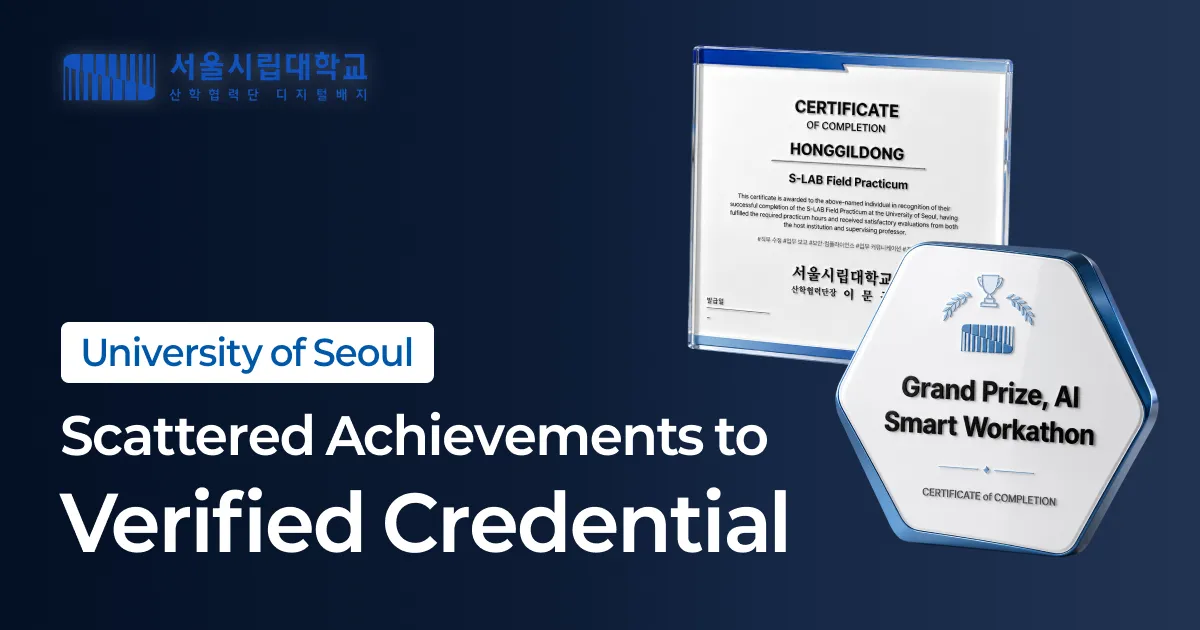
How to Connect RISE Performance with a Three-Tier Digital Badge Structure: A University of Seoul Case
The University of Seoul's RISE project team bundled the outcomes of 7 programs across 3 areas (industry-academia cooperation, AI, and convergence regional innovation) into 15 digital badges. This is the design behind a three-tier structure connecting unit badges through pathways to a comprehensive certification, turning scattered university achievements into verifiable one-line credentials.
Mother-Tongue Education: Why the Policy Exists but Doesn't Work in Classrooms
Mother-tongue education succeeds only when it starts in early grades, spans subjects, and is backed by coordinated teacher training and materials - not just official recognition.