
Uhyeonmoon Gallery | Exhibition Records Once Lost When a Space Closed Now Live On as Digital Badges
Fifty-one young artists selected on a professor's recommendation. The exhibition ends, but the credential remains. An interview with Kim Sun-hak, CEO of Uhyeonmoon Professional Arts Organization.
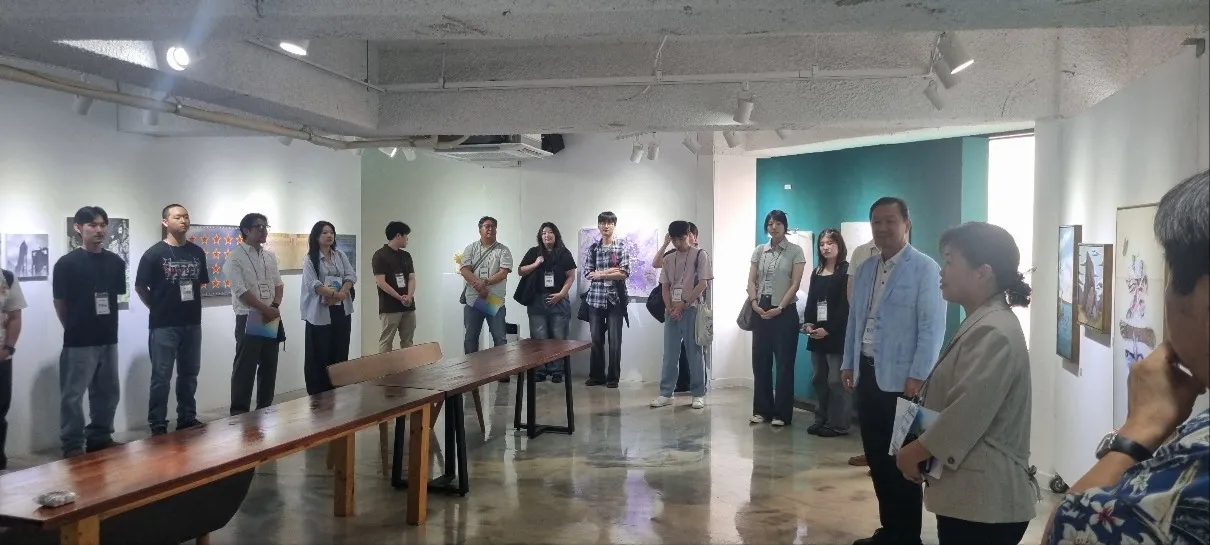
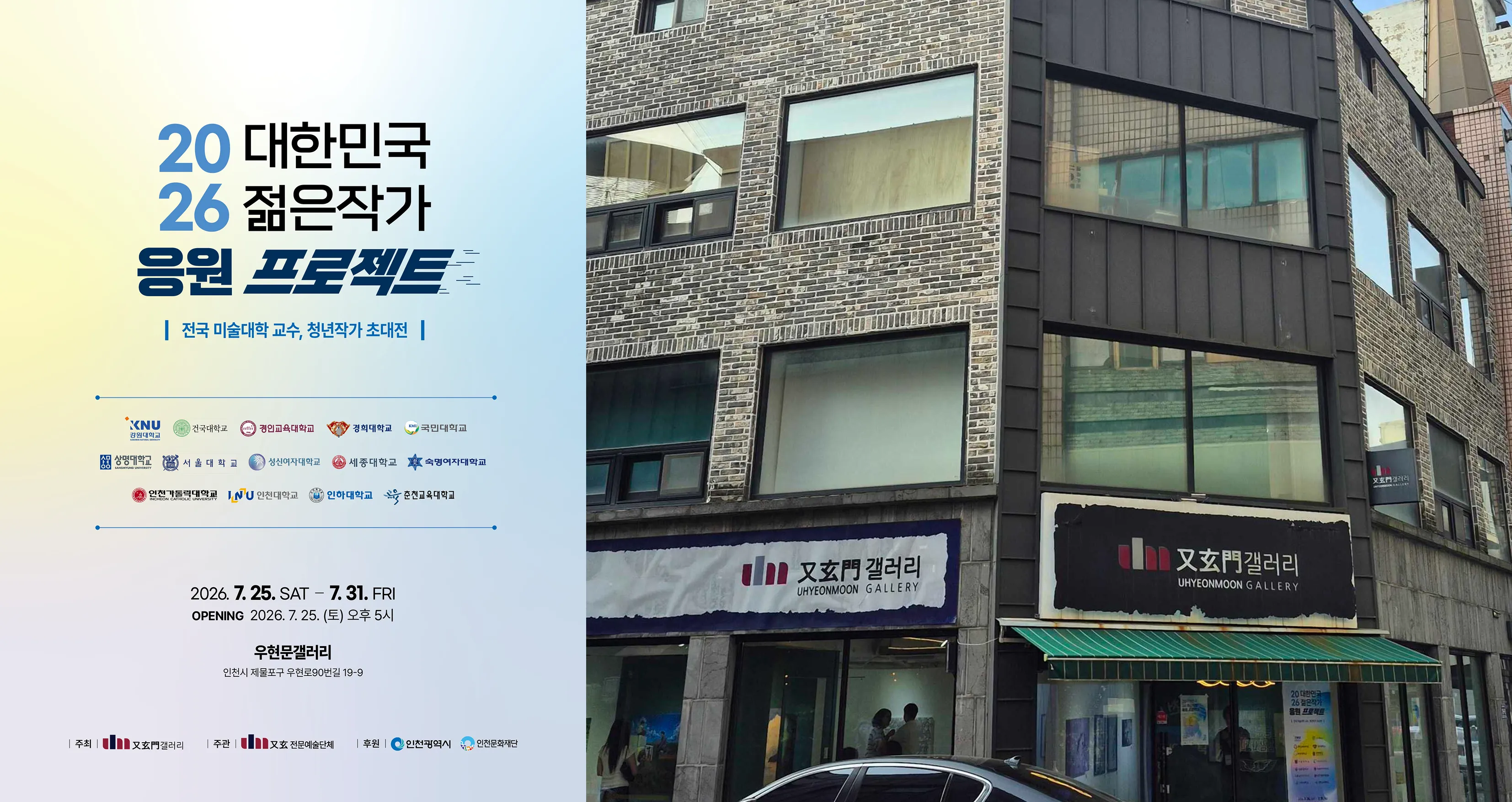
At 5 p.m. on Saturday, July 25, the opening of “Korea Young Artist Support Project 2026 - Now It’s My Turn to Run” was held at Uhyeonmoon Gallery, a multipurpose art space in Dongincheon, Incheon. It was a gathering where professors from 14 art schools nationwide and 51 of their students hung paintings and sculptures side by side (Kihoilbo, 2026). At the exhibition hall that day, we met Kim Sun-hak, CEO of Uhyeonmoon Professional Arts Organization, who has led this project since 2020. This is the story of an exhibition where a professor picks just two students and hangs their work next to their own - and of how, since 2025, the record of that selection and participation has remained as a digital badge.
An exhibition where a professor picks just two students: seven years of record
The Korea Young Artist Support Project is an exhibition supporting emerging artists that Uhyeonmoon Gallery has held every year since 2020. Art school professors from across the country each recommend two students who are about to graduate or graduated within the past year, and the work of mentor and mentee hangs in a single space. The 2026 exhibition, “Now It’s My Turn to Run,” brought together 51 participants from 14 universities, and artists from past editions have gone on to invitational exhibitions and art fairs (Kihoilbo, 2026).
Selection happens through recommendation, not an open call. A single professor picks two students out of many and exhibits alongside them with their own name on the line. Kim Sun-hak sums up the structure in a sentence.
“They chose 2 students out of a great many people. These are proven artists.”
Next to the student’s painting hangs the mentor’s painting. That is why Kim distinguishes this exhibition from a graduation show. “This isn’t the level of a typical graduation exhibition. This is the best collection from before graduation, from the pre-graduation shows. The professor hangs their own painting too, and picks two out of their own students.”
The path the project has walked is shown in the table below.
| Year | Exhibition | Scale and content |
|---|---|---|
| 2020 | Project begins | Uhyeonmoon Gallery launches its exhibition to discover and support young artists (Kihoilbo, 2026) |
| 2022 | Young Artist Support Project 2022 | 50 participants from 13 universities (15 professors, 35 students), around 80 works, sponsored by the City of Incheon and the Incheon Foundation for Arts and Culture (Kyeongin Ilbo, 2022) |
| 2025 | Dream of Departure 2025 | 10 art schools take part; digital badge certification for participating artists and artwork authentication certificates begin (Univ Journal, 2025) |
| 2026 | Now It’s My Turn to Run | 51 participants from 14 universities, July 25 to 31 (Kihoilbo, 2026) |
The process by which badges were first issued at the summer 2025 “Dream of Departure” exhibition is documented separately in the case of the joint exhibition by 10 art schools nationwide.
”This is no longer the age of school pedigree”: the proof an exhibition creates
Kim Sun-hak’s starting point in creating this exhibition was the reality that follows graduation from art school. A large share of majors put down the brush within a few years, and even those who keep working are left with no record. Kim believes that what builds an artist’s career is not pedigree but who was validated through which exhibition, and for seven years he has been accumulating that validation through the selection mechanism of professor recommendation and the mentor-and-mentee exhibition.
Opening the 2022 exhibition, Kim said this in an interview with Kyeongin Ilbo: “At the point of finishing university and stepping out into society, there is a shared feeling among everyone who majored in art of standing at the edge of a cliff” (Kyeongin Ilbo, 2022). Four years later, at this opening, the concern was the same. The evidence he offered was his own alumni roster.
“I graduated from Seoul National University, and when I got the alumni list, only 20% of them had painted.”
Take out the professors and the full-time artists, Kim adds, and only a few percent are left. If pedigree does not guarantee a life as an artist, what remains? Kim’s answer is the names of the people you exhibited with.
“People who make art learn, once they pass forty, that school pedigree counts for nothing. That’s when the names of the people who exhibited here will come to mind.”
What used to become visible only after forty will now be visible within three years, Kim says. As the times have sped up, the point at which participating artists in their late twenties recognize each other as proven peers is moving earlier too.
An icebreaker and a scrum: running the project so no artist is left alone
There are two operating principles: never leave an artist isolated, and never build a structure in which the gallery takes the profit. In the early years the gallery took no revenue even when a student’s work sold, and it still keeps its sales commission at 30%, about half the usual rate (per Uhyeonmoon Professional Arts Organization). Gallery directors who come to the exhibition every year keep an eye out here for the artists they will give a solo show the following year.
The metaphor Kim reaches for often is an icebreaker ship.
“What matters is that you’re not alone. Like the bow of an icebreaker, there has to be the sturdiness of a scrum of at least a few people, so the ice breaks and the ships behind can come through.”
The point is that the road opens for the artists who follow only when a few colleagues who remember one another are bound together, not when someone is on their own. It is also why, at the opening, he held up the exhibition booklet and urged the participating artists to keep each other’s work in mind.
The sales structure is tilted toward the artist as well. According to Kim, galleries typically take close to half the sale price as commission. On a work priced at 1.5 million won, that is somewhere around 700,000 won. Uhyeonmoon Gallery keeps it at 30%, and before that it took nothing at all. “The truth is, up until recently we didn’t take money even when the students’ paintings sold.” A 2022 report likewise confirms that the full proceeds of sales went to the students (Kyeongin Ilbo, 2022).
The results carry into the next exhibition. “Gallery directors come to this exhibition. More than ordinary buyers, it’s the directors who come, and they look here for the artist they’ll give a solo show the next year,” Kim says, adding that participating artists are actively continuing to exhibit after graduation. Trust from participating professors has also built up year by year. As he puts it, “Because they’ve seen several years of proof, and viewed the feedback on those results favorably, the level of the work keeps rising” - the weight of being selected has changed.
”We broke through the ice, but there was no record”: why the badges were adopted
Selection for this exhibition is itself a strong form of validation. The problem was that the validation never made it outside the exhibition hall. The fact of having been chosen on a professor’s recommendation, the fact of having exhibited alongside a mentor, remained only in the catalogue and in the memory of those present. This gap in the record is why Kim Sun-hak adopted digital badges starting with the 2025 exhibition.
Across six years of the exhibition, what Kim regretted was neither the publicity nor the visitor numbers.
“There was no stage where we sourced this, digitized it, socialized it, and made it known. We’d completely broken through as an icebreaker and then just assumed people would follow along on their own.”
The road was opened, but nowhere is there a record that anyone traveled it. For a young artist, an exhibition credit is close to the whole of their career history, yet after a few years what remains is a single out-of-print catalogue. There was no way for a third party to confirm which exhibition they had been selected for, or on what criteria.
The gap in the record is not unique to this exhibition. An artist’s exhibition history is usually tied to a gallery and a catalogue, so when the space disappears, the basis of the career disappears with it. It is a scene long observed by Kim Hyun-jin, CEO of Weconomy Art, who has co-organized the exhibition since 2025 (and chairs this year’s organizing committee).
“When a gallery closes, the history of the exhibitions held there and the catalogues disappear along with it. The artist loses, wholesale, any way of proving that career to the next gallery.”
With administrative documentation, matters are more urgent. Artist activity certification from the Korean Artist Welfare Foundation, the gateway to artist welfare support, requires documentation of exhibition activity, and if scattered materials cannot be gathered in time, actual activity is not recognized. This is the reality Kim Hyun-jin describes.
“With artist activity certification, if you wait three months and the exhibition history still isn’t documented, then even though you clearly held the exhibition, that career becomes useless. That’s why a considerable number of artists can’t get funding.”
An exhibition credit in a single link: artist certification since 2025
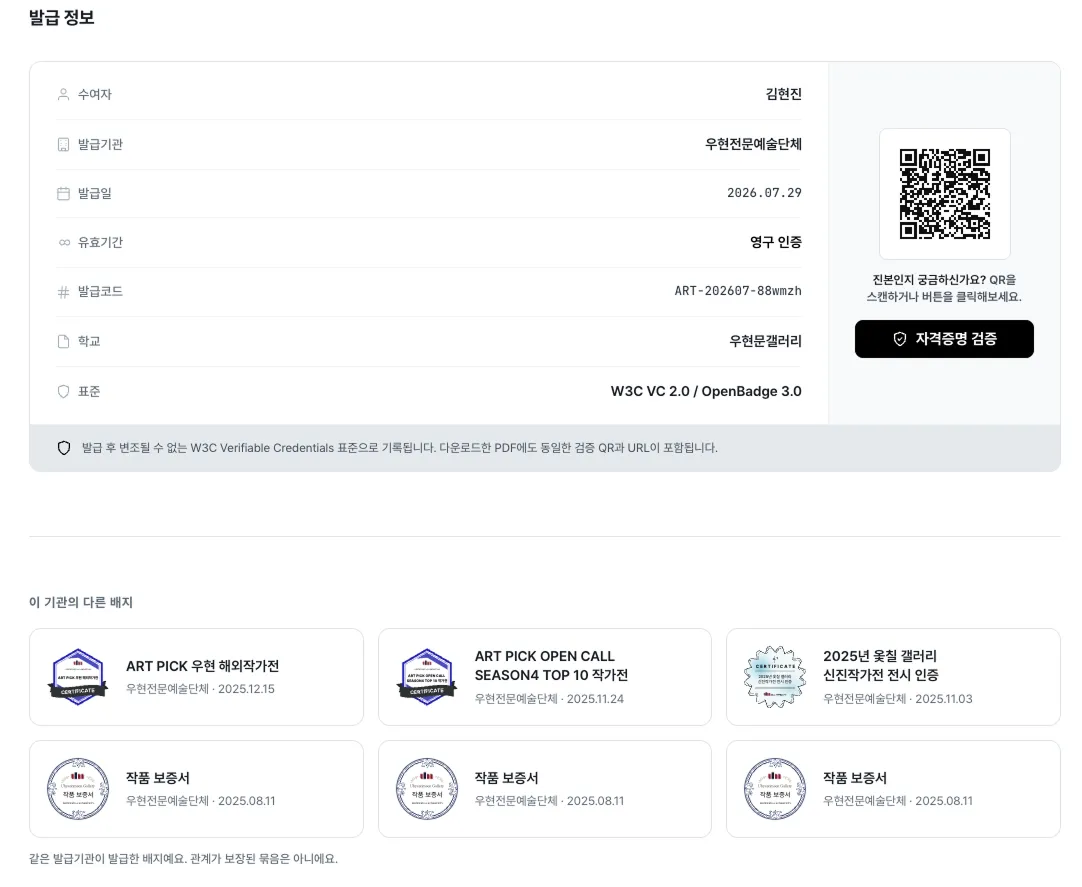
Beginning with the “Dream of Departure 2025” exhibition in August 2025, Uhyeonmoon Professional Arts Organization started issuing exhibition certifications and artwork authentication certificates to participating artists as digital badges (Univ Journal, 2025). The badge records the issuing organization, the exhibition name, the criteria for earning it - such as selection by professor recommendation and inclusion in the catalogue - and the issue date, and authenticity can be verified by link and QR code. The certification is maintained without expiry.
Issuance takes place on Kolleges infrastructure. The artist receives a link to a certification page bearing their own name and shares it. The 2026 participating artist certification was issued jointly by 17 co-issuing organizations, including Uhyeonmoon Professional Arts Organization and the participating universities. Looking at an actual issued certification makes clear what gets recorded.
- “Dream of Departure 2025” artist exhibition certification - Issued August 2025. Selection on an art school professor’s recommendation, inclusion in the official catalogue, and exhibiting alongside a mentor remain as the criteria for earning it.
- 2025 Otchil Gallery emerging artists’ exhibition certification - Issued November 2025. A case in which the same approach was applied to a curated exhibition outside the support project.
- Korea Young Artist Support Project 2026 participating artist certification - The certification whose issuance has begun for this year’s participating artists.

Certifications are issued in line with the 1EdTech Open Badges 3.0 and W3C VC 2.0 standards, so authenticity can be confirmed by link on any platform. The verification procedure is laid out in the badge authenticity verification guide.
Kim Hyun-jin was clear about the direction in press coverage at the time of adoption as well. “Proving an artist’s achievements and the authenticity of their work securely in digital form is a path the art world must take from here on” (Univ Journal, 2025).
For the artist who receives it, the badge is a link to attach to an application. When writing exhibition credits into an open call or residency review, the reviewer opens the link and immediately sees the issuing organization and the selection criteria. How to add it to a social media profile and to LinkedIn is covered in the recipient guide.
Kim Sun-hak sums up the present, with badges added, this way.
“Since last year, doing it with digital badges, an exhibition history that is permanently documented accumulates without the artists having to manage it themselves. It’s become the full stop that completes this project of supporting emerging artists’ futures.”
A gate into truth: the forty years Uhyeonmoon is drawing
The name Uhyeonmoon (又玄門) comes from the pen name of Uhyeon Ko Yu-seop, an aesthetician from Incheon. It is written with u (又, “again”) and hyeon (玄, “black”), and Kim Sun-hak reads that hyeon not as a color but as “hazy and faint” - that is, without end. Like the name, a gate into an endless pursuit of truth, Kim intends to make this exhibition a record spanning forty years.
Kim has introduced Uhyeonmoon Gallery as a space carrying on the aesthetic spirit of Ko Yu-seop (Incheon in, 2026). When the meaning of the name came up, the conversation returned to the Thousand Character Classic.
“It doesn’t mean the sky is black - it means hazy and faint, that it keeps rising endlessly higher.”
The explanation is that in the Thousand Character Classic’s “heaven is dark, earth is yellow,” hyeon (玄) points to depth rather than color. That depth leads directly to an attitude toward truth.
“The act of spreading widely into the world a search that goes toward truth - that is the hazy and faint act. It is not looking at the universe with myself at the center.”
So Kim has no intention of monopolizing this initiative. “This isn’t something only we should do, is it? Let them do it in Jeolla and in Gyeongsang too - it’s fine if I’m not the one doing it, I’d like someone to take it up. It isn’t something to monopolize.” He says he hopes the same initiative springs up across the country and that word of its success spreads. Because the purpose lies in “creating a social recognition of truth.”
Of himself he draws a line: “I’m not a philosopher.” “I met a philosopher and found they were a scholar. They study and organize and build theories, but they don’t live that way. I’m a practitioner.” The timetable for that practice is not a short one. “I’m really doing this with the intention of writing forty years of history.”
Throughout the opening, the one thing Kim repeated to the participating artists was this.
“Form partnerships now. Remember each other. That’s the most important thing. This is no longer the age of school pedigree.”
An exhibition is over in a week, but proof of having taken part goes on being used as the artist’s career record. Kolleges provides infrastructure for issuing and managing participation and achievement in exhibitions, open calls, and education programs as verifiable digital badges. If your cultural or arts organization or association is considering adoption, you can design it together with us on the basis of cases like this one at adoption consultation, and if you would like to look first, you can see the issuance screens and the verification structure at get the service brochure.
Frequently asked questions
Want to turn learning outcomes into verifiable assets?
From issuing to verifying and amplifying, see it for yourself with Kolleges.
Request a Kolleges demo
Related posts

10 Art Schools Nationwide Use Digital Badges to Certify Emerging Artists' Careers | Kolleges
Ten Korean art universities teamed up with Woohyunmun Gallery to issue blockchain-verifiable Kolleges digital badges, turning exhibition records into portable career credentials for emerging artists.

Researching education for all: how SeeD connects a network of education experts
From fleeting association activities to verifiable records of growth - how SeeD adopted Kolleges digital badges.
"The UMC Innovation Story Leading 5,000 College Developers" - Junyoung Oh, Head of Operations at UMC | Kolleges
UMC cut its top support burden - endless certificate reissue requests from 1,000 students per cohort - by switching to Kolleges bulk digital badge issuance.