
Top 5 Digital Badge Providers in Korea | 2026 Comparison Guide
We compare five major digital badge platforms in Korea along two axes - their 1EdTech certification records and what happens after issuance - and lay out selection criteria by institutional situation.
If you are evaluating digital badge issuance platforms in Korea, the field of candidates narrows to five: Kolleges, LecoS, OmniOne Badge, Soft Empire (K-OpenBadge), and Certi. Most of them have the fundamentals - 1EdTech Open Badges certification and blockchain verification - but the version and role coverage of that certification differs, and the directions diverge sharply once you look at what happens after issuance. This article compares the certification records and operational features of the five platforms along the same axes as of 2026, and sets out selection criteria by institutional situation.
Digital badges have already spread far enough that more than 200 universities in Korea issue them (Korea Higher Education Newspaper, 2025). As issuance volume has grown, the platform you start with determines your operational workload and performance management approach for the years that follow.
A comparison of five digital badge providers in Korea
The 1EdTech certification records of the five platforms can be checked in the public directory, and the direction each company puts forward for post-issuance usage differs. The table below is compiled from the 1EdTech certification directory as of August 2026 along with each company’s official site and public announcements. Detailed features and pricing are subject to change, so verifying again through official channels at the final review stage is the accurate approach.
| Comparison axis | Kolleges | LecoS | OmniOne Badge | Soft Empire | Certi |
|---|---|---|---|---|---|
| Operator | Blockspoon Co., Ltd. | LecoS Inc. | Raonsecure | Soft Empire | NFtime |
| 1EdTech certification | OB 2.0 / 2.1 / 3.0 all versions; 3.0 Issuer, Displayer, Host | OB 2.0 / 3.0; 3.0 Issuer, Displayer, Host | No directory registration confirmed | OB 2.0 / 2.1 / 3.0 all versions plus CASE 1.0 / 1.1 | OB 2.0 (three roles); 3.0 (Issuer) |
| Security and verification | ISO 27001, blockchain patent | BlockCerts blockchain | DID-based verification | GS Certification Grade 1, SoftDID, FIDO | Blockchain verification |
| Primary strength | Post-issuance usage, co-issuance expansion, performance data | Adoption scale and references | Identity verification (DID), government system integration | Standards completeness and security | Easy start, community operations |
| Recipient achievement credentialing | Levels, recommendations, skills, custom competency data | Centered on proof of completion | Centered on proof of completion | Centered on proof of completion | Centered on proof of completion |
| Sharing and distribution | Automatic sharing to LinkedIn, KakaoTalk, Instagram and other social channels; 39~68% share rate (internal figures); referral tracking and related-program recommendations | Mobile app, social sharing | Mobile ID integration | Mobile app | KakaoTalk notification messages |
| Co-issuance and expansion | Co-issuing organizations (joint-name issuance, separated permissions for affiliated bodies) | No separate information | No separate information | No separate information | No separate information |
| Institution-dedicated platform | Website builder (administrators create and edit directly, no separate maintenance cost) | No separate information | Custom build (by quote) | No separate information | No separate information |
| Cost | Flexible quotes based on issuance volume and service scope | Quote via official channel | Quote via official channel | Quote via official channel | Quote via official channel |
As the “1EdTech certification” row shows, whether a provider holds certification and the version and role coverage of it differ from company to company, while the “co-issuance and expansion” and “sharing and distribution” rows are the points where post-issuance operations diverge. Each company’s certification record can be checked directly in the 1EdTech official directory: Kolleges · LecoS · K-OpenBadge · Certi. For OmniOne Badge, no registration record can be confirmed in this directory as of August 2026.
1. Kolleges - post-issuance usage, co-issuance expansion, and performance data
Kolleges is a B2B digital credential operations platform built on 1EdTech Open Badges (2.0 / 2.1 / 3.0) and operated by Blockspoon Co., Ltd. It puts weight on what happens after issuance rather than on issuance itself, and the share of recipients who post their badges to resumes, portfolios, and LinkedIn reaches 39~68% depending on the program (Kolleges figures). For Open Badges 3.0 it is certified across all three roles - Issuer, Displayer, and Host - so badges issued by outside organizations such as IBM and Microsoft can be managed in one place (University Journal, 2025).
Badges are designed in a three-tier structure of unit badge, pathway, and comprehensive credential, and custom competency data such as job competencies, grades, and project scores can be carried in the badge. Because the badge holds both the fact of completion and the evidence of competency, completion data in corporate training carries through into hiring and HR verification material.
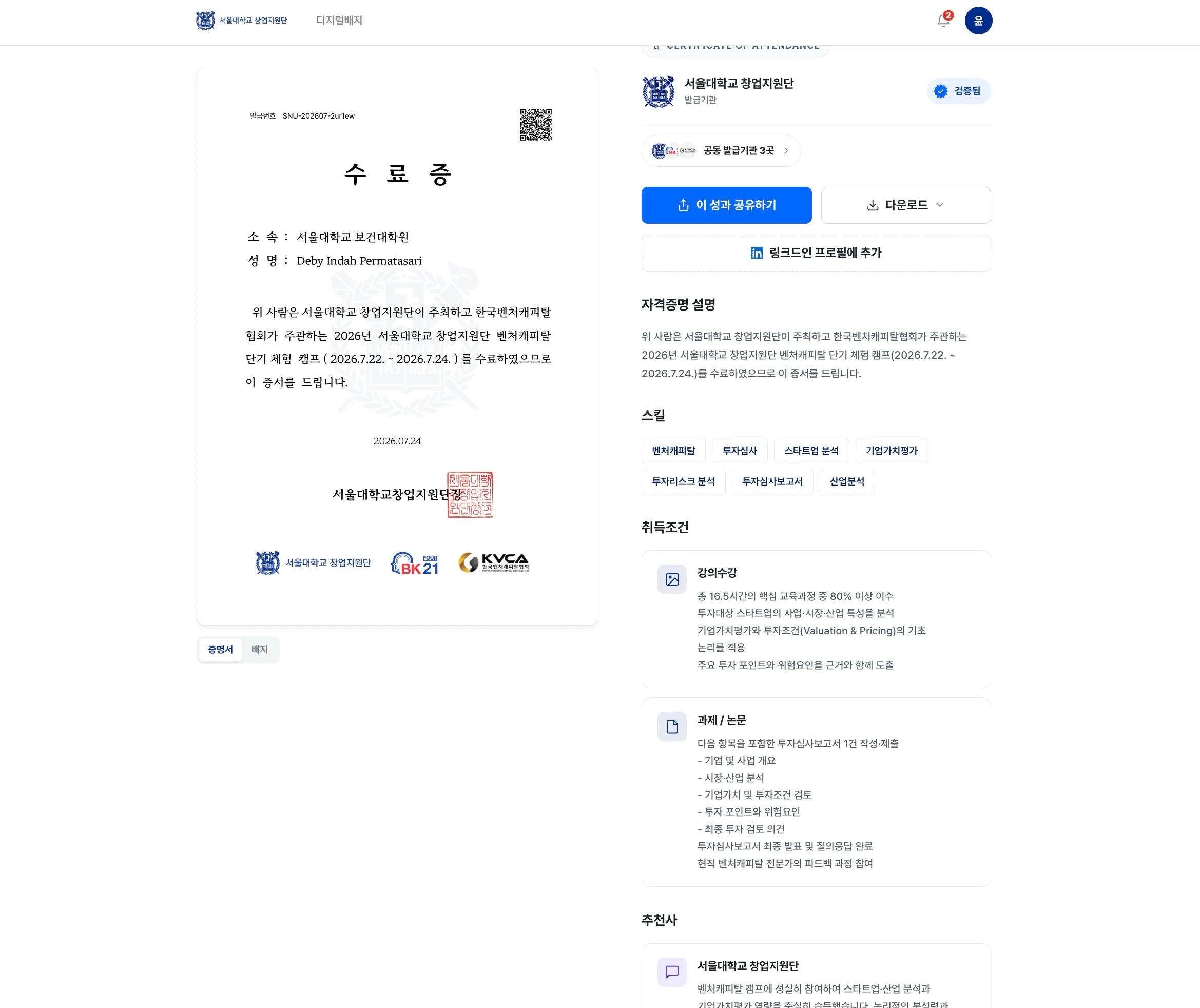
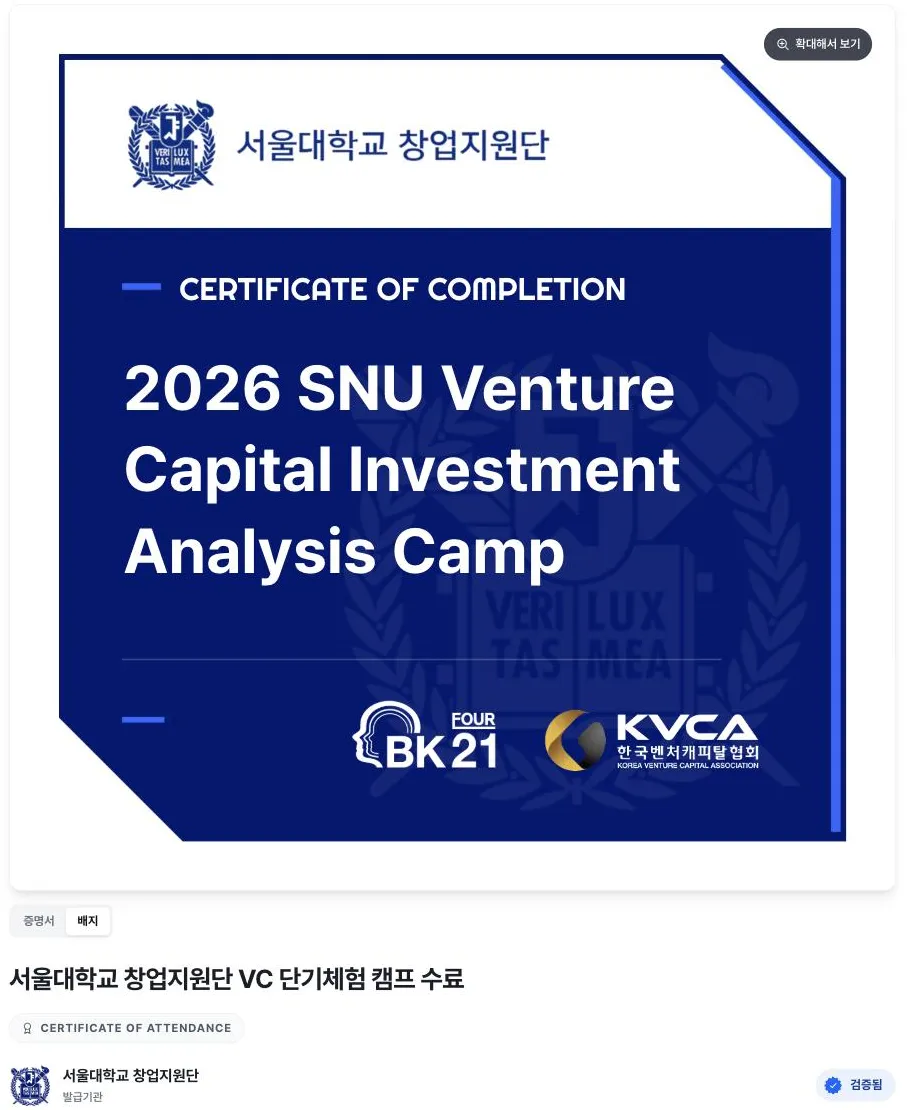
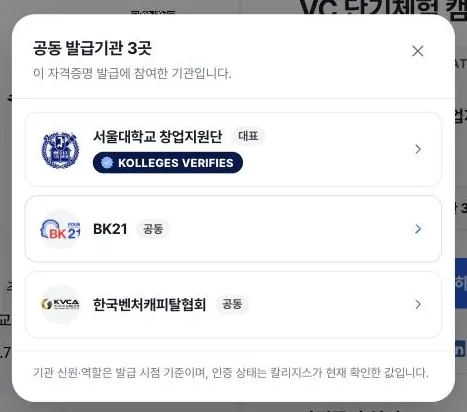
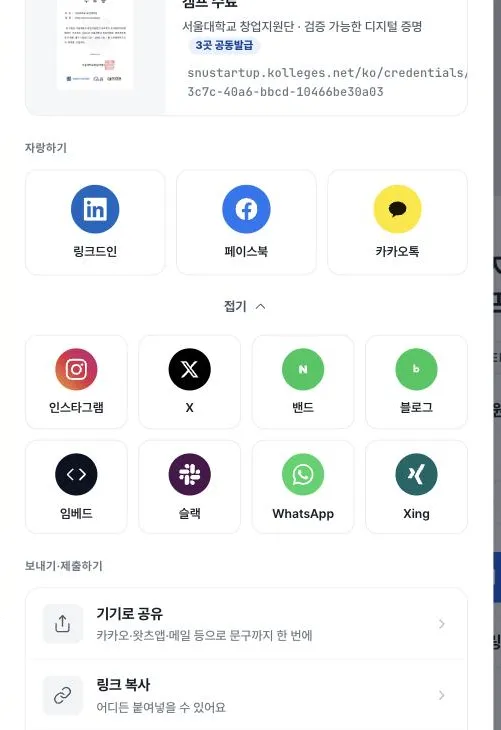
Issuances are provided in two forms together, as a certificate and as a badge. Open an actual issued screen - such as the certificate of completion for the Seoul National University Startup Center’s short-term VC experience camp - and the verification status, the co-issuing organizations (SNU Startup Center, BK21, and the Korea Venture Capital Association), and the share and download buttons all sit on one screen.
The same completion record also converts into a badge image for social media and resumes, so recipients pick between the certificate and the badge according to the use.
An expansion structure that spans departments and institutions is another axis Kolleges puts forward. The co-issuing organization feature in premium options lets multiple departments, affiliated bodies, and partner organizations issue badges under a joint name and operate with permissions divided by organization. Among the five platforms, Kolleges is the one that presents joint-name issuance and permission separation as an official feature (based on each company’s official documentation, confirmed August 2026). The Daejeon campus of Korea Polytechnic University ran consortium co-issuance with this structure, and Dongwon Institute of Science and Technology consolidated badges that three departments had been issuing separately, cutting administrative workload by roughly 40% compared with paper certificates (confirmed by the staff in charge). There are also cases where more than ten organizations have put their names on a single certificate, such as the exhibition certificate that 11 art colleges joined under a joint name. Pseudonymization of personal data, Korean and English certificates, and automatic issuance when attendance, assignment, and exam conditions are met are handled in the same option set.
An institution’s dedicated badge website can be created and edited directly by administrators through the website builder, with no separate maintenance cost. Badge archives, class recruitment, boards, and custom domains are all operated at the staff level. After issuance, recruitment automation ties together social sharing, verification page referral tracking, application button links, and related-program recommendations, carrying through to recruitment for the next cohort. The University of Seoul’s Industry-Academic Cooperation Foundation designed seven RISE programs into a 15-badge system and completed the build in about one month (see the case).
Cost is designed as a flexible quote based on issuance volume and the scope of services provided, so you can start with a small cohort and widen to the institution level. It suits institutions that need post-issuance usage (student portfolios, spreading educational outcomes) and performance data, and institutions looking to gather the credentials of multiple departments and partner organizations into one place.
2. LecoS - adoption scale and references
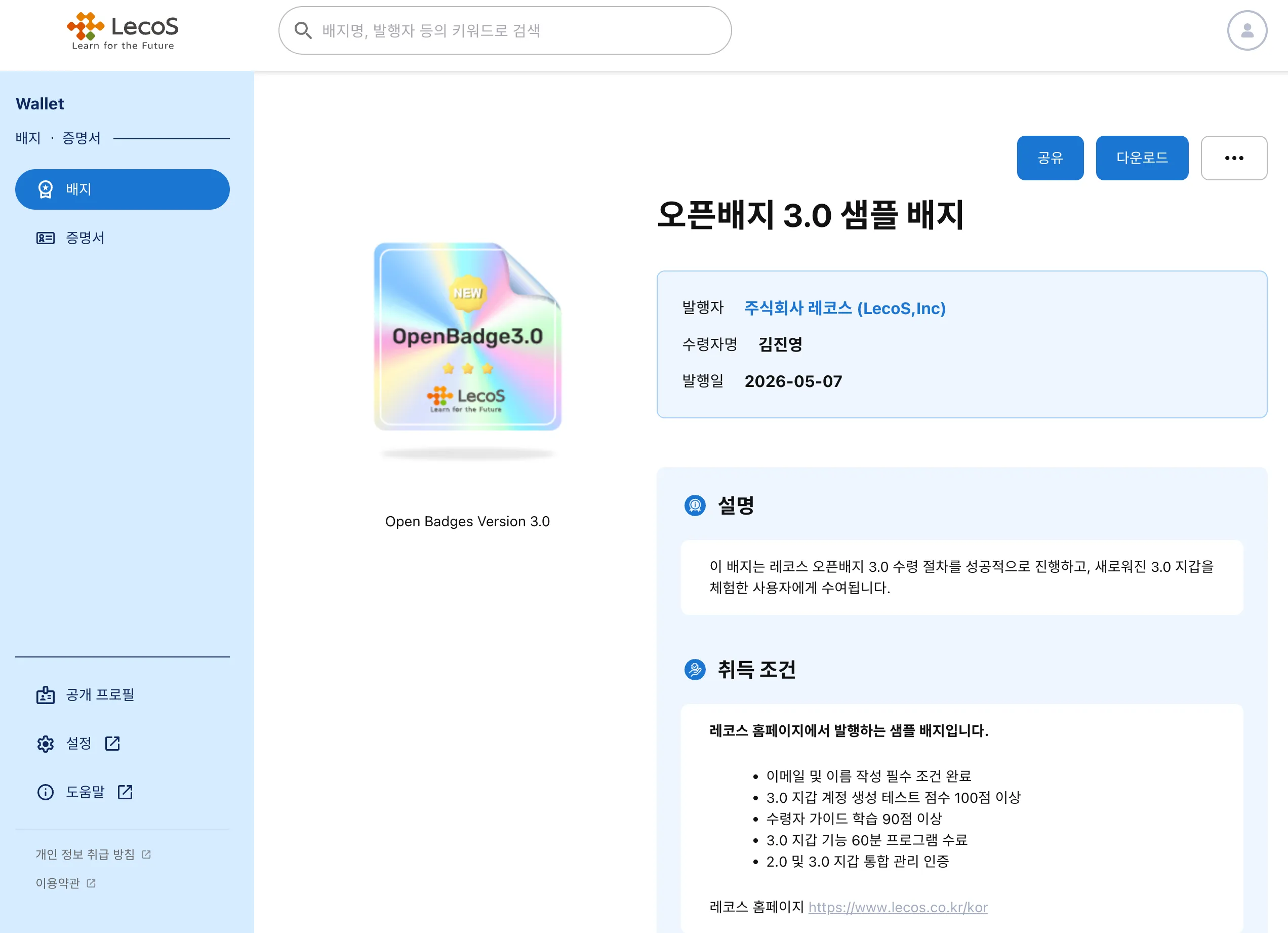
LecoS is an open badge platform that launched its service in Korea in 2021, and has announced cumulative issuance of 2 million badges, 1,000 participating organizations, and 238 universities (LecoS announcement, 2026). It states that it was the first in Asia to receive 1EdTech (formerly IMS Global) certification, and it is the provider that leads with adoption references in the Korean digital badge market.
Based on the 1EdTech directory it holds Open Badges 2.0 and 3.0 certification (Issuer, Displayer, Host), provides BlockCerts-based blockchain verification and a mobile app, and supports Korean, English, and Japanese. Early on it centered on university extracurricular and micro-degree credentialing, but more recently it has been widening its adoption scope to cyber universities, junior colleges, lifelong education institutions, and offices of education (Electronic Times, 2026).
It suits institutions that want to check the number of adoption cases and references first, and institutions that need evidence that several universities already use the platform.
3. OmniOne Badge - identity verification integration
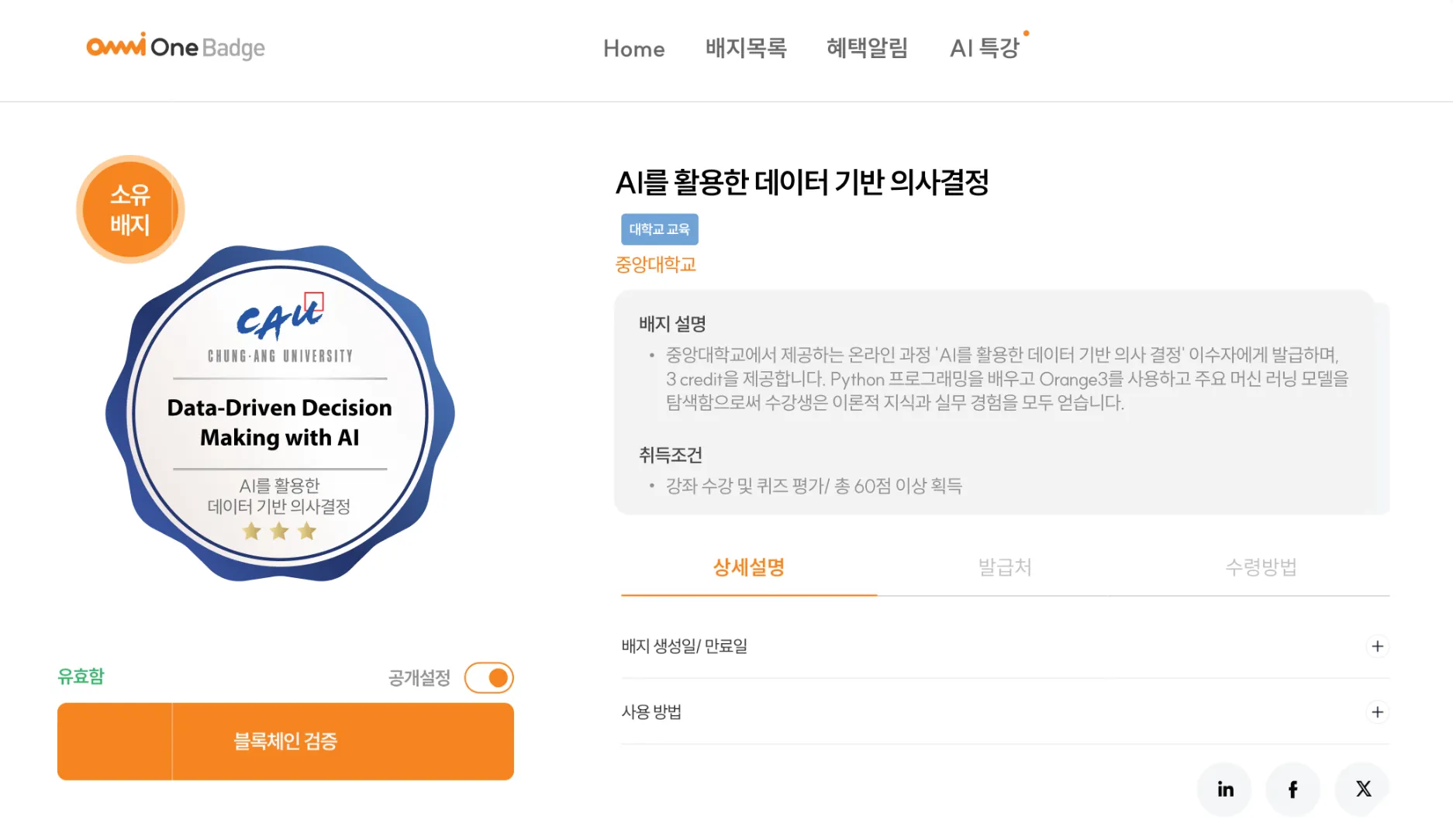
OmniOne Badge is a badge service that came out of OmniOne, the identity verification brand of the security company Raonsecure. On the technical foundation of building government identity verification systems such as mobile IDs, it verifies badge authenticity centered on DID (decentralized identifiers).
Its strength is partnerships with government and universities, and institution-dedicated websites are provided as custom builds. In June 2026 it signed agreements with organizations including the Beautiful School Movement Headquarters, widening its scope of application to credentialing the learning records of elementary, middle, and high school students (Newspim, 2026). That said, no registration record can be confirmed in the 1EdTech certification directory (as of August 2026), so if open badge standards certification is a procurement or review requirement, certification status needs to be checked separately.
It suits institutions where identity confirmation and identity verification are core requirements, and institutions planning integration with government systems.
4. Soft Empire (K-OpenBadge) - standards completeness and security
Soft Empire’s K-OpenBadge is a platform holding certification for all versions of Open Badges - 2.0, 2.1, and 3.0. In June 2026 it added 1EdTech CASE 1.0 and 1.1 certification, the competency framework standard (1EdTech directory). Together with security certifications and technologies such as SoftBadge GS Certification Grade 1, SoftDID, and FIDO, it leads with standards completeness and security.
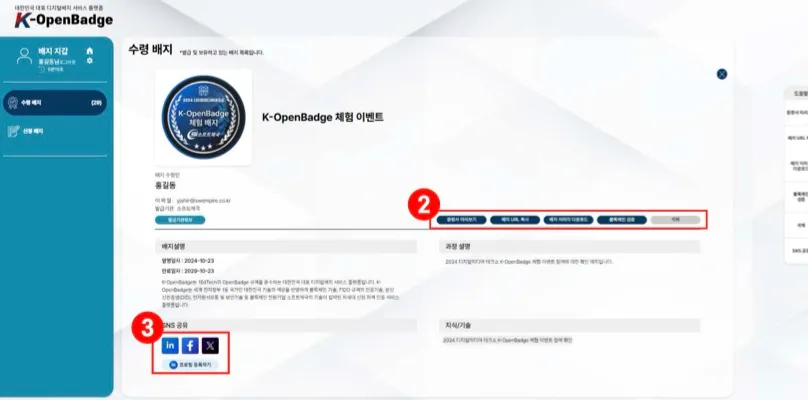
It provides a patented electronic certificate distribution technology and CASE-based competency map management, and is expanding into personalized education recommendations. It suits institutions where standards version compatibility and security requirements are specified as procurement conditions, and institutions that prioritize global compatibility.
5. Certi - community and extracurricular operations with an easy start
Certi is a digital badge platform operated by NFtime. Leading with KakaoTalk notification messages and a streamlined issuance flow, it is a good fit for starting light in operations that are not large in scale, such as clubs, communities, and extracurricular programs. It has been adopted for extracurricular programs at Korea University, Kwangwoon University, and Inha University, and it participated in the Integrated Korea Pavilion at CES 2026 (Edaily, 2026).
Its 1EdTech certification covers Open Badges 2.0 across all three roles - Issuer, Displayer, and Host - and 3.0 for the Issuer role (1EdTech directory, 2026). It also puts forward AI competency analysis in its own materials. It suits organizations that want to try badges on a small scale first, and institutions where community-level operations are the focus.
Selection guide: four questions for choosing a platform
All five platforms have the fundamentals of issuance and verification. So the selection criteria come not from a feature list but from what the institution is trying to achieve with badges. Answering the four questions below before a review meeting narrows the candidates quickly.
- Is there an after-issuance? - The dividing line is whether recipients actually use badges on resumes, portfolios, and LinkedIn, and whether those view and share records remain with the institution as data.
- Are operations automated? - Issuing to a cohort of 25 manually takes four to six hours (based on figures confirmed by Kolleges). Check whether bulk issuance by roster upload, automatic issuance when conditions are met, and reissuance handling are all covered.
- Does it expand across departments and institutions? - At a university, the industry-academic cooperation foundation, the lifelong education center, and the extracurricular center are all likely to end up issuing on their own; in a public project, the participating organizations will. Confirming from the outset whether the structure supports joint-name issuance and permission separation is what keeps the system from fragmenting later.
- Does performance data come out as reporting? - Look at whether issuance counts, claim rates, and view and share data can be downloaded and used in project reports. If responding to funding programs such as RISE and LINC is the goal, look at this axis first.
Detailed review items covering security, standards, and budget are set out in the digital badge adoption checklist. If you are considering building your own instead of adopting an external platform, you can find the judgment criteria in building a digital badge management platform.
Frequently asked questions
Want to turn learning outcomes into verifiable assets?
From issuing to verifying and amplifying, see it for yourself with Kolleges.
Request a Kolleges demoRelated posts
Digital Badge Adoption Checklist | 7 Things to Verify Before Signing in 2026
From the version and roles of 1EdTech certification to the ISO 27001 edition number, personal data processing consignment, the amended privacy law effective September 2026, and public procurement requirements - seven things to verify before signing a digital badge solution contract.
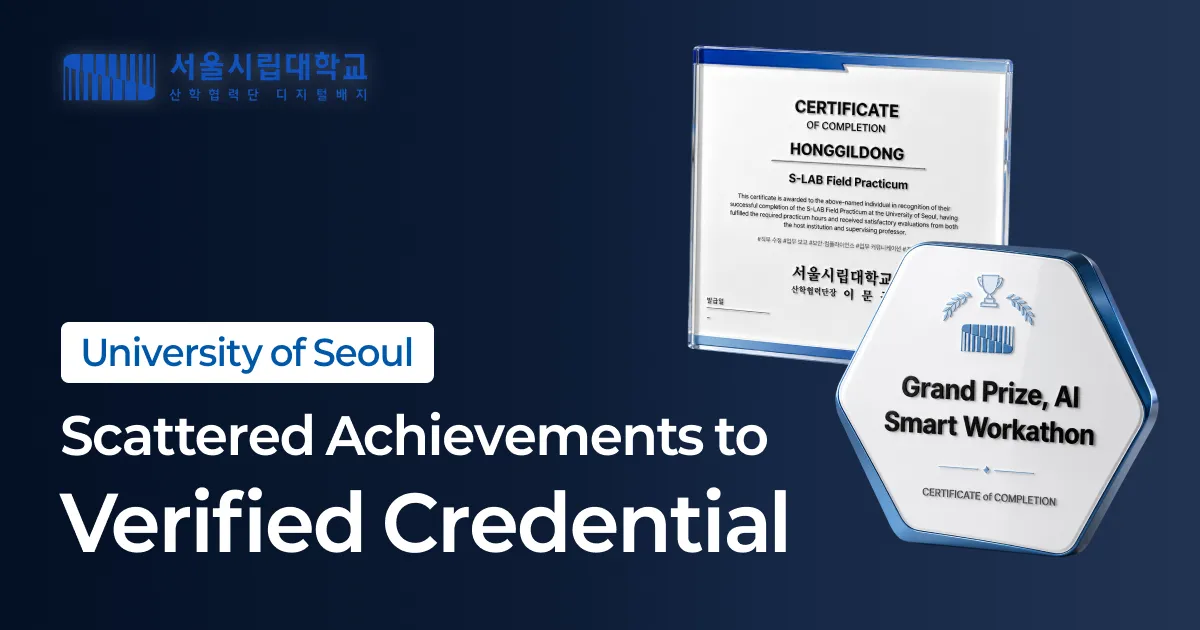
How to Connect RISE Performance with a Three-Tier Digital Badge Structure: A University of Seoul Case
The University of Seoul's RISE project team bundled the outcomes of 7 programs across 3 areas (industry-academia cooperation, AI, and convergence regional innovation) into 15 digital badges. This is the design behind a three-tier structure connecting unit badges through pathways to a comprehensive certification, turning scattered university achievements into verifiable one-line credentials.
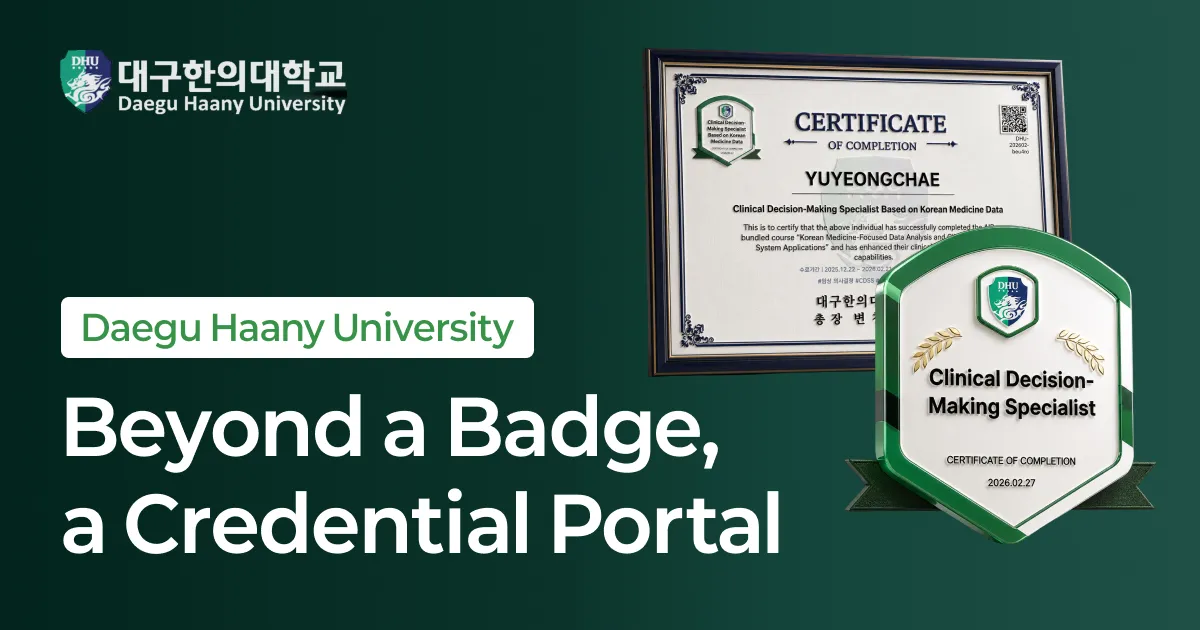
Running University Digital Badges: The Difference a Portal and Co-issuance Make (A Daegu Haany University Case)
University digital badges come down to operational structure beyond badge design. We lay out the differentiators that professors, education-innovation offices, and industry-academia foundations should look at: the dedicated portal Daegu Haany University built on Kolleges, co-issuance where two institutions sign together, KOLLEGES VERIFIED verification, and automatic issuance.